a guide to saas off-page seo & link building
stop building links to your saas blog. learn why 40-60% of conversions come from bottom-funnel pages and how to build authority where it truly counts.

What if I told you that up to 60 percent of your organic SaaS conversions come from pages you barely build links to? For most companies, that’s not a hypothetical. It’s the expensive reality of a misguided link building strategy.
We have been conditioned to pour all our off-page SEO efforts into the company blog. But while blog posts attract attention, they rarely drive direct sign-ups. The real action happens on your bottom-of-funnel pages, the ones that compare, price, and showcase your product. It’s time to change where your links point.
The Great SaaS Link Building Misconception
The standard playbook is tired. Write a blog post, do some outreach, and build links. The authority flows to the blog, and you hope some of that value trickles down to the pages that actually make you money. This is a slow, inefficient, and painfully indirect path to growth.
High-intent users are not searching for generic blog content. They are searching for solutions. They use keywords like “zapier alternatives,” “hubspot vs salesforce,” or “slack pricing.” These searches lead them directly to your high-conversion pages, but only if those pages have enough authority to rank.
When you focus link acquisition solely on your blog, you dilute your authority across dozens of informational articles. This leaves your most valuable commercial pages starving for the direct authority they need to compete in crowded search results. An effective seo agency understands this distinction is fundamental for scaling a SaaS business.
Feature-Page Link Clusters: The Better Way Forward
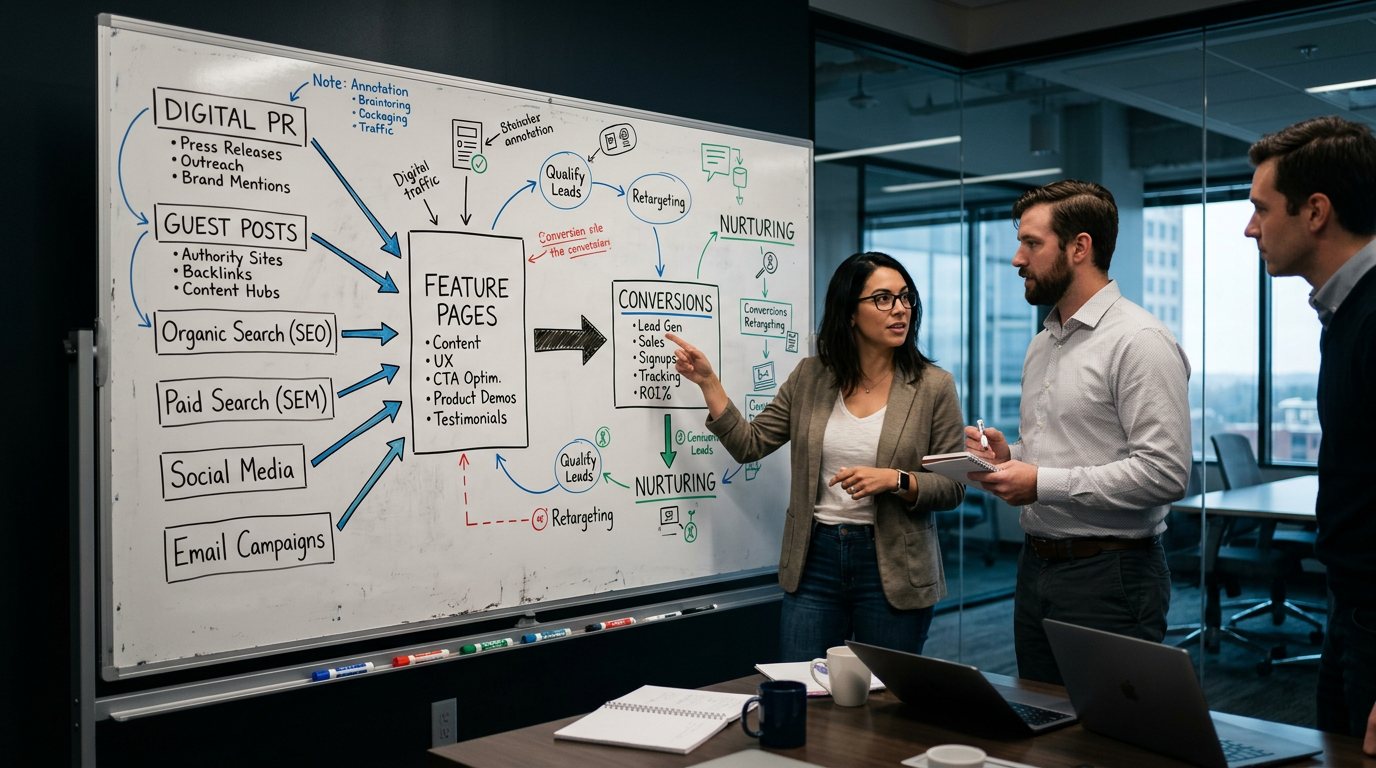
The most powerful strategy for SaaS is building “feature-page link clusters.” This means directing your link building efforts at the specific URLs detailing your product’s features, integrations, and use cases. This approach directly increases the authority of the pages prospective customers see just before they convert.
The impact is substantial. By focusing on these money pages, SaaS companies can see a two to three times lift in conversion rates compared to volume-based blog link building. You build authority where it matters most, shortening the path from discovery to purchase.
Identifying Your Golden URLs
Before you build a single link, you need to know your targets. These are your 'golden URLs.' They aren't just your homepage or pricing page. Think more granularly. Your key targets include specific feature pages, API documentation, and dedicated landing pages for each of your key integrations.
For example, if you have a project management tool that integrates with Slack, the page detailing that specific integration is a golden URL. It's the page a user lands on after searching “project management that works with Slack.” That's a buyer, not a browser. This is the page that deserves the link.
How to Build Link Clusters That Convert
Start by mapping your product features to specific problems your customers face. Instead of writing a generic guest post about “project management tips,” you should author a piece about “how to solve workflow bottlenecks with asynchronous communication.” Then, link directly to your feature page that addresses that exact problem.
Niche edits are another powerful tool here. Use a tool like Ahrefs to find existing, ranking articles that discuss a problem your software solves. Reach out to the author and offer a link to your feature page as a valuable, concrete resource for their readers. It’s far less work than a full guest post and provides a contextually perfect link.
Finally, weaponize your partnerships. When you integrate with another platform, insist on a link back from their integrations directory or marketplace. This link must point to your dedicated integration page, not the homepage. These are highly relevant, trusted links that drive extremely qualified traffic. They are non-negotiable.

High-Impact Tactics for SaaS Link Acquisition
Focusing on the right pages is half the battle. The other half is executing the right tactics to acquire links at a steady, predictable pace. The goal is progress, not perfection. Consistency is your biggest asset, a core discipline within broader marketing services.
Precision Guest Posting and Niche Edits
Generic outreach is dead. You need to be methodical. Platforms like OutreachZ are built specifically for SaaS, connecting you with vetted publishers and providing transparency on domain metrics and publisher approvals. This removes much of the guesswork and risk from guest posting.
Aim for quality over quantity. Securing even 5 to 10 high-quality backlinks monthly from authoritative sources creates sustainable momentum for B2B SaaS. For a more aggressive push, aiming for 10 to 20 links from DA 40+ domains can get your site to a DA of 50 within a year. This level of authority allows you to compete for valuable mid-tier keywords.
For a deeper dive into vetting partners and platforms, referencing a comprehensive guide on SEO for SaaS provides an invaluable checklist for strategy and benchmarks.
Digital PR and Attainable Linkable Assets
The most sustainable backlinks are the ones you earn, not just the ones you build. Creating original research, industry reports, or a free, valuable tool can generate thousands of links over time with little to no ongoing outreach. Just look at the thousands of domains linking to Ahrefs' free backlink checker or HubSpot's suite of free marketing calculators.
These “linkable assets” become cornerstone pieces that others naturally reference and cite. While they require a significant upfront investment, sometimes involving a custom website or application component, their long-term ROI is unmatched. They establish you as a definitive authority in your niche and build a defensive moat around your organic presence.
Mastering SaaS Directories for Contextual Links
Finally, don't sleep on optimizing your presence on key software directories like G2, Capterra, and Product Hunt. These are not just for collecting reviews. A well-optimized profile provides powerful contextual links, generates high-intent referral traffic, and builds critical social proof all at once.
Fill out every single field with keyword-rich, user-focused copy. Encourage your happiest customers to leave detailed reviews that mention specific features they love. A strong directory presence can even act as a form of digital geo optimization, helping you capture users searching for solutions in specific geographic markets or specialized industries. These links, whether do-follow or no-follow, signal relevance to search engines and trust to users.
Measuring What Matters: SaaS Benchmarks and Tools
You can't improve what you don't measure. In SaaS link building, that means moving beyond vanity metrics like the sheer number of links acquired. You need to track the right KPIs and use the right tools to gauge your progress toward revenue, not just rankings.
Set Realistic, Impactful Goals
Your goal isn't just 'more links.' A better goal is: “Acquire 10 new backlinks from DA 40+ industry blogs to our 'Integration Reporting' feature page this quarter.” This is specific, measurable, and tied directly to a bottom-of-funnel page that influences conversions.
Track the rankings of your bottom-of-funnel keywords obsessively. Monitor the referral traffic from your new links in Google Analytics. Most importantly, measure the organic conversions attributed to your key feature and pricing pages. Is the needle moving up and to the right? That's your true north star.
The Essential SaaS Link Builder's Toolkit
Every strategist needs their tools, and for off-page SEO, Ahrefs is simply non-negotiable. Use its Site Explorer to track your backlink profile’s growth and monitor your Domain Authority (DA). More importantly, use its Content Gap tool to see which keywords your competitors rank for that you don’t, especially for their feature pages.
The Link Intersect report is also your secret weapon. You can plug in three of your top competitors and immediately see a list of domains linking to them but not to you. This is your highest-priority outreach list, handed to you on a silver platter. It’s a systematic way to close the authority gap and win back market share in the SERPs.
The message is simple. Shift your focus. Stop chasing vanity blog traffic and start building real authority to the pages that directly fuel your growth engine. Go audit your backlink profile right now and ask yourself the tough question: are your links building your ego, or are they building your business?