ai automation pricing: what small businesses should expect to pay
wondering about ai automation pricing? the median entry cost has dropped 60%, but most businesses now pay monthly. here’s what you should expect to spend on an effective ai tool stack.

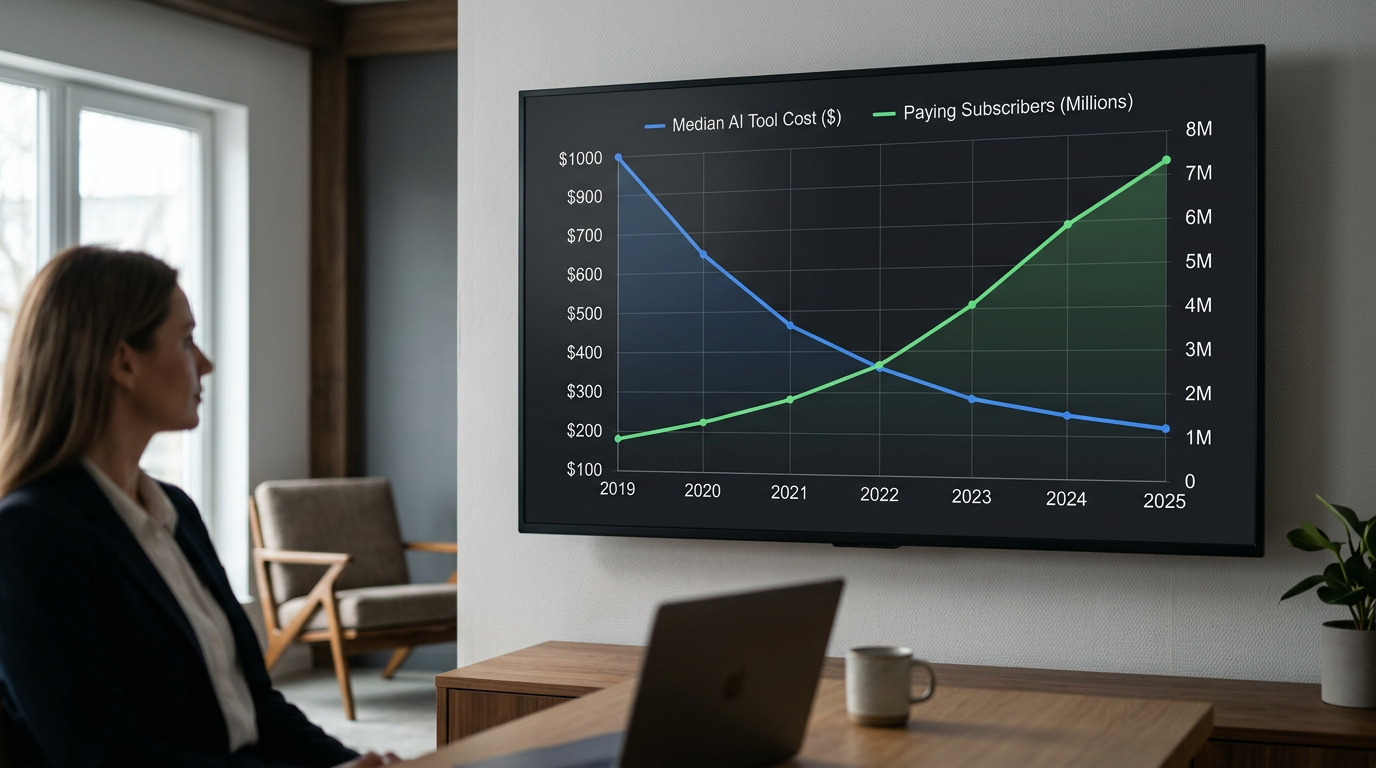
The cost of AI for small businesses is falling. Dramatically. Between 2019 and 2025, the median entry price for a new AI tool plummeted by about 60%. Yet at the same time, the share of businesses paying for these tools every single month has surged from a mere 4% to over 30%.
That isn't a contradiction. It signals a massive pivot from hesitant experimentation toward essential, ongoing investment. Smart owners are no longer asking if they should pay for AI. They are asking how to build a smart, strategic budget for it.
Stop Shopping for an 'AI Tool.' Start Building an Automation Portfolio.
The first mistake most businesses make is searching for a single price tag. There isn’t one. The smartest companies don't just buy a tool. They build an automation portfolio, tailored to their unique operational bottlenecks.
Think less about a single subscription and more about the total value of your automation stack. A recent SBE Council report found that the median small business employer now uses an average of five different AI tools. This isn't about collecting shiny objects. It's about solving five distinct, high-friction problems.
One tool might handle your repetitive customer service queries. Another automates your email marketing sequences. A third could organize your entire sales pipeline, flagging hot leads without you lifting a finger. The goal is to create a cohesive system where each component delivers a specific, measurable return. By partnering with providers of ai automation services, you can map your biggest headaches to specific tools that deliver the highest immediate return.
How Much Are Small Businesses Actually Spending?
Let's get down to the numbers. Thanks to extensive market data, we have a clear picture of what owners are paying right now, and it's almost certainly less than you think. The era of six-figure AI projects as the only option is over.
Entry-Level and Starter Costs
Getting your foot in the door is remarkably affordable. Most quality, off-the-shelf AI platforms offer powerful starter tiers in the $20 to $60 per month range. In fact, research from the JPMorgan Chase Institute shows the median entry cost for a founder's first AI tool has settled around just $20 to $30 a month.
This democratization of AI is the single biggest story in small business tech. What was once the exclusive domain of enterprise-level budgets is now accessible to any owner with a credit card and a specific problem to solve.
Total Monthly and Custom Spend
As businesses see results and add tools to their stack, the total monthly spend naturally rises. Most small firms find their total AI budget clustering in the $20 to $90 per month territory. This typically covers two to three core tools handling distinct functions, like marketing, operations, and support.
Interestingly, even as adoption has exploded, the median spend across all small business AI users has actually declined to about $30 per month. Fierce competition among tool providers and more efficient software means you get more power for less money than you did just two years ago. For more complex, multi-system automations, costs can certainly rise into the hundreds per month, but the key is to start small and scale as the savings materialize.
Real-World Examples: What Your Money Gets You
Abstract price ranges are useful, but concrete examples ground the conversation. Let's look at three common automation categories and the real pricing for leading platforms that small businesses are adopting right now.
Workflow Automation: Zapier
Think of Zapier as the digital plumbing for your business. It connects the different apps you already use, like your CRM, email client, and accounting software, creating automated workflows. For example, when a new lead fills out a form on your website (App 1), Zapier can automatically add them to your CRM (App 2) and send them a tailored welcome email (App 3).
This is the engine room of operational efficiency, killing manual data entry. While Zapier offers a free plan for basic connections, most businesses quickly find the real value in paid tiers. Expect to spend around £15 to £39 per month (about $20 to $50) to unlock the multi-step, AI-assisted automations that save serious time.
Marketing and Sales AI: HubSpot
HubSpot has become a powerhouse for small teams needing an all-in-one marketing and sales platform. Its embedded AI features can help you generate campaign email copy, score leads to identify the hottest prospects, and automate personalized follow-up sequences. This is where automation directly translates into revenue.
HubSpot’s model is built to scale with you. Many businesses start with their excellent free CRM, then upgrade to a starter plan like Marketing Hub to unlock the AI. It's a great tool to coordinate your wider strategy, from lead nurturing to ai influencer marketing. Expect to pay around £38 per month (about $45) for these valuable AI-enhanced marketing tools.
Customer Support AI: Intercom
If your team is drowning in repetitive customer questions, an AI chatbot is your first line of defense. Intercom is a leader in this space, providing sophisticated AI bots that can instantly answer FAQs, triage support tickets, and route complex issues to the right human agent.
This is often one of the first automations businesses invest in because the ROI is so immediate and clear. Fewer routine support emails mean your team can focus on high-value conversations that build loyalty. Pricing for Intercom's essential features, including its AI chatbot Fin, starts near £59 per month (about $75).

Calculating the Real ROI: This Isn't an Expense
Spending $50 or $100 a month on software can feel significant for a lean business. But the data shows this is not an expense. It's an investment with a staggering return. Across the board, small businesses implementing AI automation report time savings of 20 to 30 hours per week and seeing overall cost reductions of 30% to 40%.
Do the math. If your time is worth even a modest $50 per hour, saving just five hours a week creates $1,000 per month in reclaimed value. That easily justifies a $50 tool subscription. You can reinvest that time into growth activities like sales, product development, or improving your seo services to attract more customers.
The evidence is overwhelming. One study found that an incredible 97% of businesses using AI-supported pricing tools reported a positive impact on revenue. It’s no surprise that 93% of small firms using AI plan to keep investing. According to a detailed SBE Council survey on AI tool usage, once owners witness the results firsthand, they willingly and confidently increase their automation budget.
Beyond the Subscription: The Total Cost of Automation Ownership
A smart budget looks beyond the monthly subscription fee. To truly understand the investment, you have to consider the Total Cost of Automation Ownership (TCAO). This includes the 'hidden' costs and resource commitments that don't show up on a credit card statement.
Implementation and Training
Your team needs time to learn the new software and adapt its workflows. This is a real cost in terms of temporary productivity dips during the transition. Budget for this learning curve. Implementation isn't just a click, it's about configuring rules, integrating with existing systems, and ensuring the automation actually works as intended.
Optimization and Maintenance
An automation is not a 'set it and forget it' solution. It's a dynamic system that requires periodic review and tweaking. You need to monitor its performance, update its logic as your business evolves, and ensure it remains effective. This often requires a dedicated person internally or a partner agency to manage.
For some companies, the constraints of off-the-shelf tools eventually become a barrier. When you need a truly unique workflow, you may find yourself exploring custom software development to build a proprietary solution that perfectly matches your operations.
Future and Structural Costs
Finally, forward-looking businesses are starting to factor second-order AI costs into their plans. By 2026, the energy and infrastructure required to run these powerful models will become a more tangible part of the equation. This is becoming a new, structural cost of doing business in a hyper-efficient world, and it needs to be part of your long-term financial planning.
The question is no longer whether to invest in AI. It's about how to do it smartly. Start by auditing one single process in your business that feels slow, repetitive, or prone to human error. Your best opportunity for automation is almost certainly hiding there, and the cost to get started has never been lower.