ai will replace your va. just not how you think.
in 2026, ai won't just replace your virtual assistant, it will promote them. see how automation is absorbing admin tasks and creating a new 'ai chief of staff' role.

Let's get one thing straight. The conversation about AI replacing virtual assistants is missing the entire point. By 2026, the question is not if AI will take over VA tasks. It is about what your business will do with your VA's massively expanded capacity.
Forecasts show artificial intelligence is on track to absorb a staggering 30 to 40% of traditional administrative task volume. This is not about replacement. It is a fundamental reassignment of labor. The repetitive, low-impact work is being handed off to autonomous systems, clearing a path for a much more valuable human role to emerge from the noise.
The Myth of Replacement: From Task Executor to AI Orchestrator
The panic around AI stealing jobs comes from a basic misunderstanding of where a virtual assistant creates value. A great VA was never just about ticking boxes on a to-do list. Their real purpose was always about providing leverage. Now, AI offers a new, more powerful form of leverage, and the human role is shifting to wield it.
Call it task-level displacement, not role elimination. The 40% of administrative work AI is expected to handle by the end of 2025 includes the most tedious parts of the job. Think email triage, calendar Tetris, basic data entry, and first-draft document creation. These are the exact functions that consumed your VA's day and blocked them from tackling more strategic work.
Powerful language models like OpenAI's ChatGPT and Anthropic's Claude are the generalist "brains" behind this monumental shift. A skilled human orchestrates these tools, turning them into a force multiplier for the entire organization. They graduate from doing the work to designing the work systems. That is the new job description in 2026.
The Numbers Don't Lie: AI as a Productivity Engine
While headlines stoke fears of obsolescence, the actual data tells a story of evolution and explosive growth. The global virtual assistant market is not shrinking. Instead, it is projected to balloon from $19.5 billion in 2025 to an incredible $55.4 billion by 2035. Why? Because AI-enabled VAs are wildly more effective.
In fact, a 2025 survey revealed that 73% of virtual assistants use AI tools at least weekly. This is not just a trend, it is the new standard. Those who integrate AI report a stunning 2.4x average productivity increase. Some AI-augmented VAs are documented to produce between two and five times more output per hour than their non-AI counterparts. This is not a marginal improvement. It is a complete transformation of what is possible within the same budget.
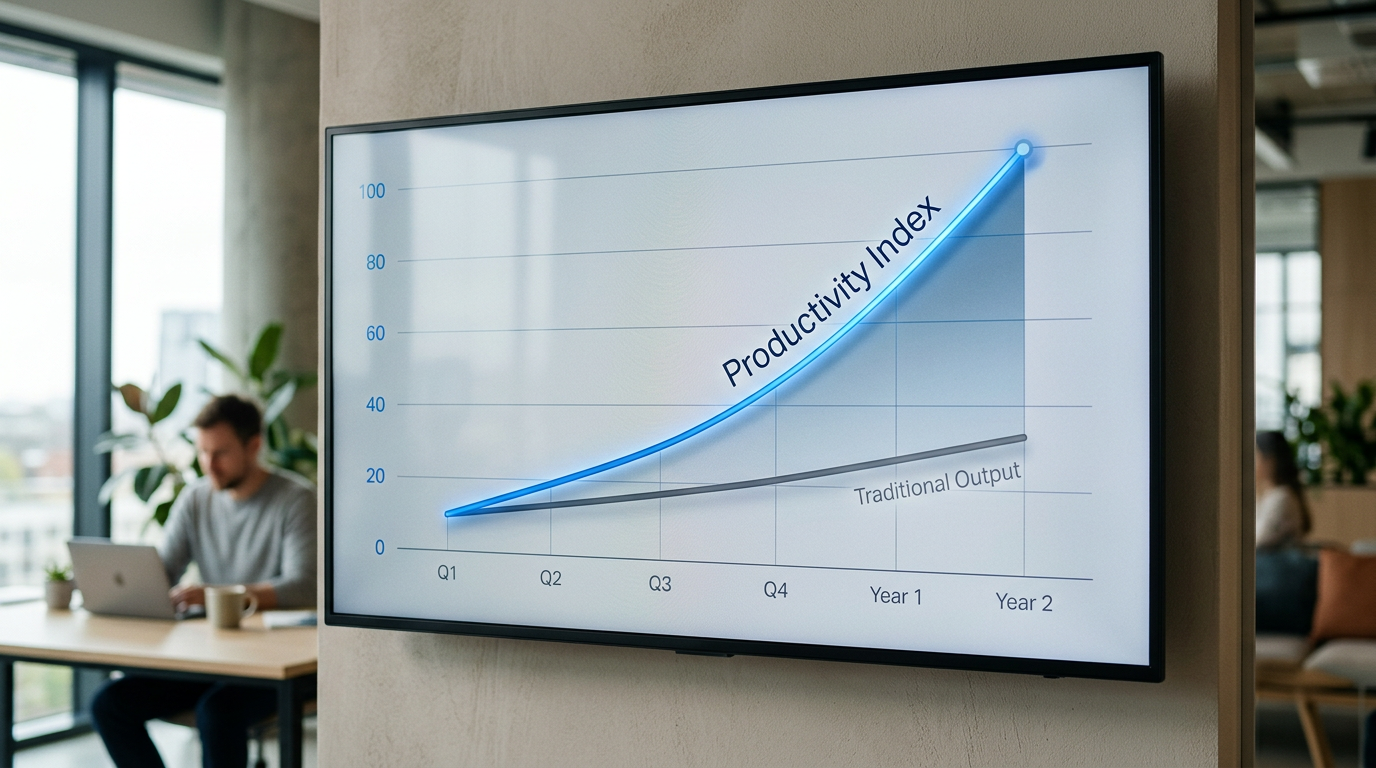
The takeaway for any business leader is direct and urgent. Hiring a “traditional VA” without proven AI fluency is quickly becoming a strategic liability. The new gold standard is a human-AI hybrid, a partnership that delivers exponentially more value than either could alone. This is precisely where professional ai automation services are focusing, building systems that amplify human talent, not just replace it.
The 2026 AI Operator's Toolkit
So what does this new AI-augmented assistant actually do all day? They operate a sophisticated stack of tools, acting less like an assistant and more like a command center for automated business functions. Their value is measured in the efficiency of the systems they build and manage.
Generalist Brains: OpenAI and Anthropic
The OpenAI ecosystem, particularly through custom GPTs and API integrations, has become the foundational layer. A modern VA uses it for far more than drafting emails. They build custom agents that can summarize sales calls from transcripts, create standard operating procedures from screen recordings, and automate CRM updates without any manual input.
For more complex logic and long-form reasoning, assistants turn to Claude. It excels at reasoning-heavy work like synthesizing dense market research reports, designing intricate workflows in a tool like Notion, and acting as an embedded reasoning engine inside other platforms. This is the difference between asking an assistant to discover influencers and asking them to build an entire system for ai influencer marketing that qualifies leads automatically.
Operational Hubs: The Automated CRM
Platforms like GoHighLevel perfectly showcase this operational shift. Previously, a VA might spend hours manually managing lead pipelines, sending templated follow-ups, and booking appointments. Now, an AI-savvy executive assistant builds and supervises fully automated funnels directly within the CRM.
They design the AI-powered logic, set the triggers for automated SMS and email sequences, and only intervene for high-value exceptions that require a human touch. Instead of being a cog in the machine, they are the architect of the machine. Building these highly integrated systems sometimes requires custom software development to connect disparate APIs, another area where a strategic assistant provides critical oversight.
How to Transition Your VA into an AI Operator
Recognizing the trend is one thing. Acting on it is what creates a competitive advantage. The transition from a traditional VA to an AI operator requires a deliberate strategy rooted in a new mindset, from both you and your assistant.
First, conduct a task audit. For one week, have your VA log every single task they perform and how long it takes. Then, sit down together and categorize each item into two buckets: tasks that require human judgment, creativity, or empathy, and tasks that are repetitive and rules-based. That second bucket, likely representing that 30-40% of their time, is your automation target.
Next comes training and empowerment. Invest in courses on prompt engineering, workflow design, and the basics of how APIs work. Give them a sandbox environment with tools like Zapier or Make to start building simple automations. The goal is not to turn them into a developer, but to make them a confident user and manager of automated systems.
Finally, you must shift your own expectations. Stop measuring their value by tasks completed. Start measuring them by the efficiency and output of the systems they create. This is a move from asking “what did you do today?” to “what did you automate today?”
From Virtual Assistant to AI Chief of Staff
This evolution culminates in a new role and a new job description: the AI Chief of Staff. This position is less about administrative support and far more about operational intelligence. They are the essential human in the loop, responsible for a growing portfolio of autonomous agents that execute business processes.
Their daily work looks completely different. Instead of manually pulling numbers and building a report, they audit the outputs of an AI agent that builds the report automatically. Instead of writing five social media posts, they fine-tune prompts for a content generation system, using their expertise for final strategy and quality control. This strategic oversight is a core part of optimizing online business processes, much like our own seo services focus on optimizing a website's overall visibility.

The macro shift is profound and accelerating. Autonomous AI agents are taking over routine digital interactions at a startling pace. Gartner-linked forecasts predict that by 2028, these agents will automate 20% of digital interactions and 15% of all enterprise decisions. As authoritative studies on business AI trends confirm, the adoption of digital assistants is already widespread in over 47% of businesses. Your VA's new job is to manage, audit, and direct this emerging autonomous workforce.
So forget about replacing your VA with AI. The real, tangible opportunity in 2026 is to promote them. Elevate your assistant from a task-taker to the person who runs your company's entire automation layer. Audit their workload, identify the repetitive tasks, and start a conversation about what they could achieve with that time back. That is how you will win.