beyond local seo: geo services for law & medicine in 2026
for sophisticated medical and legal practices, location is no longer about proximity. it's about risk, regulation, and revenue. here's how to master geo-aware data and workflows.

The medical-legal consulting market in North America is valued at around $2.25 billion. That figure has very little to do with getting five-star reviews on a map listing. It has everything to do with something far more valuable: geo-aware data.
For sophisticated medical and legal practices, “location” is no longer about proximity. It’s about risk, regulation, and revenue. It dictates the standard of care in a malpractice suit, defines jurisdiction in complex litigation, and determines compliance in a world of fractured data privacy laws. Simply put, geography is strategy.
Thinking about this as “local SEO” is a decade behind the curve. The future belongs to firms that master geo-aware data, workflows, and marketing. It's a fundamental operational shift, moving from a pin on a map to a core business intelligence function.
The New Geo-Economic Landscape in High-Stakes Services
The entire medical-legal sector is expanding, projected to grow at a 5.61% compound annual growth rate through 2035. This growth isn't just about more lawsuits. It's about more complexity, driven by demand for expert testimony tied directly to where incidents, providers, and facilities are located.
A fascinating tension is emerging in the legal field. While the industry consolidates among massive global firms, the highest-value work is fragmenting geographically. Civil litigation, the largest practice area by market share, hinges almost entirely on local factors. Venue, jurisdiction, and regional standards of care are not just details, they are often the entire case.
This creates a powerful opportunity for smaller, specialized firms. With superior geo-intelligence, a boutique practice can outmaneuver a global giant in a specific jurisdiction. They can win by knowing the local courts, regulatory bodies, and expert witness networks more intimately than any generalized competitor.
Industry analysis confirms this trend. The most successful firms are those that can think globally, with expansive cross-border capabilities, while executing with intense local precision. This is not a contradiction. It is the new strategic imperative, and it runs on geo-specific intelligence.
When AI Automates the Routine, Your Expertise Goes Geo
Artificial intelligence is rapidly consuming routine, standardized work across both professions. In healthcare, AI is already streamlining claims, handling prior authorizations, and managing revenue cycles. In legal, the story is the same, with predictions from firms like KPMG underscoring a massive shift.
As KPMG's report on the "legal department of the future" outlines, most standardized work will become self-served or outsourced. What's left for the human expert? The messy, high-stakes, and complex matters. This is where real value is created, and that work, whether it's complex litigation, a thorny regulatory challenge, or executive defense, is always deeply geo-specific.
Consider a medical malpractice case involving a patient who lives near a state line and receives care in two different hospital systems. The standards of care may differ, a detail AI automation might miss but a sharp legal team armed with geo-data will seize upon. Integrating smart ai workflows doesn't replace this expertise, it frees up your best people to focus on it.
This is the core of the new value proposition. Your firm’s worth is not in processing forms, but in applying nuanced, geographically informed judgment to problems that have no easy answer. AI handles the 'what', your team handles the 'so what' based on 'where'.

Your New Client Is an AI: Marketing for Geo-Specific Discovery
The way clients find legal and medical expertise is undergoing a revolution. The era of just optimizing for a few keywords is over. We are now in the midst of an AI search transformation, where generative platforms act as the primary discovery engine for users.
These AI models don't just scan for keywords. They seek signals of credibility, authority, and relevance. For law firms and specialized medical services, one of the most powerful signals is geo-specific technical implementation on your digital properties. This is the core of next-generation generative engine optimization, and it's about feeding the machine exactly what it needs.
This means going far beyond a simple address on your contact page. It involves using structured data and schema markup like `LegalService` to clearly define your practice areas in the context of specific jurisdictions, courts, and regulatory environments. You are not just telling an AI that you are a litigator. You are showing it, through code, that you are a litigator who understands the nuances of the Ninth Circuit's precedent on data privacy because you've explicitly marked up your expertise for that `jurisdiction`.
From GIS to the Courtroom: Geo-Aware Workflow Tools
This strategic shift is powered by real-world tools that bridge location, regulation, and data. These platforms are far more sophisticated than consumer mapping applications. They are becoming essential instruments for case preparation, evidence gathering, and workflow management.
Mapping Risk and Opportunity with Esri ArcGIS
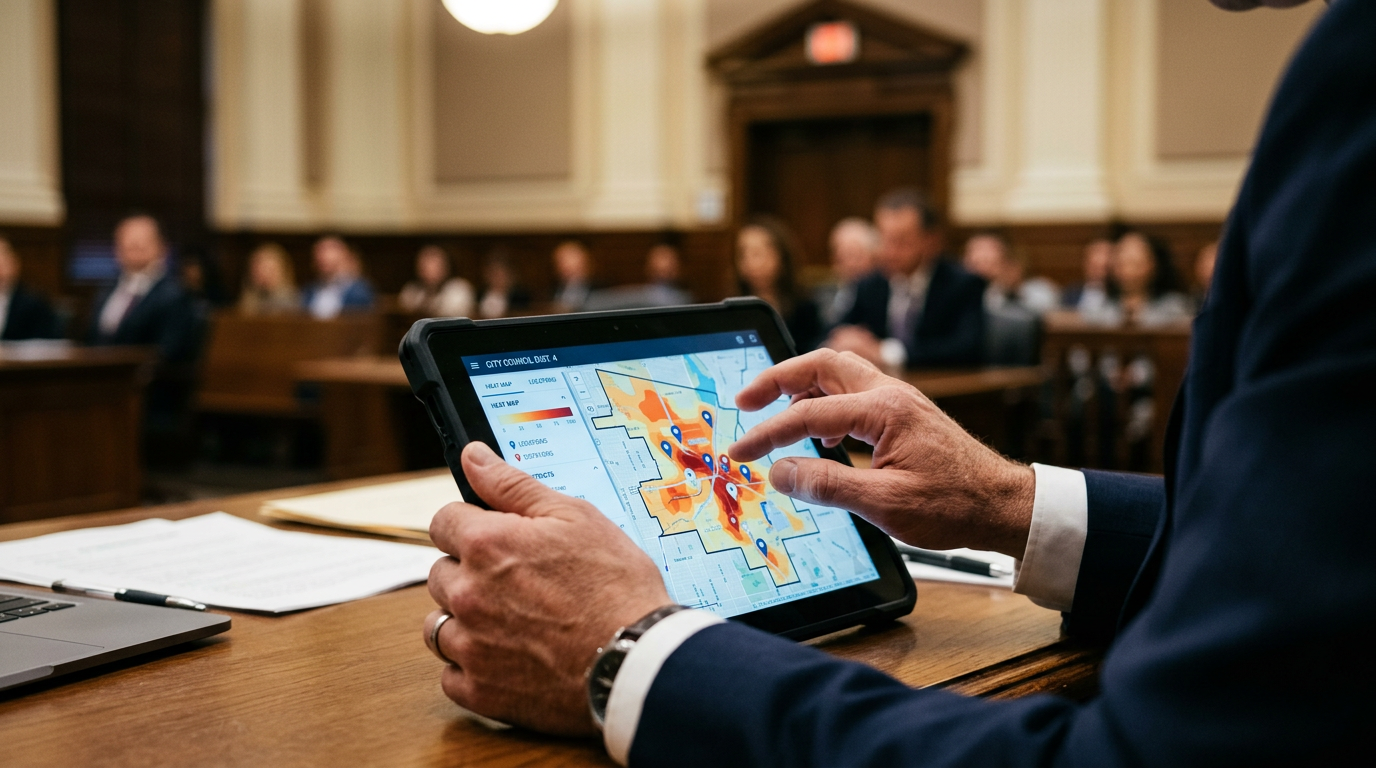
Tools like Esri's ArcGIS platform, with its dedicated solutions for Health & Human Services and Public Safety, are a prime example. Governments and hospital systems use it to map everything from service coverage and crime patterns to social determinants of health. In a legal context, this data becomes powerful evidence. A plaintiff’s attorney can use ArcGIS public health data to demonstrate a pattern of under-resourced facilities in a specific census tract, adding a compelling, data-driven layer to a negligence claim.
Embedding Geo-Data into Case Workflows
On a more granular level, the Google Maps Platform APIs for Places, Routes, and Geocoding are frequently integrated directly into case and claims management software. They are used to validate addresses, calculate travel times in emergency care disputes, and reconstruct incident locations for personal injury cases. For an insurance carrier, this means an adjuster can instantly verify the location of an accident against policy coverage zones and calculate the distance to the nearest in-network repair facility, all within their claims platform. Here, geography is evidence.
This technology is also the backbone of the booming medical-legal consulting market. Firms now routinely pair expert testimony with GIS-enabled analysis to show things like regional deviations in standards of care or access delays caused by facility density. A powerful digital marketing strategy involves showcasing your firm's ability to leverage these very tools in public case studies or expert commentary.
Navigating the New Map of Geo-Regulated Litigation
A new wave of litigation is rising, and it is intrinsically tied to geography. Lawsuits over insurers' use of AI to deny coverage claims and ongoing litigation around health data breaches are set to escalate significantly into 2026. The core of these disputes lies in a patchwork of rules that differ dramatically by jurisdiction.
Because insurance and data privacy rules are largely regulated at the state level in the U.S., a single corporate action can trigger a cascade of legal challenges with different standards of proof and potential damages. An algorithm used by an insurer that is compliant in Texas might violate specific patient protection laws in California. This reality puts a massive premium on geo-aware compliance and legal services.
The winners in this new environment will be those who can expertly navigate this complexity. They will understand the key geo-trends businesses must now follow and build their services around them. This creates a two-sided market: one for the advisory services that help providers avoid these pitfalls, and another for the litigators who handle the disputes when they inevitably arise.
For both sides, a deep, data-driven understanding of geography is no longer optional. It is the foundation of modern practice. The map is not the territory, but in law and medicine, it increasingly defines the rules of the game.
Is your practice built for this reality? It's time to move your strategy from a pin on a map to an integrated, geo-aware system. To see how this approach can transform your client acquisition and case management, talk to our geo specialists.