digital marketing for small business in 2026: systems, not tactics
by 2026, juggling scattered digital marketing tactics is a losing game. learn how to build a unified system for your small business that drives measurable growth.

Let's cut right to it. If your 2026 marketing plan is just a list of tactics like “post on social media” or “send an email blast,” you're already falling behind. By now, around 75% of brands have integrated generative AI into their strategies. The game is no longer about just doing things; it's about building a system that does the work for you.
Most small business owners are incredibly busy. You don't have time to master ten different platforms that don't talk to each other. The secret isn't to work harder on your marketing, but to build a smarter, interconnected growth engine. This guide shows you how to move from scattered actions to a single, measurable system that produces results.
The Game Has Changed: Why Your Old Playbook is Obsolete
For years, marketing was a series of campaigns. You'd run a promotion, let it die down, then plan the next one. That model is broken. Your customers are always online, and your marketing needs to be, too. It needs to be an always-on engine, not a sputtering vehicle you only start for special occasions.
This shift is driven by a new reality called “search everywhere” behavior. Your potential customers aren't just searching on Google. They are discovering products on Instagram, asking questions on TikTok, and getting recommendations from AI assistants. Your business needs to show up consistently across all these surfaces, which is impossible if your efforts are siloed.
Personalization is another non-negotiable factor. With nearly 75% of consumers saying they're more likely to buy from brands that personalize their experience, generic messages are just noise. The data shows businesses that nail personalization are far more likely to crush their revenue goals. This isn't a luxury for big brands anymore; it's a fundamental requirement for small business survival.
Building Your 2026 Marketing Engine: The Core Components
Creating a system sounds complicated, but it's really about connecting a few powerful, accessible components. You are likely already using most of these tools. The key is making them work together to drive a single, primary goal: revenue.
The Brain: Data and Analytics with Google Analytics 4
Your marketing system needs a brain, a single source of truth that tells you what's working and what's not. For over 70% of small businesses, that tool is Google Analytics. The latest version, GA4, is built specifically for today's customer journey, tracking users across your website and apps.
Forget vanity metrics like traffic spikes or social media likes. The only question that matters is, “Did this marketing activity lead to a sale or a qualified lead?” GA4 helps you connect the dots between a Facebook ad, a blog post visit, and a completed contact form. It’s the scoreboard for your entire system, and understanding its basic reports is a critical first step. A proper website development process ensures these tracking points are built in from the start.
The Fuel: Consistent, Purposeful Content
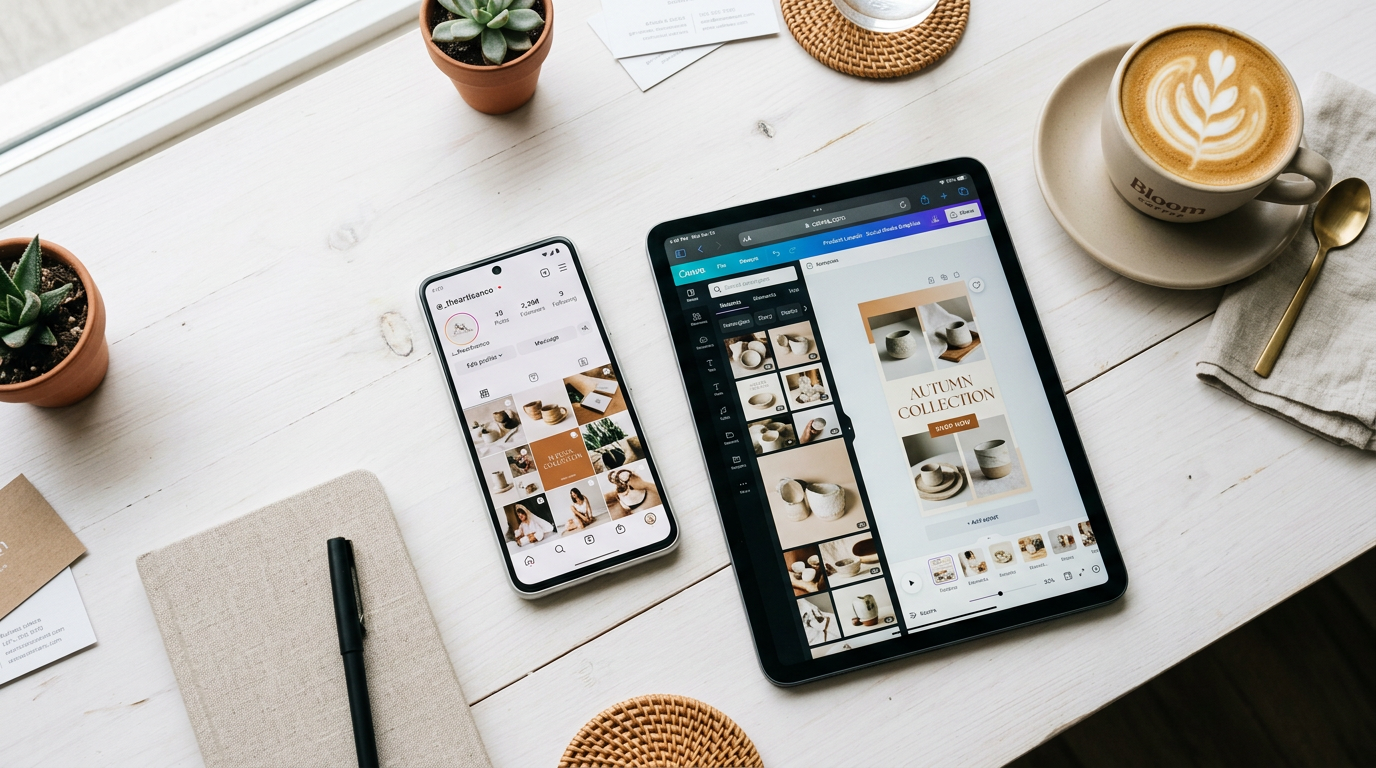
If data is the brain, content is the fuel. Your engine can't run without it. The good news is that producing content has never been easier. Over 63% of small businesses now use DIY design tools like Canva to create professional-looking graphics, ads, and flyers without hiring a designer.
The system-based approach means every piece of content has a job. A blog post is crafted not just to exist, but to rank for specific terms and answer customer questions, a core tenet of any good seo agency. A short-form video demonstrates a product feature and pushes viewers to a specific landing page. An Instagram graphic announces a sale and is tied to a trackable link. Every piece of fuel moves the engine forward.

The Distribution Network: Social, Search, and Email
Once you have your fuel, you need pipelines to deliver it. For most small businesses, the primary channels remain dominant. Over 90% use Facebook and 74% are on Instagram for marketing, while 53% rely on email marketing. These are your distribution networks.
In a system, these channels work in concert. A blog post optimized for search can be promoted via an email newsletter. Key insights from that post can be repurposed into a carousel for Instagram and a short video for Facebook Reels. This is what small business marketing trends in 2026 point towards: integration over isolation. Every channel reinforces the others, driving traffic back to your website where GA4 can measure the financial impact.
The Accelerator: How AI Ties It All Together
This is where everything clicks. Artificial intelligence is the accelerator that makes the entire system manageable for a small team. AI doesn't replace your strategy; it executes the repetitive parts of it faster and more effectively than any human could.
Think of AI's role in three parts: production, personalization, and performance. AI tools can generate first drafts of blog posts, brainstorm social media captions, and create endless variations of ad copy for testing. This frees you up to focus on the human elements: your brand story, your offer, and your direct interactions with customers.
AI also powers the deep personalization that customers now expect. It can help you segment your email list and send automated, relevant messages based on user behavior. As we look forward, emerging technologies like Augmented Reality are also becoming more accessible, with 71% of consumers saying they’d shop more if a brand offered AR experiences. This can now even extend into new frontiers like ai influencer marketing, creating unique and engaging campaigns.
Putting It Into Practice: A Simple System for a Local Service Business
Let's make this real. Imagine you run a local plumbing business and want to increase high-value jobs like water heater installations.
First, you define the goal and the system. The goal is 10 new installation leads per month. The system will use your website, Google Business Profile, and email to capture and nurture leads, all tracked in GA4.
Next, you create the content fuel. You write a definitive blog post titled “5 Signs You Need a New Water Heater in [Your City].” You use Canva to create a simple checklist graphic from the post. You shoot a quick smartphone video walking through one of the signs with an old unit.
Finally, you activate the distribution network. The blog post is optimized for Google and linked from your Google Business Profile. The graphic is posted to Facebook with a link. The video goes on Instagram Reels. Anyone who fills out a contact form on your site gets an automated email confirming their request and sharing a link to the helpful blog post. Every action is designed to prove expertise and drive a single conversion, which GA4 tracks as a goal completion.
AI helps you write the initial blog draft and generate social post ideas. The business owner, the human, provides the real-world expertise and authentic voice. It's a simple, repeatable process. If this kind of setup feels overwhelming, it might be the perfect time to book a strategy call and get an expert opinion on your specific needs.
From Tactics to Engine
The era of random acts of marketing is over. Success in 2026 and beyond belongs to the small businesses who stop thinking in campaigns and start building systems. The tools are more accessible and affordable than ever before.
You don't need to implement this entire playbook overnight. Start with one small step. Connect your website to Google Analytics 4 and define just one conversion goal. That single action is the first gear in building your own automated, revenue-driving marketing engine.