email automation for ecommerce: your brand's revenue os
for ecommerce brands, automated emails drive over 30% of revenue from just 2% of sends. it's time to stop chasing campaigns and build a true revenue operating system.
Let’s get one thing straight. Your ecommerce email strategy is probably upside down. For years, we’ve been conditioned to think in campaigns, blasts, and newsletters. But the data tells a story that brands can no longer afford to ignore.
Automated emails, the ones that run quietly in the background, now account for a tiny 2% of total sends for most stores. Yet, according to Omnisend's latest reports, they drive a staggering 30% to 37% of all email-attributed revenue. Per send, these automations generate 16 times more revenue than a scheduled campaign. Let that sink in.
This isn't an incremental improvement. It’s a fundamental shift in how scalable revenue is generated online. It’s time to stop thinking in fleeting campaigns and start thinking like a systems engineer. It’s time to build your brand’s revenue operating system.
The End of the Campaign Era: A Necessary Funeral
The campaign-first mindset is a relic. It’s a strategy built for a world that doesn’t exist anymore, one with simpler inboxes and far less discerning customers. Today, you're fighting for attention against a tidal wave of content, and your one-off promotional blast is just more noise.
The performance gap is undeniable and growing. Top-tier ecommerce brands report that their automated flows generate around 300% more revenue than their traditional campaigns. Open rates are roughly 70% higher, and click-through rates more than double. For the most optimized stores, these flows attribute up to 30% of their total store revenue. This isn’t a tactic; it’s a business model.
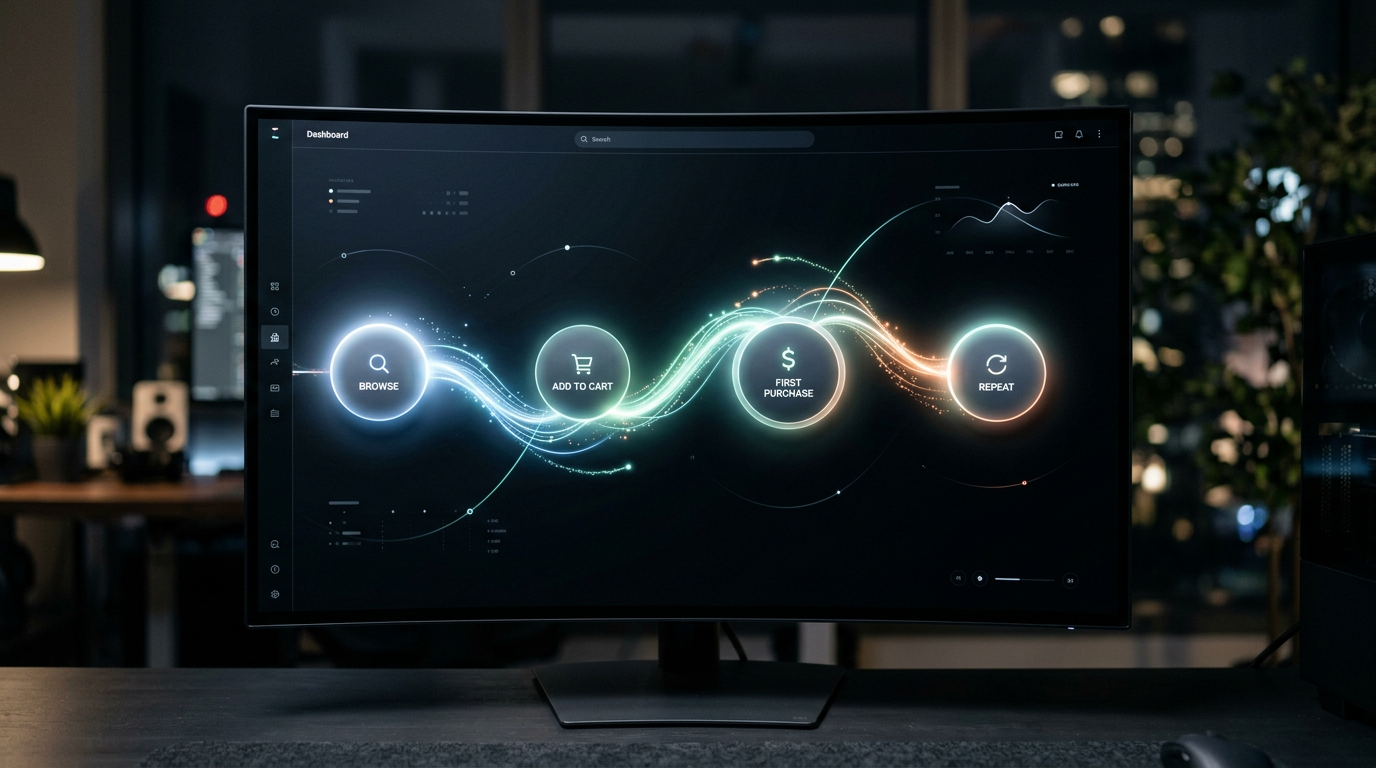
Why the massive difference? Because automations are built on context and intent. They are direct reactions to a customer’s specific behavior. A customer browsed a product, added it to their cart, just made their first purchase, or is due to reorder. Each action is a signal, an invitation for a hyper-relevant, valuable conversation. A weekly newsletter simply cannot compete with that level of personal timing.

Designing Your Lifecycle OS: The Foundational Four
Treating email automation as a profit-generating operating system (OS) means you map every critical event in the customer journey into a single, cohesive machine. This isn't a random collection of siloed flows. It's one orchestrated system where customer behavior triggers precisely the right message at the right moment.
The core of this OS is built on a handful of high-impact automations that statistically drive the vast majority of automated revenue. Before you get fancy, you must perfect these first. We call them the Foundational Four.
The Core Automations Driving Profit
- The Welcome Series: Its job is indoctrination and activation. For new subscribers, it sets expectations, tells your brand story, and uses social proof or a small incentive to drive the crucial first purchase.
- The Abandoned Cart Flow: This is pure revenue recovery. It targets the highest-intent shoppers with timely reminders, overcomes common objections like shipping costs, and creates urgency to complete the purchase.
- The Post-Purchase Flow: This turns a one-time buyer into a repeat customer. It starts with a genuine thank you, provides product education, solicits a review, and then strategically introduces a cross-sell or a reason to return.
- The Browse Abandonment Flow: Lower intent than a cart abandoner, but still valuable. This flow re-engages shoppers who showed specific product interest but didn't add to cart, keeping your brand top-of-mind without being pushy.
Powerful platforms like Klaviyo have become the gold standard for building this kind of customer OS, largely due to their deep data integration with Shopify and sophisticated flow-building logic. However, native tools like Shopify Email are rapidly advancing, offering powerful built-in AI and behavior-driven workflows that are perfectly integrated with store data. The tools are ready. The strategy is what separates the winners from the losers.
Orchestrating the Machine: How Flows Work Together
A true OS isn't just a list of flows; it's an interconnected system. The magic happens when you define how these automations speak to each other, ensuring the customer receives the single best message for their current context, not five conflicting ones.
This orchestration is managed through suppression logic and flow filters. For example, a customer who enters your Abandoned Cart flow should immediately be removed from the Browse Abandonment flow. The cart is a much stronger signal of intent, so its message takes priority. A customer who just made a purchase should be suppressed from receiving a promotional email for the next 7 to 10 days to let the post-purchase experience breathe.
Advanced strategies use customer tags to pass information between flows. A user who clicks on three items from the "Men's Outerwear" category in your Welcome Series can be tagged as an `outerwear_enthusiast`. This tag can then be used to show them dynamic, personalized content blocks featuring jackets in all future emails, from a holiday campaign to a win-back series. This level of detail transforms your email program from a series of disjointed messages into a single, evolving conversation.
Getting this architecture right is a complex task requiring a deep understanding of data, consumer psychology, and your tech stack. It's a key pillar of the marketing services we provide, turning channel chaos into a unified customer experience.
Thriving in the Age of AI Inboxes and Agentic Commerce
The game is changing underneath our feet. Inbox providers like Google and Apple are deploying AI that ranks, sorts, and even summarizes your emails before a human ever sees them. Your sender reputation is no longer just about avoiding the spam folder. It’s about being deemed valuable enough by an algorithm to get prime placement in the "Primary" tab.
This is where your automation OS becomes a massive competitive advantage. These AI inboxes prioritize authentic engagement. A well-timed, behavior-triggered abandoned cart email that gets a click and a purchase is a powerful positive signal to Google's algorithms. A generic, batch-and-blast promotional email that gets ignored or deleted without opening is a definitive negative one. In this new world, sending fewer, more context-dense messages is the key to deliverability and visibility.
Many experts are documenting how to prepare for emerging 2026 email marketing and AI inbox trends, and the consensus is clear: behavior-based automation is the foundation of modern deliverability. It also demands a radical shift in measurement. Obsessing over open rates, a metric now obscured by Apple's privacy changes, is a waste of time. Your focus must shift to intent-rooted KPIs that reflect real business impact: repeat purchase rate, time-to-second-order, and customer lifetime value (CLTV). These are the metrics that prove your OS is actually building the business. This pivot from vanity metrics to value metrics is a core discipline for any high-performing seo agency.

From Foundation to Full-Stack Automation
Once you’ve mastered the Foundational Four flows, you can begin layering in more sophisticated sequences that compound your results. This is where you evolve from a basic OS to a full-stack retention engine, creating the systems that allow top stores to attribute up to 30% of their total revenue to automation.
Phase two involves expanding both your channels and your triggers. You can weave SMS into your cart abandonment flow using tools like Klaviyo or Omnisend to add a second, high-urgency touchpoint. You can build a replenishment reminder for consumable products, triggering an email when a customer is likely running low. You can create a VIP flow that recognizes and rewards your best customers with exclusive access or perks, solidifying their loyalty.
The future-state, phase three, is even more powerful. It involves proactively collecting and using zero-party data. A post-purchase quiz that asks a skincare customer their skin type or main concern allows you to personalize every subsequent message. The principles of ai influencer marketing can even be applied here, using AI to match customer segments with specific user-generated content or influencer testimonials inside your emails, adding a layer of social proof that feels organic and personal.
Your goal is to have an always-on system that nurtures customers from their first look to their tenth order, all running continuously in the background. Every new automation you add is another asset that works for you 24/7, compounding value over time and freeing up your team to focus on bigger strategic initiatives.
Stop thinking about your next campaign. Start architecting your automation OS. Your email list is not a megaphone; it's a network of customer relationships waiting for the right signal to act. Building this system is the single highest-leverage activity an ecommerce brand can undertake today. If you're ready to shift from one-off blasts to a compounding revenue engine, you can book a strategy call with our team to map out your brand's unique architecture.