fast web dev that ranks: the 2026 speed-to-serp formula
don't choose between a fast launch and high rankings. learn the new playbook combining pre-built solutions and seo-first platforms to dominate google's serps in 2026.

Everyone wants a website built yesterday. The pressure for speed is immense, but here’s the uncomfortable truth: most “fast” web development is just a race to the bottom, delivering a product that Google quietly ignores. The prevailing myth is that you must choose between launching quickly and ranking well.
That's no longer true.
The smartest teams are now combining specific development methodologies with SEO-first platforms. This hybrid approach delivers launch speeds twice as fast as traditional builds while systematically hitting the ranking signals Google demands. It's not about cutting corners, it's about using the right ones to accelerate success.
Why Quick Launches Often Fail Google's Test
Let's be blunt. When a business hires a cheap, fast developer, they are often buying technical debt. The site goes live and it might look fine on the surface. Under the hood, however, it’s a mess of bloated code, unminified JavaScript, poor image optimization, and sluggish server response times. It fails the performance test before it even gets a chance to compete.
This technical debt isn't just an abstract concept for developers. For stakeholders, it surfaces as a frustratingly slow admin dashboard, layouts that break on certain mobile devices, and unexplained bugs that pop up months after launch. The initial speed is an illusion, paid for with long-term instability and poor performance.
Google made its standards explicit with Core Web Vitals. These aren't suggestions, they are critical ranking factors that directly measure the quality of user experience. Top-ranking sites are those that demonstrate technical excellence. A recent Futurmedia analysis revealed that sites achieving 90% compliance can boost rankings by a staggering 20-30%.
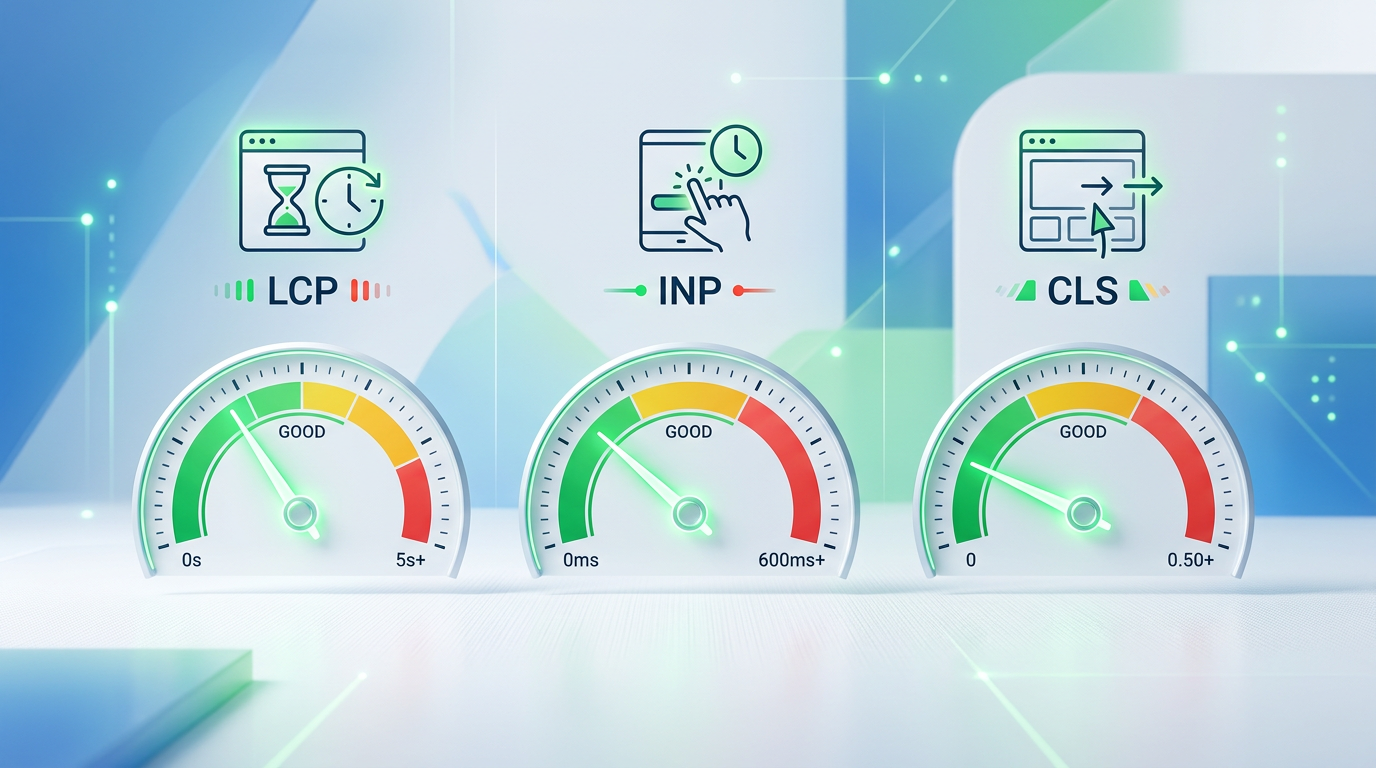
The three pillars you absolutely must master are Largest Contentful Paint (LCP), Interaction to Next Paint (INP), and Cumulative Layout Shift (CLS). You can find Google’s specific thresholds in their own documentation, which details the technical requirements for Core Web Vitals. Hitting an LCP of under 2.5 seconds isn’t a bonus, it’s the price of entry.
Ignoring these metrics is like trying to win a race with a flat tire. Your content could be amazing, but if the user experience is slow and clunky, your SEO plan is dead on arrival. This is why a solid process for any seo services must begin with these technical foundations.
The Pre-Built Revolution: Slashing Development Time by 50%
So, how do you build a technically sound website without it taking six months? The answer lies in pre-built, standardized architecture. Think of it like using high-quality, prefabricated components to build a house instead of mixing concrete and laying every single brick by hand.
Agencies like DBB Software are pioneering this model with their Pre-Built Solutions. By using standardized, cloud-based blocks for common functionalities, they are reducing total project time by up to 50%. According to their 2025 Clutch-recognized data, the planning stage alone is cut in half, and prototyping stages shrink by 30%. This isn't just about speed, it's about structured efficiency and proven reliability.
What Are Pre-Built Solutions, Really?
Let's clarify what a “pre-built block” is. It's not a simple website template. It's an encapsulated piece of functionality, like a user authentication module, a Stripe payment gateway integration, or a complex filtering system. Each block is engineered, tested, and pre-optimized for performance and security on platforms like AWS.
When you build a site this way, you're assembling verified, high-quality components. The development process becomes less about writing every line from scratch and more about intelligently configuring and integrating these powerful blocks. The result is a highly custom final product built with the speed and reliability of a standardized system.
This modular approach is perfect for startups and companies needing to launch a Minimum Viable Product (MVP) and enter the market twice as fast. Because the core components are already optimized, the final product is inherently more stable and scalable. This shift is a fundamental change in modern software development services.
Stacking Speed with SEO: Platforms That Deliver Both
Building the backend fast is only half the battle. You need a frontend platform that translates that speed into performance Google can see and reward. This is where the "stack" part of our formula comes in. Not all website builders are created equal, and the choice has massive SEO implications.
For teams that need maximum control and the cleanest possible code, Webflow is the undisputed leader in 2026. It excels at Core Web Vitals, often delivering LCP scores under two seconds right out of the box. It gives you the granular control of hand-coding without the extended timeline, making it a favorite for agencies building high-performance sites. It's a key part of our custom website development process for a reason.
On the other end of the spectrum, you have platforms like Wix. Once dismissed by serious SEO professionals, it has evolved significantly. With its guided SEO checklists and direct Semrush integration, Wix now helps beginners and small businesses achieve strong local and niche rankings up to 40% faster than they would on their own, according to Launch Codex research. It automates many of the technical best practices that new site owners often miss.
The choice is strategic. For a complex SaaS application, the combination of a custom pre-built backend with a Webflow frontend is ideal. For a local service business, Wix's integrated toolset might be the fastest path to visibility. The key is to consciously select a tool that is maniacally focused on performance metrics, not just drag-and-drop visuals.

Your Blueprint: Launch a Site That Ranks in Weeks
Ready to put it all together? Here is the proven workflow for launching fast and ranking high. This isn’t theory. This is what the elite agencies recognized by SpacetoTech, like Matebiz (5.0/5 rating) and eSparkBiz (4.9/5), are doing to dominate the market with rapid MVP and SaaS delivery.
First, partner with a development team that uses a pre-built or modular approach. Vet them on their process. Ask them how they reduce planning and prototype stages, and demand proof. Look for evidence, like DBB Software's 30% reduction in prototyping time, that confirms their efficiency claims.
Second, build your project on an SEO-first platform. For most performance-critical projects, this means taking the clean foundation from your development partner and deploying it on a platform like Webflow. This combination gives you both backend development speed and frontend technical purity, a stack that is incredibly difficult for competitors to beat.
Budgeting for Velocity: What Does Speed Cost?
Efficient development isn't always the cheapest per hour, but it delivers the highest ROI. Fast agencies leveraging these optimized systems often charge in the $25, $49 per hour range, a price point that reflects extreme efficiency, not a lack of quality. This rate is an investment in market entry speed.
When you can launch an MVP twice as fast, you start gathering user feedback, iterating, and generating revenue months ahead of schedule. The cost of development should be weighed against the opportunity cost of delay. In that context, paying for a process that guarantees both speed and quality is one of the smartest business decisions you can make.
This hybrid model is the secret sauce. It's how you can go from concept to a ranking MVP in weeks, not quarters. It’s an adaptable strategy that works for complex web platforms and even certain types of mobile app development where a high-performance web component is critical.
Stop thinking of speed and quality as a trade-off. By intentionally stacking a rapid development methodology with a performance-obsessed platform, you create a powerful, durable competitive advantage. Your competitors are almost certainly still choosing one or the other.
Take a hard look at your next web project. Is it engineered for both launch speed and Google's non-negotiable performance benchmarks? If not, it's time to rethink your entire strategy from the ground up.