founder-led seo: a lean system for under $300/month
stop overpaying for seo services. this guide shows startups on a tight budget how to create a powerful, founder-led seo system for under $300 a month.

The median retainer for a full-service SEO agency now sits around $3,500 per month. Even basic packages rarely dip below $1,500. For a bootstrapped startup, that figure isn't just expensive, it's a non-starter.
But here’s the counterintuitive truth for 2025 and beyond: you might not need an agency at all. The rise of AI-augmented workflows and smart, focused strategies has made founder-led SEO more powerful than ever. It's about building a system, not just buying a service.
This isn't another generic list of SEO tips. This is a playbook for building a lean, effective SEO machine for under $300 a month and about 5 to 10 hours of your time per week. A system designed for the new realities of search, not the old rules of ranking.
The New Math of Startup SEO
Let's be blunt. The economics of traditional SEO services are broken for most startups. Agency pricing has soared, with standard retainers for small businesses landing between $2,500 and $5,000 monthly. That’s a significant cash burn for an early-stage company trying to find product-market fit.
Even the so-called “affordable” options are becoming less so. What used to be a $500 monthly package for local SEO is finding a new floor. In fact, by 2026, many local SEO costs are projected to double, pushing typical spend toward the $1,000/month mark. This widening gap leaves founders in a tough spot.
The solution isn't to find a cheaper, lower-quality service. It's to change the equation entirely. Time, not cash, has become the most valuable input for a startup's SEO success, thanks to a new generation of intelligent tools that collapse execution time from hours to minutes.
You, the founder, possess the single most important asset for modern SEO: genuine expertise. Pairing that expertise with the right lightweight system can generate results that a generic, outsourced agency simply cannot replicate. It’s a fundamental shift in how we should approach organic growth.
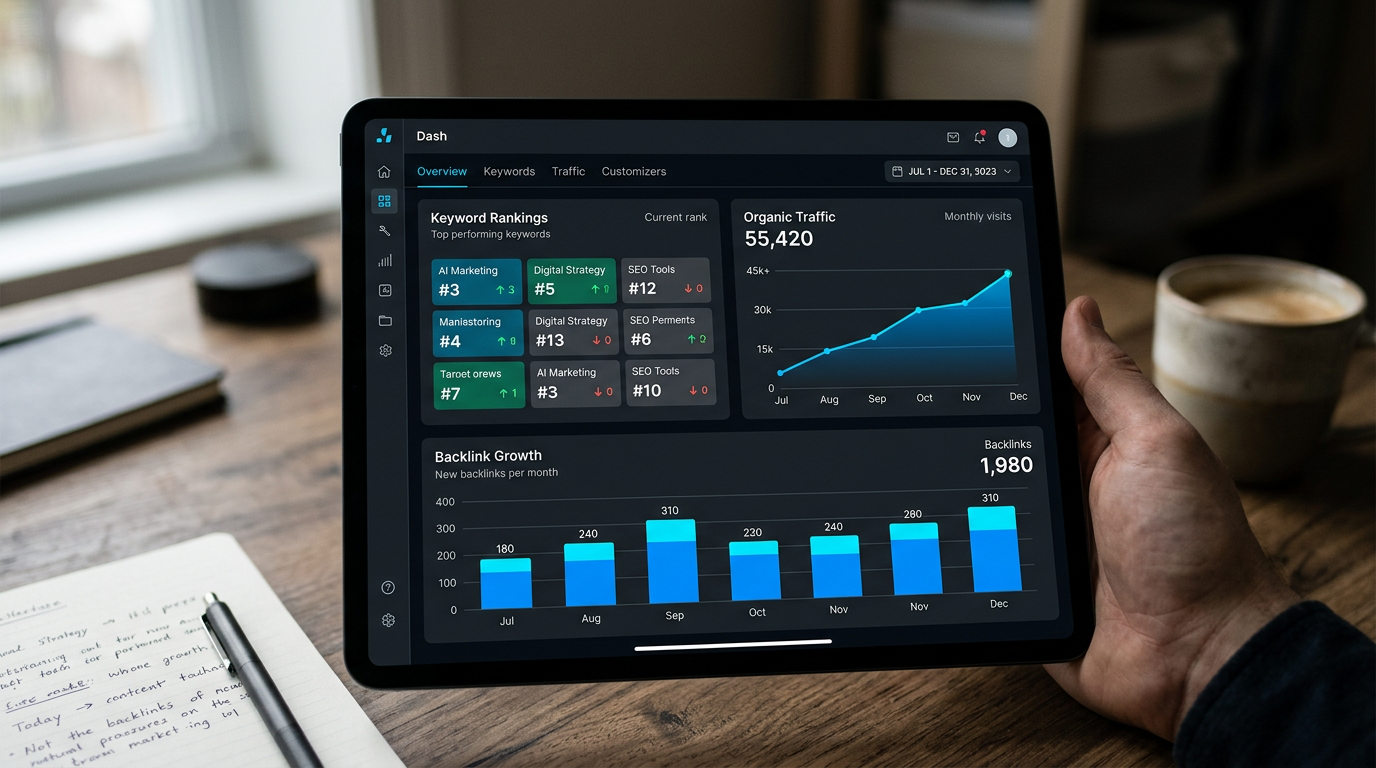
Your Founder-Led SEO Stack: The Sub-$300 Toolkit
Building an in-house SEO system doesn't require a dozen complex subscriptions. It starts with a free, powerful foundation and adds one low-cost layer of automation and intelligence.
Start with the Free Foundation
Before you spend a single dollar, get your Google toolkit in order. This is non-negotiable. Set up Google Search Console (GSC) to see which queries bring users to your site and monitor technical health. Connect Google Analytics 4 (GA4) to track user behavior and conversions. For any local component, a complete Google Business Profile (GBP) is your most valuable asset for capturing "near me" searches.
This trio gives you the raw data you need to make informed decisions. GSC tells you what people are searching for, GA4 tells you what they do next, and GBP gets you on the map. Master this data first.
Add a Low-Cost Automation Layer
This is where your budget comes into play. Instead of a retainer, you're buying access to a platform. AI-driven platforms like Moonrank are emerging that bundle daily technical optimization, content publishing workflows, and visibility tracking for as little as $99 per month. These tools handle the tedious work so you can focus on strategy and content.
Think of it as an automated SEO assistant. It ensures your site is technically sound and helps structure your content process, making your 5-10 hours a week incredibly efficient. It's a core piece of a modern startup's marketing services stack.
Compress Workflows with AI Tools
The final piece is an AI workflow tool. Tools cited in recent startup research, like Averi AI, can take a process like keyword research or a content audit and shrink it into minutes. They help you identify question-based queries and structure your content for the new world of AI-powered search results, which is a key part of effective ai search optimization.
The Zero-Click Playbook: Win by Being the Answer
For years, the goal of SEO was to get the click. You fought to rank number one so a user would visit your page. That game is changing, and fast. Zero-click searches, where a user gets their answer directly on the search results page, have increased by 2.5 times. In some AI-driven search environments, only 8% of users actually click on a traditional blue link.
Fighting this trend is a losing battle. The winning strategy is to embrace it. Your new goal isn't just to rank, but to be the cited answer within Google's AI Overviews and featured snippets.
How do you do this? You have to structure your content to provide direct, authoritative answers. This means moving beyond a simple list of keywords and adopting a few key tactics:
- Question-Based Headings: Structure your articles around the exact questions your audience is asking. Use H2s and H3s like “What is the best SEO tool for a startup?” or “How much should a startup spend on SEO?”
- Direct-Answer Paragraphs: Immediately following a question-based heading, write a concise, 2-3 sentence paragraph that directly answers the question. The rest of the section can elaborate, but that first paragraph is your ticket into a featured snippet.
- FAQ Schema: Implement FAQ schema on your key pages. This is structured data that explicitly tells search engines you are answering specific questions, making it easier for them to pull your content for answer boxes. Whether on your homepage or within a custom website, this structure is vital.
When you optimize for zero-click visibility, you win mindshare even when you don't get a pageview. Being the source of truth that Google's AI trusts builds brand authority that pays dividends down the line.

Content Strategy on a Budget: Topical Clusters & Founder-Led E-E-A-T
With limited time, you can't afford to write random blog posts. You need a focused content strategy that builds authority and signals expertise to search engines. The highest-ROI approach for a lean team is the topical cluster model.
Instead of chasing dozens of topics, pick two or three core "clusters" that are central to your business. For each cluster, plan to build a pillar page and at least five supporting articles that are all interconnected with internal links. This dense web of content signals to Google that you have deep knowledge on a subject.
This is where your founder advantage becomes unstoppable. Google's quality guidelines and AI systems heavily weigh E-E-A-T: Experience, Expertise, Authoritativeness, and Trustworthiness. A generic article written by a freelancer for $50 can never compete with content that reflects your real-world experience as a founder.
Weave your personal story, your unique perspective, and your hard-won lessons into your writing. Use explicit authorship, with a clear byline and a detailed bio that showcases your credentials. This isn't just good for branding; it's a critical SEO signal. Founder-led content is, by its nature, rich in E-E-A-T.
Finally, keep your best content alive. Once a quarter, review your top-performing articles. Update them with fresh data, new insights, and add a visible “Last reviewed” date. This simple act of maintenance signals to both users and search engines that your content is current and trustworthy.
The path to organic growth for a startup is no longer paved with five-figure agency retainers. It’s built with a founder's expertise, a smart and repeatable process, and a small, strategic investment in the right tools. Your biggest advantage is you. Now, it's time to build the system that proves it. If you're ready to see how these principles can be applied to your unique situation, get a free consultation and let's map out your plan.