geo agency services: who to trust for ai search visibility
getting real traffic from ai search engines requires more than just seo. we break down the top geo agency services and tools with proven, measurable results.

Getting traffic from AI search engines isn't a theoretical exercise anymore. One agency, Siege Media, already drove over 250,000 visits from ChatGPT for its client Mentimeter. This isn't a future trend. It's a present-day reality creating clear winners and losers right now.
But as the gold rush for Generative Engine Optimization (GEO) heats up, a critical question emerges. How do you separate the real experts from the opportunists making hollow promises? The answer isn't in old-school keyword rankings, it's in verifiable measurement technology.
Why Yesterday's SEO Fails in the AI Search Era
For two decades, success was a blue link on a search results page. Your entire seo services strategy revolved around climbing that ten-item list. That game is changing faster than most marketing departments can process.
In generative AI, there is no page two. There's only the answer. Your content is either part of the synthesized response, cited as a source, or it's completely invisible. The goal is no longer just ranking. It is to become the foundational knowledge for the AI model itself.
This reality fundamentally alters your entire digital marketing strategy. Traditional metrics like keyword position and impression share become far less relevant. The new key performance indicators are source inclusion, citation frequency, and, most importantly, attributable traffic from AI-generated answers. Tracking this new, complex user journey requires a completely different toolset and mindset.
Think about the user. Someone asking Google "best running shoes" expects a list to research. Someone asking Perplexity or Gemini the same question expects a definitive, synthesized recommendation. To be part of that final answer, your content needs to be authoritative, clear, and easily digestible for a machine, not just a human.
The New Credibility Benchmark: Patent-Verified Measurement
If an agency can't prove where your AI traffic is coming from, their claims are worthless. The biggest challenge in GEO isn't getting mentioned by an AI. It's attributing the subsequent user action back to that specific mention. This is where the serious players are separating themselves from the crowd.
For example, agencies like Go Fish Digital have developed proprietary, patent-based AI measurement tools. A patent isn't just a marketing gimmick for a slide deck. It represents a unique, defensible methodology for tracking and analytics that competitors cannot legally replicate. It’s the difference between guessing and knowing.
What to Ask a Potential GEO Partner
For any enterprise SaaS or Fortune 500 company, demanding this level of transparency is non-negotiable. Without it, you can't calculate ROI or justify budget. Before signing any contract, your team should be asking pointed questions.
First, how do you attribute traffic from an AI answer engine? Ask them to walk you through the technical process. Vague answers about referral strings are not good enough. You need to hear about specific methodologies for tracking users who read an answer and then navigate to your site.
Second, what is your measurement stack? Do you rely solely on third-party platforms like Semrush, or do you have proprietary technology? While platforms are essential, agencies with their own tools, like Go Fish Digital, demonstrate a deeper investment and understanding of the attribution problem.

Evaluating Top GEO Agencies & Their Specializations
The market for GEO expertise is evolving at a breakneck pace. While many agencies now list it as a service, only a few have demonstrated repeatable, verifiable success at scale. These are the partners who combine deep technical knowledge with proven measurement frameworks, and they each have a distinct specialty.
Siege Media: Proven Content-to-Traffic Drivers
Siege Media stands out for publishing the most significant, publicly documented GEO traffic result to date. Securing over a quarter-million visits from ChatGPT isn't an accident. It is the outcome of a content strategy engineered specifically to provide direct, citable answers to user queries that are popular on these new platforms.
Their success provides a powerful proof point. By creating hyper-specific, well-structured articles, they effectively made their client's content the most logical source for ChatGPT to cite. This confirms that a targeted content strategy can yield massive traffic from generative engines, moving GEO from theoretical to practical.
Onely: The Technical Titans for Enterprise Architecture
For large, complex organizations, GEO presents unique technical hurdles. Onely has carved out a niche as the leading agency for enterprise-grade architecture, particularly for businesses running headless or JavaScript-heavy websites. These sites often struggle with indexing and content interpretation by search crawlers, a problem that is amplified with AI models.
Onely’s approach is distinguished by its hands-on technical implementation and sophisticated tracking. They resolve complex client-side rendering issues that prevent bots from seeing the final content. They also deploy a unique 4-platform system that includes conversation intelligence, allowing them to map and measure user interactions far beyond simple clicks. This makes them a top choice for enterprises needing a deeply integrated and technical geo agency.
Go Fish Digital: The Measurement & Attribution Innovators
As mentioned before, Go Fish Digital brings the most crucial element to the table: trust. Their patent-based analytics provide transparent, verifiable impact for enterprise SaaS clients. When your sales cycle is long and your customer acquisition cost is high, attributing every touchpoint is absolutely critical.
Their offering is built for the CFO as much as the CMO. By using proprietary tools to connect AI mentions to actual revenue impact, they solve the biggest attribution headache in the GEO space. This focus on validated analytics makes them an indispensable partner when you need to defend your marketing spend in a boardroom.
Essential Tools Powering Modern GEO Strategies
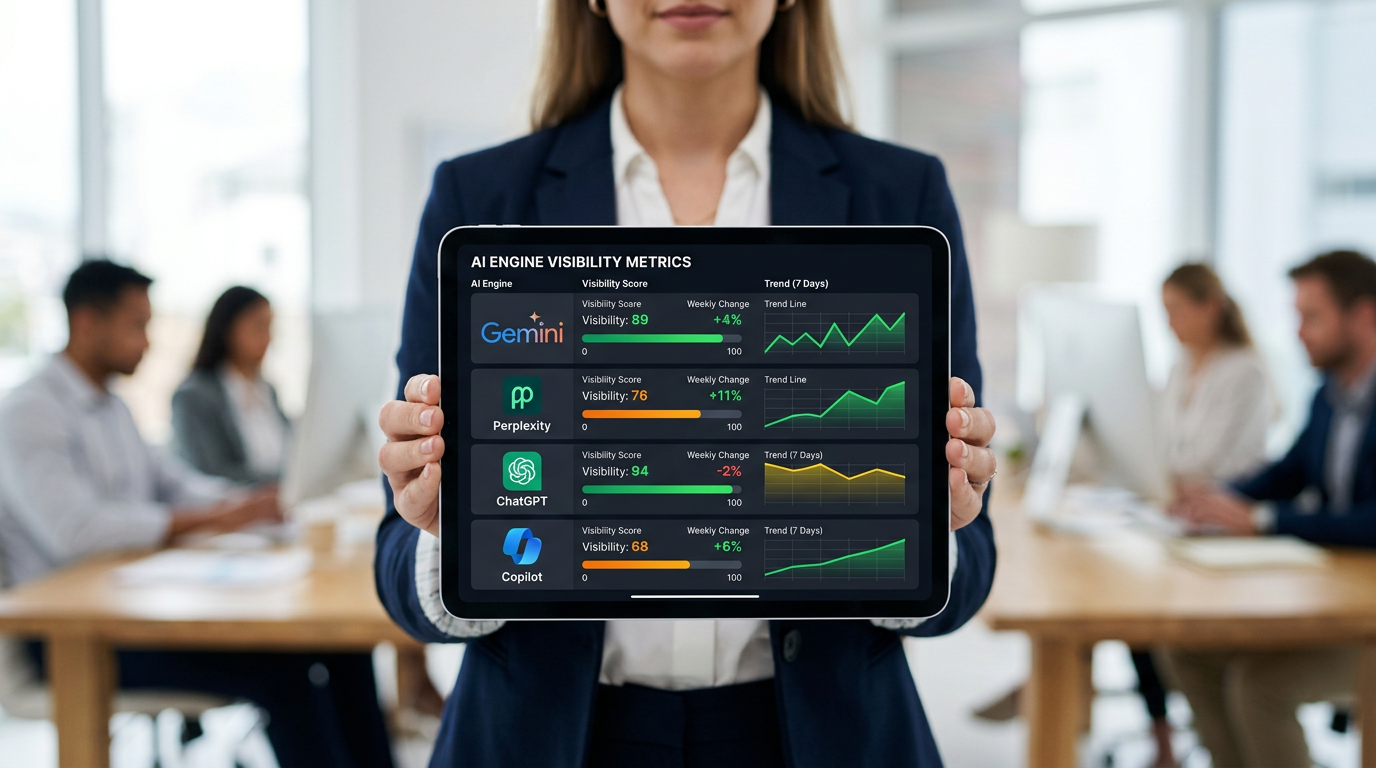
Even the best agency is only as good as its tools. The GEO technology stack is maturing, with several platforms offering the intelligence needed to compete for AI visibility. These tools provide the data that fuels effective strategy, and they generally fall into two categories: integrated suites and dedicated platforms.
Integrated Suites: The Semrush Approach
Semrush, a long-time leader in SEO, has successfully pivoted its massive platform with its AI Visibility Toolkit. This integrated suite helps bridge the gap between traditional SEO and generative engine performance. It offers specific metrics for visibility within engines like ChatGPT and Perplexity, moving beyond simple keyword tracking into true AI-answer analysis.
The main advantage here is workflow integration. For teams already using Semrush for keyword research, rank tracking, and site audits, adding GEO metrics into the same dashboard creates a more holistic view without adding another separate tool to the budget.
Dedicated Platforms: The Profound Advantage
For those seeking a dedicated, specialist solution, Profound has emerged as the top GEO-native platform for 2026. Its entire focus is on generative engine intelligence. Profound excels at providing native visibility metrics and, most importantly, actionable recommendations based on how different AI models source their information. It tells you not just *if* you're visible, but *why* and how to improve.
A dedicated tool like Profound often provides more granular data on model behavior and covers a wider range of AI systems than an all-in-one suite. This deeper intelligence is critical for teams looking to build a significant competitive advantage.
Analytics & Reporting: The AthenaHQ Focus
Another key player, especially for enterprise analytics teams, is AthenaHQ. This platform is less about content optimization and more about reporting and business intelligence. It focuses on creating GEO-centric dashboards that prioritize comparative views and easy data exports. It's designed to fit seamlessly into enterprise workflows, allowing teams to integrate GEO data with their broader BI stack. The market is full of options, and a full analysis of available GEO tools shows just how specialized this field has become.
Building Your GEO Strategy for 2026 and Beyond
The choice between an integrated suite like Semrush and a dedicated platform like Profound often depends on your team's structure and goals. An all-in-one tool can streamline workflows for smaller teams. A specialized platform provides the granular data that large, dedicated GEO teams require to gain a decisive edge.
Ultimately, the right technology provides the answer to the most important question. Which of our efforts are influencing AI models, and what is the tangible business impact? Without this data, you're flying blind, no matter how great your content is.
The era of AI search is here, and it demands a higher standard of proof. Winning requires a partner who can move beyond speculation and deliver measurable, verifiable results. If you are ready to build a strategy based on concrete data, not just theories, it's time to find the right experts and the right tools.
Ready to demand more from your AI visibility efforts? Let's discuss a strategy built on verifiable measurement. You can talk to our geo specialists today and start building a real, defensible competitive advantage.