geo for ecommerce: win assisted conversions, not just clicks
generative engine optimization for ecommerce isn't about traffic. it's a conversion strategy focused on getting your products recommended by ai to drive real revenue.

Think about this for a second. Nearly a third of all ecommerce revenue, 31% to be exact, now flows directly from sessions involving personalized product recommendations. That isn't a small feature. It's a primary revenue channel.
For years, ecommerce brands chased rankings and clicks. The game was simple: get to the top of the search results page. But the game has changed completely. AI-driven search doesn't just present links. It synthesizes information and makes direct recommendations, acting like a personal shopper.
This is the new reality of generative engine optimization. It's not about getting seen. It's about being recommended.
Why Traditional SEO Falls Short for AI Search
Your classic search engine optimization playbook is officially outdated. It was built for a world of keywords and blue links, where success was measured in impressions and click-through rates. That world is fading. AI engines don't just match keywords; they seek to understand context, solve problems, and answer complex user questions.
This shift isn't just a technical curiosity. It's a fundamental change in user behavior. A solid 45% of online shoppers now outright expect AI to give them personalized recommendations while they shop. It's no longer a neat little trick. It's a baseline expectation for any competitive online retailer.
The measurement of success is also totally different. Instead of asking how many people clicked a link, we now have to ask, “How did an AI mention influence a final purchase?” We’re moving from counting clicks to tracking assisted conversions, a metric that finally connects search visibility to actual bottom-line revenue. This is a much healthier way to think about performance.
Simply put, optimizing for a list of links won't help you when the AI engine is building a comparative list of the top three products for a user's specific need. You need a new strategy entirely.

product-page-structured-data-ai
The Three Pillars of Product Page GEO
Getting your products recommended by an AI-powered engine isn't luck. It’s a deliberate process built on providing the right information in the right format. It boils down to three core pillars that work together to make your product the most logical and compelling choice for the AI to suggest.
1. Structured Data is Your Foundation
Structured data, or schema markup, is the language of search engines. For generative AI, it's even more critical. It’s the non-negotiable set of facts about your product: price, SKU, availability, color options, dimensions, materials. Without it, the AI is just guessing.
Retailers who implement full and accurate product schemas see their products indexed up to 30% faster on these new search surfaces. This isn't just a vanity metric. Faster indexing means you appear in AI-generated answers sooner, especially as new products launch or inventory changes. It’s the ticket to the game.
Think of it this way: structured data is the spec sheet you hand the AI. If your spec sheet is incomplete or inaccurate, you are disqualified before the evaluation even begins.
2. Contextual Content Creates Persuasion
Facts are the foundation, but context is what persuades. A list of features doesn't explain *why* a customer should buy your product. That's where rich, contextual content comes in. Research shows that product pages with more descriptive, long-form content see a 20-40% increase in view duration. People are leaning in.
This kind of content includes detailed use cases, stories about how the product solves a problem, comparisons to other items (even your own), and answers to common customer questions. This is the material the AI uses to craft its narrative. It uses your content to explain *why* your waterproof jacket is better for a hiking trip in the Pacific Northwest than a competitor's, even if the specs are similar.
Bullet points are for scanning. Paragraphs are for convincing. The AI reads both, but it builds its strongest arguments from your prose.
3. Product Entity Optimization
An entity is a clearly defined concept. In GEO, your product needs to be a distinct entity that the AI understands in relation to everything else on the web. This goes beyond simple keywords. It's about defining your product's place in the market.
Who is this product for? A beginner or an expert? What problems does it uniquely solve? How does it compare to the market leader? Answering these questions within your product page copy, your meta descriptions, and your FAQs helps the AI build a complete profile of your product. This is crucial for answering comparative queries like, “What’s a good alternative to the Oura Ring for sleep tracking?”
When you optimize the entity, you’re not just ranking for “sleep tracker.” You are positioning your product as the answer for a specific user with a specific need. You are directly feeding the AI the conversational points it needs to make a recommendation.
Measuring What Matters: From Clicks to Assisted Conversions
Let's be perfectly clear: the entire point of ecommerce GEO is to increase revenue, not just mentions. Success isn't appearing in an AI-generated answer. Success is when that mention leads to a profitable sale. This requires a complete overhaul of how we measure performance.
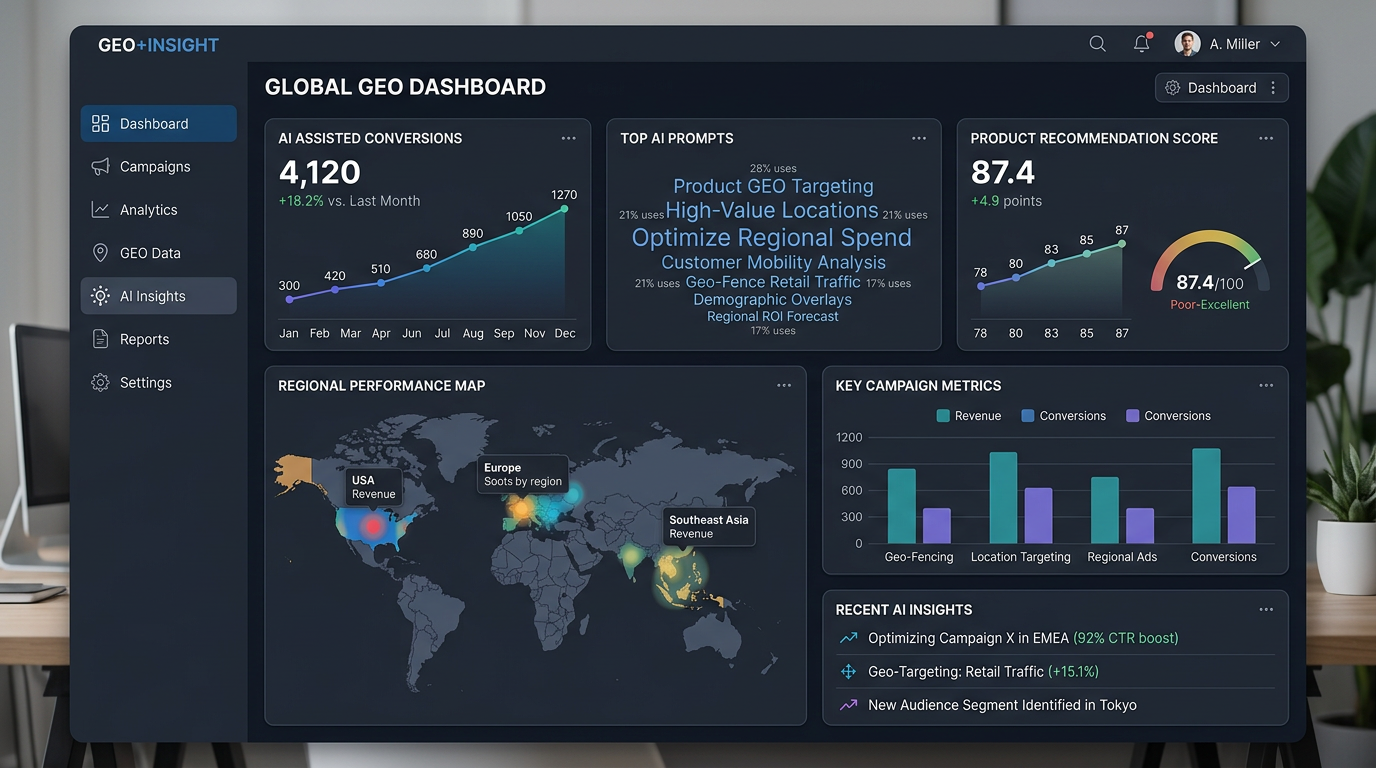
Legacy metrics like impressions and SERP position are becoming irrelevant. The new key performance indicator is the assisted conversion. We need to track how often an AI recommendation leads to a customer adding a product to their cart or making a purchase, even if they don't click directly from the AI result.
Platforms are already evolving to meet this need. For instance, some tools can now create shoppable funnels based on the exact prompts that drove a visit, offering a clear line of sight from query to conversion. You can see what question a user asked, how your product was featured, and what action they took next. For a much deeper look at the mechanics, you can read a more detailed guide on GEO attribution that breaks down this new funnel.
This approach transforms your digital marketing from a cost center focused on traffic into a profit center focused on influence. It’s a far more powerful and sustainable model.
geo-ecommerce-analytics-dashboard
The New GEO Tech Stack for Ecommerce Teams
Winning at generative engine optimization requires more than just a content strategy. It requires a dedicated technology stack. Unlike traditional SEO, which can sometimes be a “set and forget” activity, GEO is an ongoing discipline of monitoring, adapting, and iterating.
Purpose-built tools are emerging to handle this complexity. For example, platforms like **Answee** are designed specifically for product GEO. They monitor multiple AI shopping platforms and even track the activity of AI crawlers like GPTBot and ClaudeBot, giving you real-time intelligence on how your products are being seen and interpreted.
Other tools are integrating GEO into existing workflows. **SE Ranking's 'Visible'** tool, for instance, includes a Shopify integration and an 'Agentic Commerce Optimizer' to score and improve product visibility within AI systems. These tools treat GEO as a continuous operational task, which is exactly what it is. It demands consistent attention, much like inventory management or PPC bidding.
Using the right ai automation services and platforms provides the data you need to react to shifting trends and stay ahead of competitors. It's about building a system, not just running a one-time campaign.
Ultimately, generative engine optimization repositions search from a simple gateway to an active, influential participant in the customer journey. It's no longer enough to be on the shelf. You have to be the product the expert recommends. If you're ready to make that shift from chasing visibility to driving measurable revenue, we should connect. Our team can help you build the right strategy, so talk to our geo specialists today.