geo vs. seo: why clicks don't matter to ai search
seo gets you clicks, but geo (generative engine optimization) gets you cited by ai. learn the critical difference and why your strategy must include both.

Here’s a number that should make any marketer sit up straight: 41% of consumers now intentionally use AI search as their primary information source. This isn't a future trend. It's happening right now.
For fifteen years, we’ve all played the same game. Create content, optimize it, get backlinks, and win the click. That was search engine optimization. But the game has fundamentally changed. A new discipline is taking over, and it has nothing to do with clicks.
It’s called Generative Engine Optimization, or GEO. And if you’re still measuring success by website traffic alone, you're about to become invisible to a huge, and growing, part of your audience.
What is GEO, Really? It's Not 'SEO 2.0'
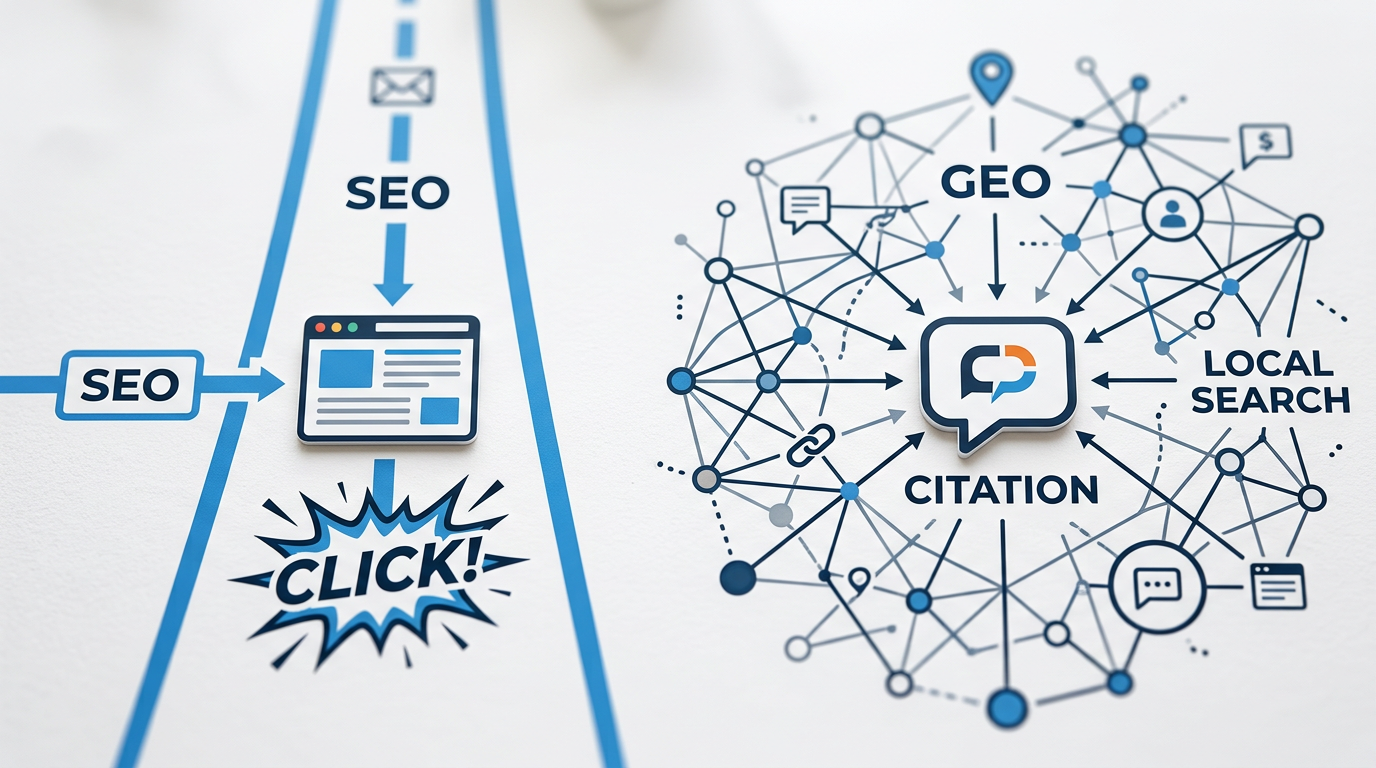
Let's be very clear. GEO is not the next version of SEO. It is a completely different strategic mindset built on a new reality: the citation vs. click paradigm shift.
In traditional SEO, the goal is to rank your page high enough to earn a user's click, bringing them to your website. Your domain is the destination. Success is measured in traffic, time on page, and conversions. It's a model we all know inside and out.
GEO flips this entire model on its head. With AI search tools like ChatGPT, Perplexity, or Google's AI Overviews, the user asks a question and gets a direct, synthesized answer. They may never need to click a single link. Your new goal is not to get the click; it's to be cited as a trusted source within the AI's answer.
Think about that. Success is being mentioned, recommended, and validated by the AI itself. The real battle is for brand authority, not just page authority. The data supports this dramatic shift. Our research shows that a brand's own website content drives a mere 5-10% of AI answr citations. The other 90%? It comes from what other people say about you on third-party sites, forums, and publications.
SEO vs. GEO: A Head-to-Head Comparison
Confusing the two is a critical mistake. While they can and should coexist, their objectives, tactics, and metrics are worlds apart. Understanding the distinction is the first step toward building a resilient digital marketing strategy for the AI era.
The Core Objective
With SEO, the objective is simple: drive qualified organic traffic to your owned digital properties. You want people on your website, reading your blog, and filling out your forms. The entire funnel is built around capturing and converting that click.
With GEO, the objective is influence and authority. You want the AI model to trust your brand so much that it recommends your products, quotes your data, or presents your business as the solution. The win is the citation, which builds brand equity even if the user never visits your site.
Primary Tactics and Levers
Traditional search engine optimization relies on a well-established toolkit. It involves on-page optimization, technical site health, keyword research, and building a strong backlink portfolio. The focus is almost entirely on improving your owned assets.
GEO, however, is an exercise in external reputation management. The primary levers are things you don't directly control. This includes generating positive reviews, earning mentions in reputable online publications, being discussed in niche communities like Reddit, and ensuring your brand information is accurate everywhere it appears online.
How Success is Measured
SEO measurement is straightforward. We use tools like Google Analytics and Ahrefs to track keyword rankings, organic sessions, user engagement, and goal completions. The data is clear and directly tied to website performance.
Measuring GEO is much more complex. It's about tracking your "share of voice" within AI answers. How often is your brand mentioned for key queries compared to competitors? What is the sentiment of those mentions? This requires new tools and a continuous monitoring process, as there's no single dashboard for it yet.
Stability and Volatility
Once you achieve a top ranking in Google, it can often be defended for months, if not longer. SEO provides a certain level of predictability. You can build a strategy on a relatively stable foundation.
GEO is the wild west. Research shows that 40-60% of the sources cited in AI answers can change from one month to the next. This incredible volatility means GEO is not a "set it and forget it" task. It demands constant vigilance, content freshness, and an always-on approach to building and maintaining brand authority.
The New Playbook: How to Win at Both SEO and GEO
SEO isn't dead. It's the price of admission. With Google AI Overviews now appearing in over 16% of all searches, the line between traditional and AI search is blurring. You need a unified approach that treats SEO as the foundation and GEO as the critical next layer of your visibility strategy.
Step 1: Solidify an Authoritative SEO Foundation
Your website is still the canonical source of truth about your brand. High-quality, genuinely helpful content is essential for both users and the AI crawlers that feed large language models. A technically sound website that is fast, secure, and easy to navigate is non-negotiable.
This expert content serves as the anchor for your brand's identity. While it may only account for a small percentage of direct citations, its authority and clarity indirectly influence how AI models perceive your expertise across the entire web.
Step 2: Embrace the "Be The Source" Mentality
Stop thinking like a webmaster and start thinking like a public relations expert. Your focus must shift from optimizing a page to building a brand that deserves to be discussed. Actively seek out opportunities to be featured, reviewed, and mentioned on the platforms that AI models trust.
Is your product being debated on Reddit? Participate. Are there top-10 lists in your industry? Pitch the editors. Are your customers leaving reviews? Encourage them and respond. This is about creating a rich tapestry of third-party validation that AI can't ignore.

Step 3: Optimize and Monitor Across Multiple AIs
The AI search landscape is not a monopoly. ChatGPT boasts over 800 million weekly users, Perplexity is a rising star for deep research, and Google's Gemini models power its AI Overviews. These systems don't all behave the same way; some models are stricter about their sources than others.
A one-size-fits-all approach will fail. You need to understand how your brand appears on each major platform. This requires a dedicated effort to monitor your brand's presence and sentiment, which is where specialized tools and ai automation services can provide a significant advantage in tracking your visibility at scale.
The Future is Here: Don't Get Left Behind
If you're still on the fence, consider the projections. According to one eMarketer forecast on AI search user growth, nearly a third of the entire US population, 31.3% to be exact, will be using generative AI for search by 2026. This isn't a niche audience; it's the mainstream.
The behavioral shift is already profound. People are turning to AI for recommendations, summaries, and direct answers, bypassing the traditional list of blue links entirely. Ignoring GEO is a conscious decision to become invisible to a massive, commercially active part of the market.
The work to secure your place in this new world is not easy, and it doesn't produce results overnight. It requires a long-term commitment to building genuine brand authority. But the choice is simple: adapt now, or try to play catch-up when your traffic has already disappeared.
Ultimately, SEO gets your website found, but GEO gets your brand trusted. You need both to not just survive, but to thrive in the years ahead. The first step is to benchmark your current visibility. Are you ready to see how your brand really shows up in AI search? Let's talk to our geo specialists and get a clear picture.