how much does a mobile app cost in 2026? the real numbers
the price tag for building a mobile app in 2026 is just the start. we break down the real lifecycle costs, from initial build to long-term maintenance and updates.

Everyone wants to know the number. The single figure that answers, "how much does it cost to build an app?" But in 2026, the initial build price is only about half the story. The real cost isn’t a one-time expense, it’s a three-year investment in technology, maintenance, and evolution.
The sticker price you get from an agency is just the down payment. Thinking about the total lifecycle cost, including post-launch support and updates, is the only way to budget accurately. Let's break down the real numbers.
Breaking Down the 2026 App Cost Brackets
While the range is enormous, from a simple prototype for $15,000 to a complex enterprise system for over $300,000, most serious business applications find their home in a predictable middle ground. Industry data from over 5,000 projects shows an average cost of $171,450, but that figure is skewed high by massive, feature-rich platforms.
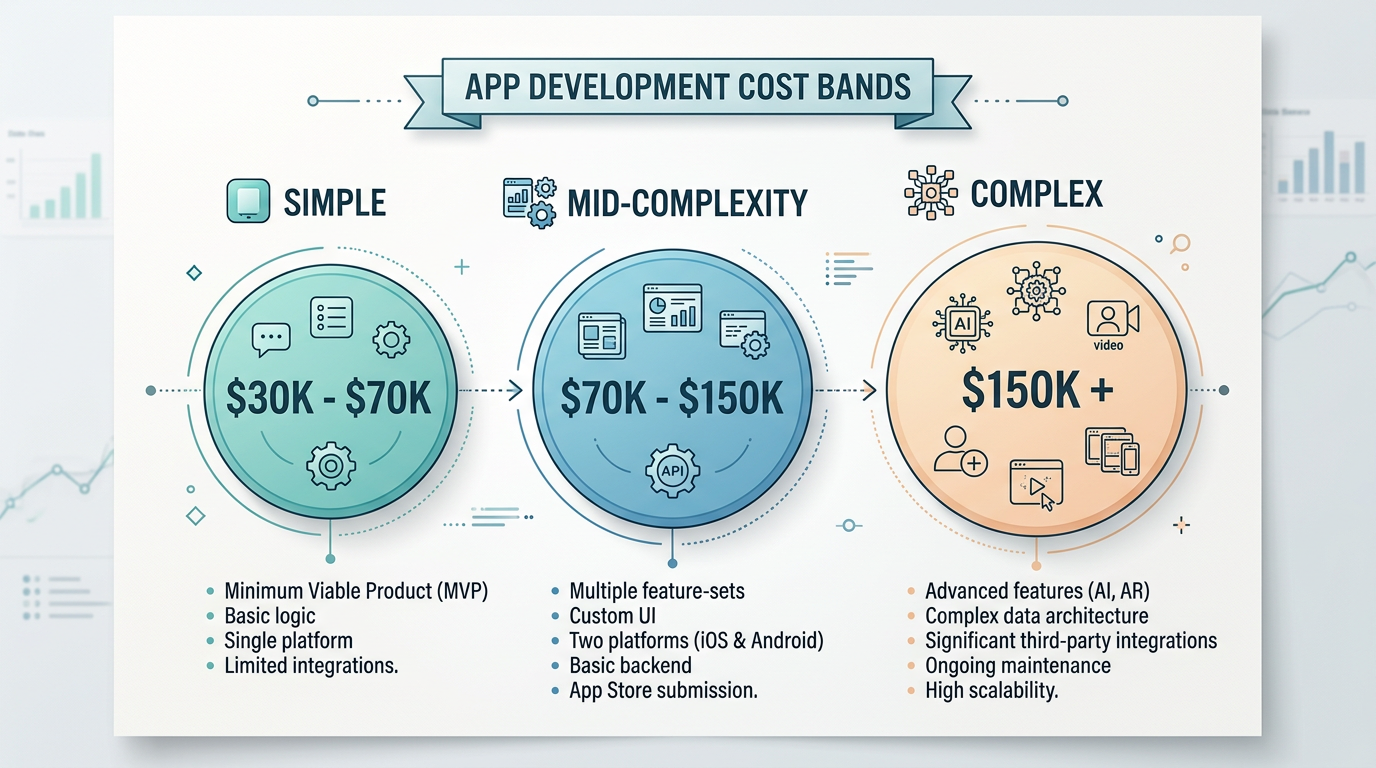
For most businesses, the budget conversation starts in the five-figure range and scales with complexity. Here’s how the tiers typically break down in 2026.
Simple Apps: The $10,000, $40,000 Starting Point
This budget gets you a functional, but basic, application. Think of it as a Minimum Viable Product (MVP) with a handful of screens, basic UI, no user login or backend data synchronization. It's perfect for validating an idea or serving a single, simple purpose. You won't get fancy animations, user profiles, or payment integrations here.
Mid-Complexity Business Apps: The $50,000, $120,000 Sweet Spot
This is the most common territory for businesses building a core product. An app in this range includes essential features like user accounts, social sign-in, payment processing, push notifications, and integration with an API. It's a robust application that can serve as the foundation of a digital business, designed to handle real user traffic and transactions.
Most projects that land with a professional mobile app development agency fall squarely into this bracket. The final price depends on the number of unique user roles, the complexity of the backend, and the polish of the user interface.
Complex & Enterprise Apps: The $150,000+ Frontier
Once your budget crosses the $150,000 threshold, you're building a deeply complex piece of technology. These applications often feature real-time data synchronization, intricate backend architecture, compliance with regulations like HIPAA, and custom administrative dashboards. Many now include sophisticated ai automation features or machine learning models.
For large-scale, enterprise-grade apps, costs can easily climb to $400,000 and beyond, especially when they involve multiple platforms and heavy custom engineering.
The Hidden Costs: Why Your Budget Is More Than Just the Build
Here’s the part most budget guides gloss over. The initial development cost might only be 60-70% of what you'll actually spend in the first few years. Post-launch costs aren't optional, they're critical for keeping your app functional, secure, and relevant.
Industry standard is to budget 15-25% of the initial development cost for annual maintenance. So, a $100,000 app requires a $15,000 to $25,000 budget each year just to stay afloat.
What does that maintenance budget cover?
- OS Updates: Apple and Google release major operating system updates annually, which often require code adjustments to prevent crashes.
- Bug Fixes: No app is perfect. As users discover edge cases, you'll need developers to patch the issues.
- Security Patches: The digital world is constantly facing new security threats, and your app and its server need regular updates.
- Hosting & APIs: Servers, databases, and third-party API subscriptions are recurring operational expenses.
Over three years, post-launch overhead for fixes, hosting, and updates can easily add another 30-50% on top of the original build price. That $100,000 app is really a $130,000 to $150,000 total investment.
How Technology Is Shifting App Development Budgets in 2026
The good news? New tools are changing the cost equation. But they don't just make things cheaper; they shift where the money goes. Smart founders are reallocating budget from raw coding hours to strategic planning, architecture, and faster iteration.
The Rise of Low-Code and No-Code: From MVP to Enterprise
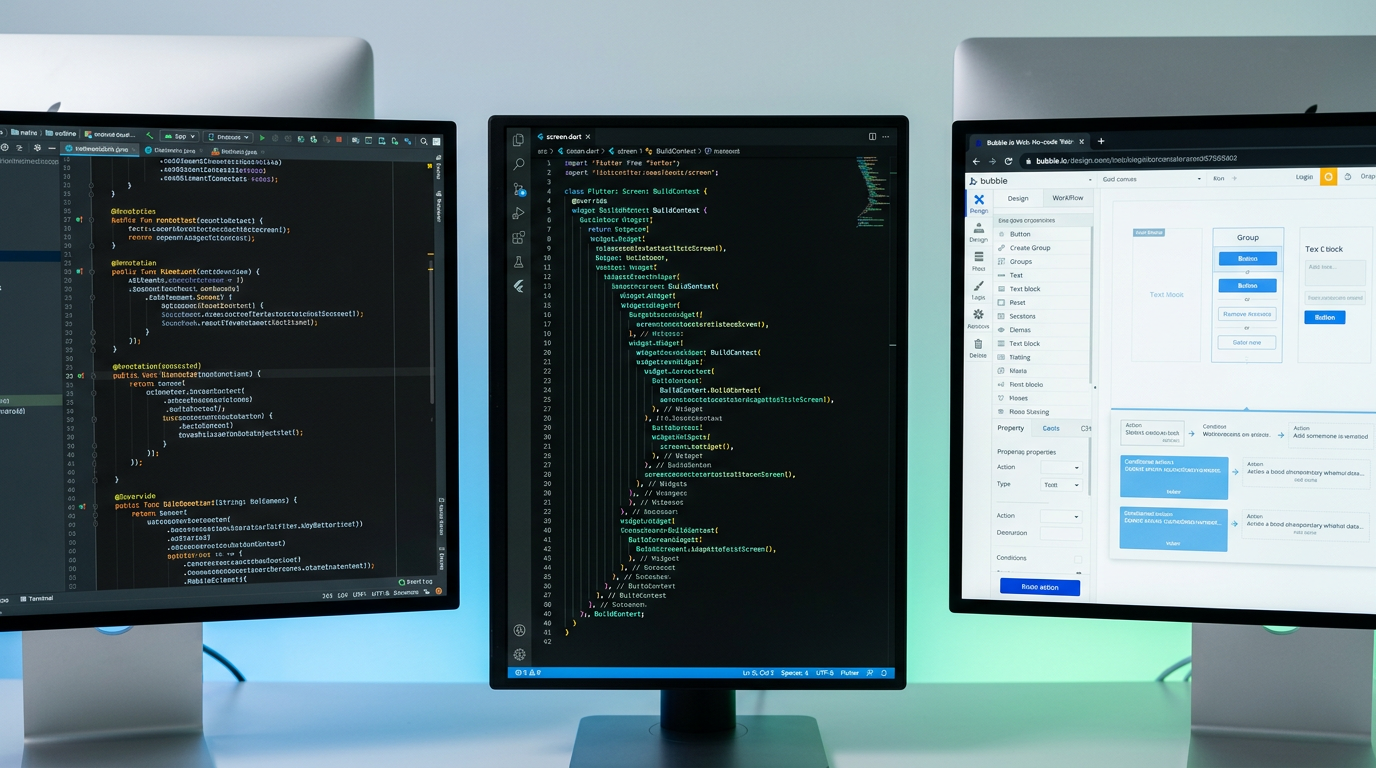
Platforms like Bubble have become incredibly powerful for building MVPs and internal tools without writing traditional code. This aligns with Gartner's prediction that by 2026, a staggering 75% of new application development will involve low-code or no-code tools.
This allows you to launch a functional product for as little as $15,000 to $40,000. It dramatically lowers the barrier to entry, but the cost isn't eliminated. Instead, you're spending less on initial engineering and more on product strategy and user testing. The trade-off is that you might face higher costs later if you need to refactor or rebuild on a more scalable platform.
Cross-Platform Frameworks: The Efficiency of a Single Codebase
Frameworks like Google's Flutter represent a powerful middle ground. Instead of building two separate native apps for iOS and Android, developers can write one codebase that serves both. This can significantly reduce the hours and cost compared to a fully native approach.
A hybrid build using Flutter combined with a managed backend might fall into the $50,000 to $100,000 range. You get much of the performance of a native app with the efficiency benefits of a single development cycle, making it a very popular choice for all but the most demanding applications.
Managed Backends and Cloud Services
A huge chunk of any app's budget is the backend, the engine that runs everything behind the scenes. This used to require a massive investment in server architecture and DevOps. Today, platforms like AWS Amplify provide pre-built, managed backend services for authentication, data storage, and APIs.
This shifts spending from hiring expensive DevOps engineers to paying for a managed service. While a simple backend can still cost $10,000 to $20,000 to integrate, using a service like Amplify streamlines the entire process of full-stack software development, making it faster and more predictable.
Location Still Matters: Global Rates and Finding the Right Partner
Your developer's location remains one of the single biggest factors in your app's cost. The hourly rate for a senior app developer varies dramatically across the globe, and those hours add up quickly.
In 2026, the typical rates are clear:
- US & Canada: $100, $200/hour
- UK & Western Europe: $70, $150/hour
- India & Southeast Asia: $25, $60/hour
Global surveys confirm this spread, with comprehensive app developer cost data showing rates from $10 to over $200 per hour depending on experience and location. While outsourcing to a lower-cost region seems tempting, it's a decision that comes with trade-offs in communication, time zones, and quality control. The cheapest hourly rate doesn't always lead to the lowest total cost or the best product.
The right partner is about expertise, not just price. An experienced team might cost more per hour but work faster, make smarter architectural decisions, and ultimately deliver a superior product with a lower total lifecycle cost. The question isn't just about what you can afford, but what level of quality and partnership you need.
Building an app is a major strategic decision. Armed with realistic cost brackets and an understanding of the total lifecycle, you can move from asking "how much does it cost" to "what should we build for our budget?" Planning for the long-term is the key to success. Ready to scope your project and get a concrete figure? It's time to request a quote.