how much does it really cost to build an app in 2026?
forget the obsolete $50,000 mvp. in 2026, ai tools and smart sourcing can cut mobile app development costs by 80%. here’s a breakdown of real-world budgets and strategies.

Anyone telling you a mobile app MVP costs $50,000 is living in the past. That figure is officially obsolete. Today, thanks to a new class of AI tools, building a functional, market-ready MVP can cost as little as $5,000 to $15,000, slashing traditional agency quotes by up to 90%.
This isn't an exaggeration. AI-powered platforms have fundamentally broken the old pricing models. But building the MVP is just the first lap. The real challenge, and the real cost, comes when you need to scale that prototype into a secure, feature-rich application that people actually want to use. That's where a new, smarter strategy becomes essential.
The New Cost Spectrum for App Development
Forget flat-rate pricing. In 2026, app development costs live on a spectrum, dictated entirely by complexity and functionality. Understanding where your project fits is the first step toward building an accurate budget, not a hopeful guess.
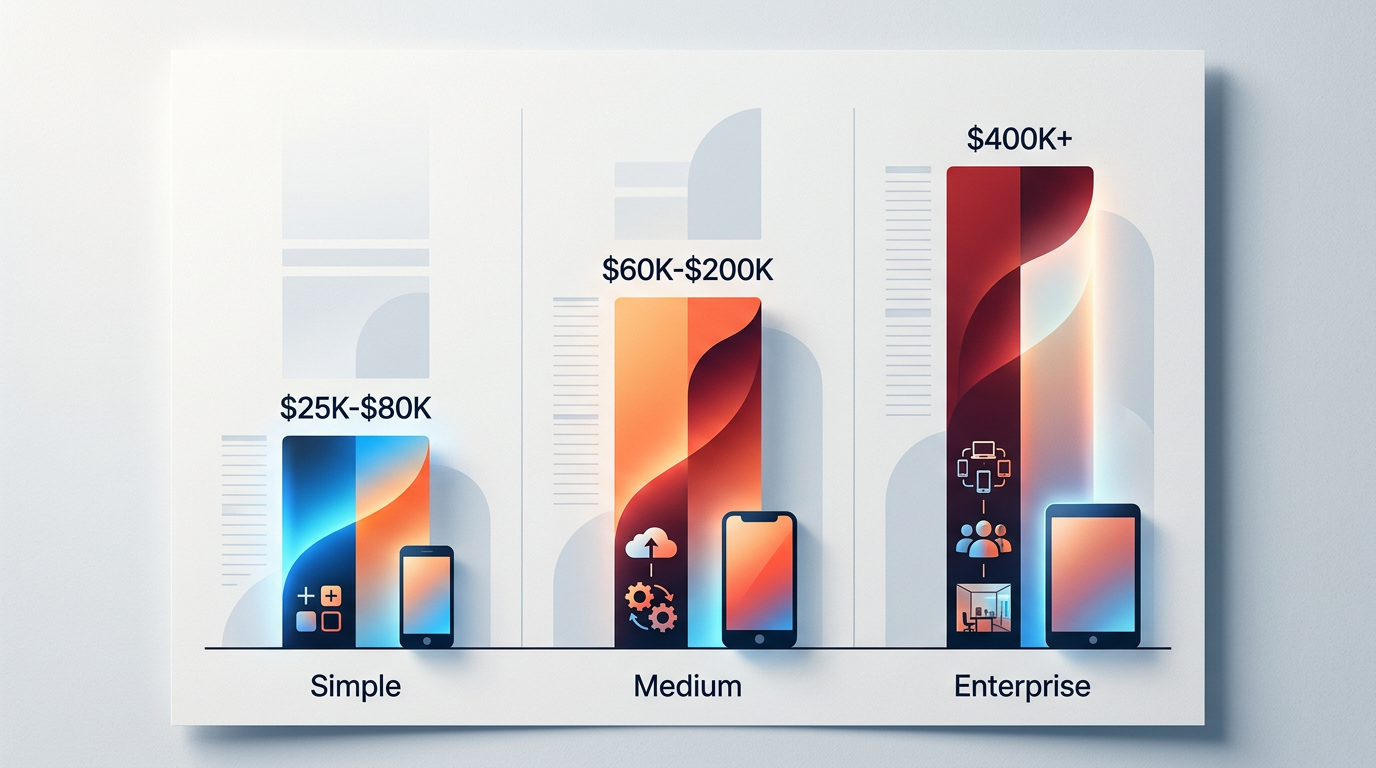
Simple & MVP Apps: $15,000, $80,000
This is your entry point. A basic app typically includes core features like user login, simple profiles, static informational content, or a straightforward product catalog. With a traditional agency, most simple projects land in the $25,000 to $80,000 bracket, though some quotes can stretch to $100,000.
However, this is the tier most profoundly disrupted by AI. Using a tool like Forge can bring your initial build down to the sub-$15,000 range. It's a massive shift for solo founders and small teams looking for market validation without betting the farm on an untested idea.
Medium-Complexity Apps: $60,000, $200,000
Here’s where things get serious. A medium-complexity app moves beyond static screens and incorporates dynamic, interactive functionality. We're talking third-party API integrations, payment gateways like Stripe, real-time chat, or custom analytics dashboards.
These projects require a dedicated team and a typical development timeline of six to nine months. Costs can fluctuate wildly based on the number of integrations and the sophistication of the user experience. This is the category where strategic sourcing and smart technical choices become critical to controlling your budget.
Enterprise-Grade Apps: $400,000+
When your app needs to serve millions of users, handle sensitive data, and meet strict regulatory compliance, you’re in the enterprise zone. The price tag, often exceeding $500,000, isn't just about features. It’s about architecture, security, and scale.
These costs are driven by the foundational need for extreme scalability, advanced security protocols, and robust backend infrastructure. Compliance with regulations like HIPAA in healthcare or PCI DSS in finance adds layers of complexity and cost. At this level, you’re not just building an app; you’re building a fortress. There is no cutting corners on the underlying software development, which demands a team of specialized engineers in DevOps, security, and data governance.
The Hidden Costs That Sink Most App Budgets
The initial development cost is just the price of admission. The real financial commitment comes after your app hits the store. Two key areas consistently catch founders off guard, turning a promising launch into a financial nightmare if left unplanned.
Annual Maintenance and Feature Runway
Your app is not a static product; it's a living piece of software that requires constant care. You should budget 15% to 25% of the initial development cost for annual maintenance alone. This covers server hosting, bug fixes, third-party library updates, and essential compatibility updates for new iOS and Android versions.
Ignoring maintenance isn't a way to save money. It's a fast track to security vulnerabilities, crashes on new devices, and a flood of negative App Store reviews. On top of maintenance, plan for an extra 10% to 15% for active feature development. User feedback will pour in, and you'll need the resources to iterate and improve. Without this, your app will quickly feel stale and become irrelevant.
The Non-Negotiable 20% Contingency Buffer
No project plan survives contact with reality unscathed. Unforeseen challenges will arise, whether it's a technical hurdle, a key API changing its terms, or a shift in market demand from a new competitor. That’s why a 20% contingency buffer built into your budget is non-negotiable.
This fund provides the flexibility to solve problems without derailing your entire roadmap. It allows you to absorb unexpected costs, pivot on a feature, or expedite a fix. Think of it as the difference between a minor, manageable course correction and a catastrophic, project-ending failure.
Your 2026 Tech Playbook: Building Smarter, Not Harder
The smartest teams aren't just spending less; they're making better technical decisions from the start. A couple of key choices during the planning phase can radically reduce both your timeline and your total budget, without sacrificing quality or long-term scalability.
Embrace Cross-Platform Frameworks
The old way involved building two separate, native apps: one for iOS using Swift and one for Android using Kotlin. This was expensive, slow, and required two separate development teams to maintain feature parity. Today, that approach is often inefficient.
Cross-platform frameworks like Flutter allow you to build for both platforms from a single codebase. This approach doesn't just get you to market faster. It can slash your development costs by a staggering 40% to 60%. For the vast majority of business apps, the performance trade-offs are negligible, making frameworks like Flutter the default choice for efficient, modern development.
The AI Revolution in App Prototyping
The single biggest shift in the last few years has been the rise of AI-driven development. Platforms like Forge are completely changing how we approach the Minimum Viable Product (MVP). Instead of spending three months and $50,000 with an agency on a v1, you can generate a functional coded base in a fraction of that time.
This is a critical distinction: these tools generate real, production-ready code, not just static, unclickable Figma designs. This new wave of ai automation has democratized app development, making it possible to validate a core business idea in the market for a fraction of what it cost just a few years ago. It’s the ultimate validation tool before you commit serious capital.
The 80% Cost-Saving Strategy: The AI + Offshore Hybrid
So how do you combine these elements to build a scalable, high-quality app without the insane price tag of a San Francisco or New York agency? The answer is a hybrid strategy. It's how savvy founders will build major apps for under $100,000 in 2026.
Executing the Hybrid Model Step-by-Step
First, you use an AI tool like Forge to scope and build your MVP for $5,000 to $15,000. You get a working product in weeks, not months. You launch it, acquire your first users, get real-world feedback, and validate your core assumptions with data, not just hope.
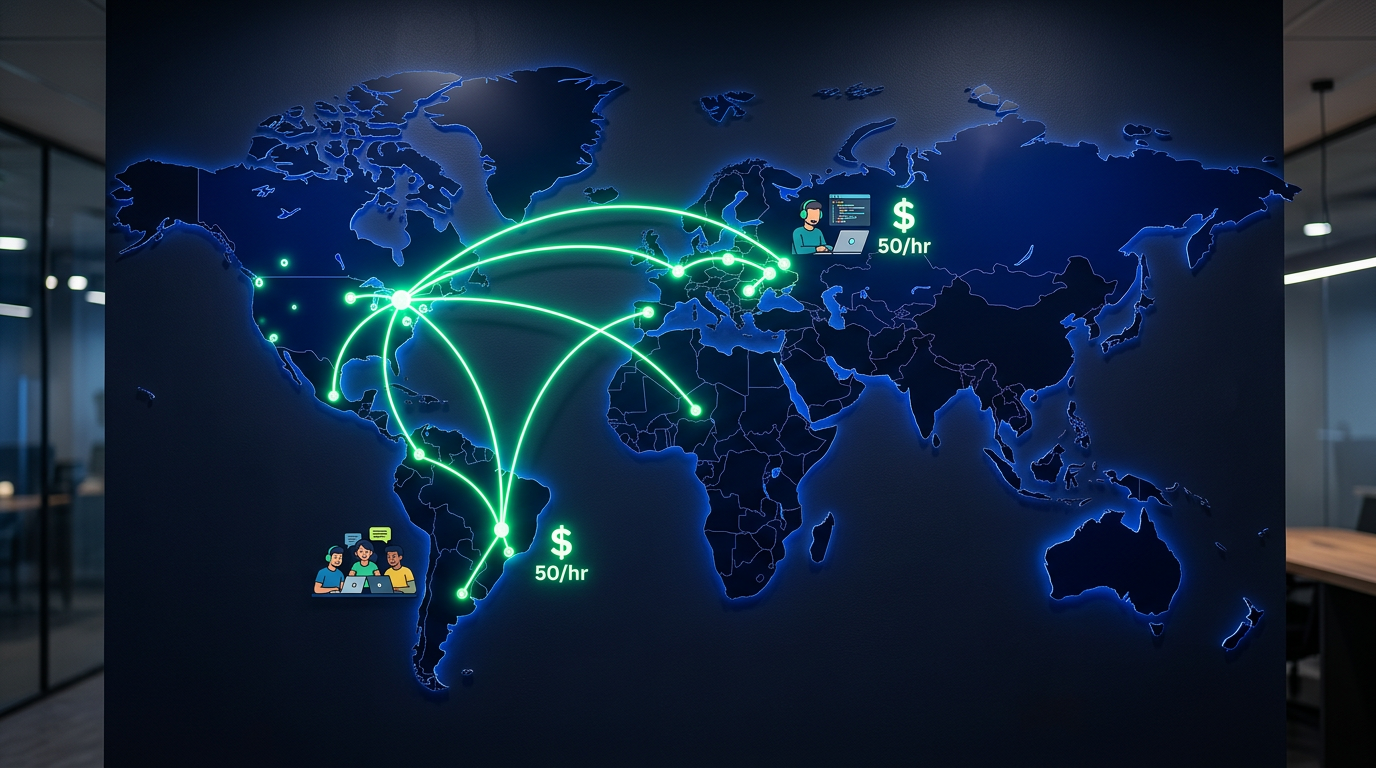
Next, with a validated concept and an existing codebase, you avoid hiring a US-based team at $150-$250 per hour. Instead, you take your project to a skilled, vetted team in a more affordable market. World-class developers in Eastern Europe, particularly in Poland and Ukraine, offer elite talent for rates between $50 and $90 per hour. Similar talent pools exist in LATAM, offering even better timezone alignment for North American companies.
This isn't your typical outsourcing gamble where you send a PDF of ideas and pray. You’re not starting from scratch. You're giving an expert team a validated, working foundation to build upon. They can focus on scaling, security, and complex features, not guesswork. You can find more information in this detailed guide to mobile app development costs breaking down rates by region.
By blending these two approaches, you bypass enormous agency premiums and achieve what was once unthinkable: a custom, enterprise-ready application for potentially 80% less than the traditional model. This moves far beyond the scope of typical web development and gives you a powerful, scalable asset for your business.
So, What's Your Next Move?
The cost of building an app is no longer a mystery hidden behind opaque agency retainers. The tools and strategies are available for anyone to build smarter, faster, and more affordably than ever before. The combination of AI-powered MVPs and elite global talent has leveled the playing field for good.
You can achieve the quality and security of a top-tier domestic agency at the price point of a highly-skilled offshore team. This is the new formula for success. If you're ready to stop guessing and start planning, the best next step is to request a quote. Get specific numbers tailored to your unique vision and start building your budget on a foundation of solid data, not speculation.