how to track brand visibility in chatgpt, perplexity & claude
relying on traditional seo rank trackers is a mistake. with 48% of searches showing ai overviews, learn the framework for tracking and improving your brand's visibility inside large language models.

By 2026, ChatGPT alone will have 883 million monthly users asking questions, comparing products, and making decisions. If your brand isn't being cited in those conversations, you are effectively invisible to a massive, motivated audience. The old keyword rank report is a relic. The new benchmark is AI visibility.
For years, we've obsessed over climbing Google's ten blue links. But what happens when the search engine simply gives a direct answer? That's the reality now, with AI Overviews appearing in a staggering 48% of all Google searches. A consumer doesn't need to click your link if a large language model (LLM) has already summarized, or worse, ignored your content.
This creates a terrifying blind spot. Your Google Analytics and Search Console reports show you nothing about what happens inside a ChatGPT, Claude, or Perplexity chat window. You could be losing market share right now and not even know it. This isn't theoretical. It's the new front line of your digital marketing strategy.
Why Traditional SEO Reporting Fails in the Age of AI Chat
The core philosophy of SEO is changing from ranking to citation. It's a subtle but profound shift. You no longer just compete for a position on a page, you compete for a mention in a paragraph of generated text. Your expert content must be so clear, structured, and authoritative that AI models choose to use it as a source.
Standard seo services and the dashboards that power them miss this entirely. A rank tracker might happily report you're in position #2 for "best small business accounting software." Yet, when a user asks ChatGPT the same question, it might cite three of your competitors by name and completely omit your brand from the generated answer. Your report shows a win, but the customer just heard three other options.
This isn't just about ChatGPT. It's a systemic change across AI Overviews on Google, custom chatbots, and the entire ecosystem of generative answers. If your reporting doesn't account for your brand's presence in these models, you're flying blind, making strategic decisions with dangerously incomplete data.
Establishing Your AI Visibility Baseline: A 4-Week Audit
Before you can improve, you must measure. Don't fall into the trap of daily, frantic checks. Daily fluctuations are too noisy to be meaningful. The most effective approach is a structured, four-week baseline audit to understand your current standing and identify clear, actionable trends.
We recommend a consistent weekly rhythm for clients. Once a week, for four consecutive weeks, test a standardized set of 20 to 50 customer prompts across your target models like ChatGPT, Claude, and Perplexity. These prompts must reflect real questions your audience asks, from broad discovery to specific purchase decisions. Think like your customer.
For example, a B2B SaaS company might test prompts like: "what are the best alternatives to [competitor]?", "compare [our brand] vs [competitor] on pricing," or "how to implement a project management system for a remote team." Track everything: the frequency of mention, your position within the answer (first, second, not mentioned), and the sentiment of the citation. Is your brand positioned as a leader, a budget alternative, or just a passing name?
After four weeks, you can establish your visibility score and share of voice. Industry benchmarks put visibility into clear tiers:
- 0-10% (Invisible): Your brand is virtually absent from AI conversations. This requires urgent action.
- 30-60% (Moderate): You appear sporadically but inconsistently. There are clear content and data gaps to fill.
- 80%+ (Dominant): You are a market leader, consistently cited as an authority in your space across most prompts.
This baseline audit gives you a real, data-backed starting point. It moves the conversation from guessing to strategy, showing you exactly where you need to focus your generative engine optimization efforts first.
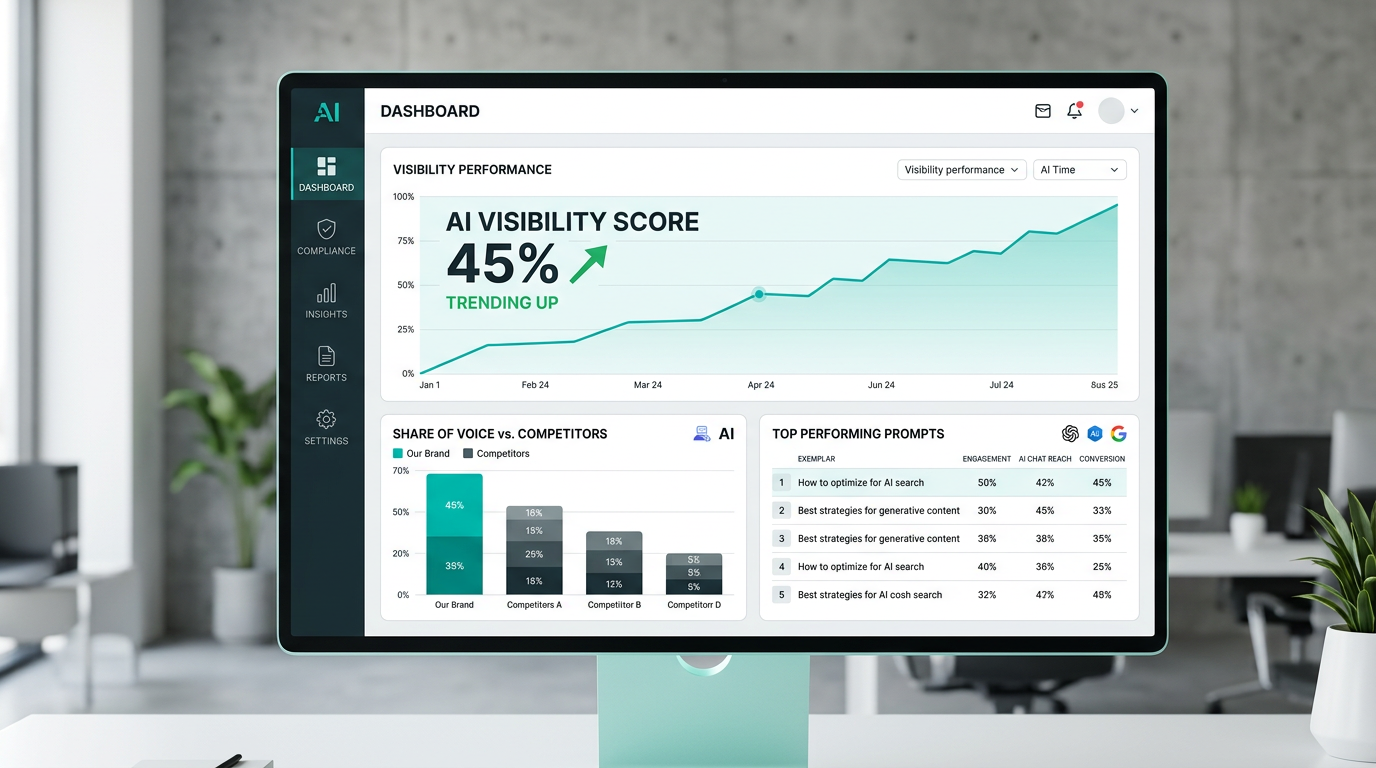
The Strategist's Toolkit: Platforms for Tracking AI Mentions
Manually prompting AI models day after day simply isn't scalable or scientific. As the importance of AI visibility grows, a new category of specialized software has emerged to automate the process and provide strategic insights. Relying on spreadsheets and manual checks is a recipe for missed opportunities and burnout.
Choosing the right tool depends on your specific needs, whether it's deep competitive analysis, real-time speed, or integration with your existing marketing stack. These platforms are leading the charge in 2026.
Specialized Platforms: Sanbi.ai and Profound
For laser-focused AI visibility tracking, specialist tools offer the most detailed data. Sanbi.ai, for instance, is built exclusively for this challenge. It automates prompt testing across ChatGPT, Claude, and Perplexity, synthesizing the data into visibility scores, source analysis, and competitor benchmarks. Many brands start with their free audit to get a quick, eye-opening snapshot of their current AI invisibility.
If speed is your primary concern, Profound is a strong contender. It offers real-time alerts when your brand or competitors are mentioned, allowing you to react quickly to market shifts. Starting around $74/month, it's an accessible way to monitor which of your web pages are influencing AI responses, providing direct feedback on your content's effectiveness.
Integrated Suites: Semrush One
For larger teams who need to connect AI visibility to broader marketing KPIs, an integrated suite like Semrush One makes a lot of sense. The platform now tracks brand mentions within major LLMs like ChatGPT and Perplexity, tying that data directly to metrics like share of voice. The key advantage is seeing everything in one place, allowing you to correlate a drop in AI citations with a change in organic traffic to diagnose problems more holistically.
The choice is strategic. A dedicated GEO team might prefer the depth of Sanbi.ai, while a CMO may favor the integrated reporting of Semrush One to justify budget and show cross-channel impact.
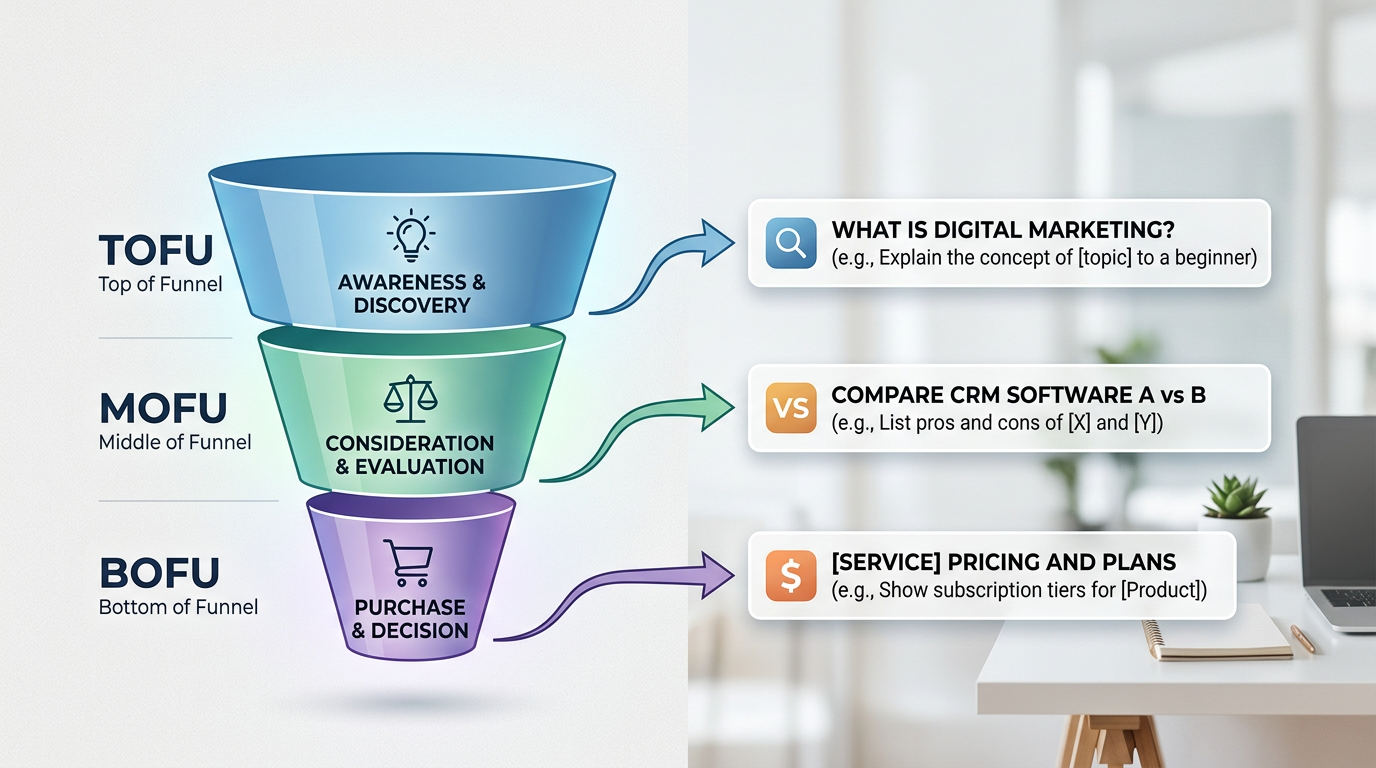
Beyond Mentions: Mapping Prompts to the Buyer Funnel
Simply tracking mentions isn't enough. The most advanced strategists are going a level deeper. They are mapping prompts to specific stages of the buyer journey to find content weaknesses that traditional SEO could never reveal.
Think about the different kinds of questions people ask. A top-of-funnel (TOFU) prompt is informational, like "what is generative engine optimization?" A middle-of-funnel (MOFU) prompt is for comparison, such as "compare AI visibility tracking tools." A bottom-of-funnel (BOFU) prompt is transactional, like "Sanbi.ai vs Profound pricing."
Your visibility might be great for broad TOFU queries but completely absent for critical BOFU queries. This indicates your high-intent, bottom-funnel content isn't structured for AI consumption. You are losing customers at the final step, and your rank tracker won't tell you a thing. Analyzing these gaps is a core discipline, and you can find a complete 2026 guide to tracking AI tool visibility that covers this process in depth.
Once you find a gap, the fix is targeted. For example, a BOFU visibility problem often points to a lack of structured data. We've found that implementing specific schema, like `Product`, `FAQPage`, and `HowTo` markup on key product and pricing pages, can lead to a 20-30% uplift in citations, especially within Claude and Perplexity. These AIs crave unambiguous data about features and costs to form confident answers.
A TOFU gap, on the other hand, might require you to publish more comprehensive, authoritative guides. The response is tailored to the problem. This level of analysis turns a simple tracking exercise into a powerful content strategy tool.
Forgetting AI visibility is no longer an option; it's the new measure of digital relevance. Start today. Take your five most important bottom-funnel customer questions and manually test them in ChatGPT. The results will likely be sobering, but they will also give you a very clear, urgent place to begin.
If the gaps you find seem overwhelming, our team is here to help build a winning AI visibility strategy. You can always talk to our geo specialists to translate audit findings into a powerful action plan.