landing page cro in 2026: ditch the art, build the machine
in 2026, cro is no longer about static design; it's about performance engineering. this is our guide to treating landing pages as data-driven systems to achieve elite conversion rates.

Let's start with a brutal fact. Mobile devices drive around 83% of your landing page traffic, yet they convert at roughly half the rate of desktop. That isn't just a small leak. It's a gaping hole in your revenue strategy, and generic best practices won't fix it.
For years, marketers have treated landing pages like digital brochures. We polish the design, follow a checklist, and hope for the best. That approach is dead. In 2026, winning at conversion rate optimization (CRO) means shifting your mindset entirely.
Welcome to Post-Click Performance Engineering. It’s about treating your landing pages not as static art, but as living, data-driven systems designed for one purpose: to convert. We aren't decorators. We are systems engineers for the post-click experience, using a disciplined process of diagnostics, ruthless prioritization, and continuous learning.
The Diagnostics-First Mandate: Stop Guessing, Start Measuring
Best practice lists are where good intentions go to die. Every audience is different. Every traffic source has unique user intent. Applying generic advice is a recipe for mediocrity.
A professional approach always begins with diagnostics. Before you change a single pixel, you must understand the existing problems with forensic clarity. What's your current conversion rate? If it’s not near or above the top-quartile benchmark of 11.45%, you have significant, tangible room for growth.
Start inside Google Analytics 4. GA4 is your toolkit for finding the real leaks. Don't just look at the overall conversion rate. Build a funnel exploration report to precisely measure the drop-off between key stages. How many users land versus start the form? How many who start the form actually submit it? Segment this by device. A huge drop-off on mobile before the form is even touched points to a page experience problem, not a form problem.
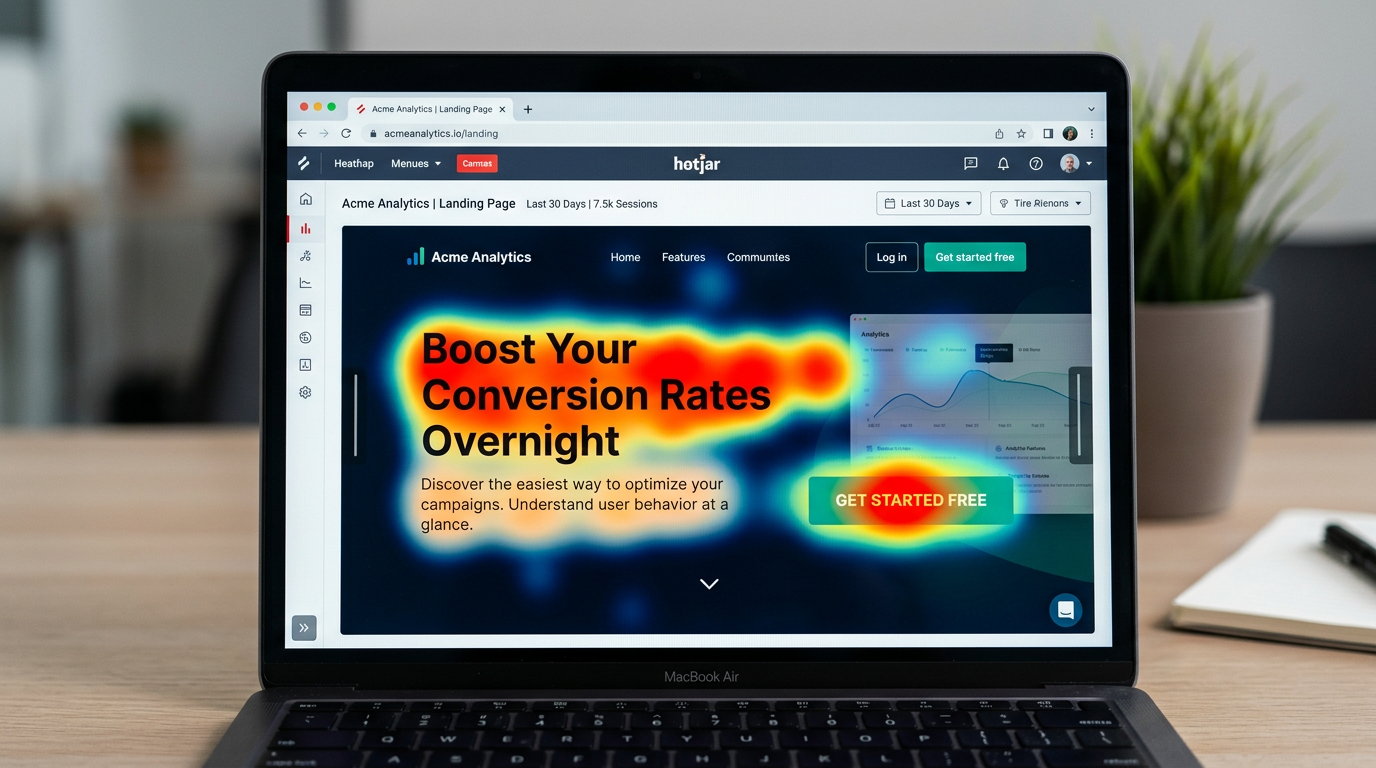
GA4 gives you the 'what,' but qualitative tools give you the 'why'. This is where platforms like Hotjar are indispensable. Your immediate goal should be to watch at least 20 session recordings for any high-traffic landing page. You’ll see exactly where users get confused, where their cursors hesitate, and what makes them leave. For example, maybe 10 out of 20 mobile users frantically scroll up and down, then bounce. That's a clear signal your value proposition is buried or your layout is confusing on a small screen. This is how real hypotheses are born.
Ruthless Prioritization: Why Not All Tests Are Created Equal
Once you have a list of problems and ideas, it’s tempting to start with the easiest fixes. This is a trap. Effective CRO requires a systematic way to prioritize your experiments to ensure you’re always working on the highest-impact tasks.
A simple but powerful framework for this is PIE: Potential, Importance, and Ease. You score each test idea on a scale of 1 to 10 for each category.
Potential measures how much improvement you expect from the change. Tweaking a button color might have low potential, while rewriting a weak headline has very high potential. Importance refers to the value of the page; optimizing your primary checkout page is far more important than a low-traffic blog page. Ease is about the cost in time and resources. A headline change is easy. A full page redesign is not.
Create a simple spreadsheet, score your ideas, and sum the scores. The highest-scoring ideas are your top priorities. This disciplined process prevents you from wasting weeks on low-impact tests and forces you to confront the big, needle-moving opportunities. It transforms your optimization efforts from a random walk into a strategic assault on your biggest problems.
Mastering the First Impression: Your 5-Second System
You have about five seconds. That's it. In that time, a visitor must know they're in the right place, understand what you offer, and feel compelled to learn more. Your above-the-fold content isn't just a part of the page. It's a mini-funnel all its own, and it's your highest-leverage area.
Optimizing this compact system should be your obsession. Research shows that headline optimization alone can drive conversion lifts up to 250% or 300%. The system works when five elements are in perfect sync. The Headline must instantly connect with the ad they just clicked and state the core value. The Sub-headline then elaborates, adding a key benefit or critical detail.
Next, you need instant trust, which is where Social Proof comes in. A customer quote, star rating, or row of client logos works wonders. Your Call-to-Action (CTA) must be unmissable, with clear, action-oriented text. Finally, good systems proactively address fears with FUD-Reduction elements, like text that says “No credit card required” or “Trusted by 50,000 users.”
When this five-second system fires on all cylinders, you earn the right to ask for the scroll. It’s why shorter pages built around a single, clear message consistently outperform long, unfocused pages by 13% to 15%. Nail the hook, and the rest of the page gets a chance to work.
The 2026 Goldmine: Mobile Experience and Form Friction
Let’s return to the mobile conversion gap. It’s the single largest opportunity for most businesses in 2026, and it’s almost entirely a user experience problem. What works on a 27-inch monitor often fails completely on a 6-inch vertical screen held in one hand. Your approach must be aggressively mobile-first, not just mobile-responsive. This often requires dedicated website development focused on performance and usability.
This means obsessing over speed and designing for the thumb. Are your primary buttons and interactive elements within the natural arc of a user's thumb? Is text large enough to be read without pinching? Every piece of friction you remove prevents a potential exit.

Once you get them to the offer, the form is your final boss. Form friction is a notorious conversion killer, but fixing it is an absolute goldmine. Recent case studies show that improving form design can produce conversion lifts of up to 120%. Think beyond simply reducing the number of fields.
Instead, engineer a frictionless process. Use multi-step forms with progress bars to break up long requests into manageable chunks; this reduces cognitive load and builds momentum. Go further by enabling social logins, implementing slick inline validation that gives real-time feedback, and setting up browser autofill correctly. Each tiny improvement removes a reason for someone to abandon ship seconds before they convert.
From Isolated Tests to a Strategic Feedback Loop
A test isn't just about finding a winner. It's about learning. An experiment that loses can be just as valuable as one that wins, as long as you understand the 'why.' This is the final and most crucial step: turning isolated tests into a strategic feedback loop that benefits the entire organization.
Document every result in a central knowledge base. Why did headline A beat headline B? Did users respond to appeals to security, or to speed? Platforms like OptiMonk make testing and personalization more accessible, but the learning is your responsibility.
This is how you build a powerful learning engine. Say your tests reveal that landing page visitors for a fintech product respond better to messaging around 'simplicity' than 'power'. That's not just a CRO win. That insight should immediately be fed to your ad team to test in their copy, and your content team should explore it in new articles. This cross-department learning is what our seo agency considers a cornerstone of mature digital strategy.
A great post-click experience also pleases the platforms themselves. A fast, relevant, and helpful page is precisely what Google's guidance on landing page experience rewards, which directly impacts your Ad Quality Score and costs. The holistic marketing services we provide are built around this philosophy of interconnected systems.
Your landing page is the final, critical yard in your acquisition strategy. Treating it with the discipline of an engineer separates the brands that struggle from the ones that scale. Start by auditing your most important landing page today. If you want a team of performance engineers to help you find and fix the leaks, book a strategy call with us.