next.js vs. react vs. vite: which to choose for your web app
should you use next.js or a lean react and vite stack? the best choice depends entirely on the type of application you're building: a public site, a saas dashboard, or something in between.

Plenty of developers still use React. According to recent Stack Overflow data, a massive 42.6% of professional developers choose it for their projects. But the conversation has moved beyond just the library itself. The real question in 2026 isn't if you should use React, but how.
This isn't just an abstract technical debate. The stack you choose directly impacts your budget, your team's velocity, and your ability to attract customers. Get it right, and you build a foundation for growth. Get it wrong, and you're staring down a costly rewrite in two years.
The debate between a meta-framework like Next.js and a leaner combination like React with Vite isn't about a simple list of features. It's about philosophy. It's about what you are trying to build. Forget the feature-by-feature comparison sheets; the smartest way to decide is to first define your application's archetype.
The Real Question: What's Your App's Archetype?
Picking a frontend stack based on ideology is a recipe for technical debt. Instead, you have to start with your business goals and the shape of the final product. Is it a public-facing site where search engine visibility is everything? Or is it a password-protected tool for a specific group of users?
Most web applications fall into one of a few key categories, and your choice of tools should follow from this decision.
- Public, SEO-Driven Sites: Think marketing websites, blogs, and news platforms. First impressions and search engine crawlability are non-negotiable.
- Hybrid or E-commerce Apps: These blend static content (product pages) with dynamic, authenticated sections (user accounts, checkout). They need the best of both worlds.
- Authenticated Single-Page Apps (SPAs): This is the world of SaaS dashboards, complex data analysis tools, and project management software. Rich interactivity and client-side performance are king.
- Internal Tools and Prototypes: Here, speed of development and simplicity often matter more than perfectly optimized production builds.
Framing the decision this way moves the discussion from abstract technical arguments to concrete business outcomes. It forces you to prioritize what actually drives value for your specific use case, a core principle of effective software development services.

When Next.js is Your Default Winner
For any public-facing application where organic traffic matters, Next.js is the undisputed champion. It's not even a fair fight. The framework is designed from the ground up to solve the biggest challenges of modern, content-heavy websites that need to perform at scale.
Its power comes from its hybrid rendering model. With Server-Side Rendering (SSR) and Static Site Generation (SSG), Next.js delivers pre-built HTML pages to the browser. This means lightning-fast initial page loads and perfectly indexable content for search engines, two areas where our seo services team focuses intensely for clients.
The market has clearly voted with its feet. One 2026 industry tracker reports over 201,000 active domains running on Next.js, powering an incredible 2.6% of the entire internet. We're talking about heavy hitters like TikTok, Hulu, and Shopify who can't afford to compromise on performance or scale.
Next.js is more than just a renderer; it's a full-stack framework. File-based routing, built-in image optimization, middleware, and API routes are all included out of the box. This opinionated structure reduces decision fatigue and streamlines development, especially for complex projects.
When you pair Next.js with a hosting platform like Vercel, which is built by the same team, you get a seamless path from development to deployment. This tight integration is a massive tactical advantage. You get automatic CI/CD, preview deployments for every pull request, and optimized serverless functions for API routes, removing a whole class of DevOps headaches.
However, this opinionated nature can be a double-edged sword. For teams with highly specific architectural needs or a strong desire to control every piece of the build process, Next.js can sometimes feel restrictive. If your project deviates from the 'Vercel way' of doing things, you might occasionally fight the framework instead of working with it.
The Case for a Leaner Stack: React + Vite
So where does that leave a pure React and Vite setup? It shines brightest when you're building applications that live primarily behind a login screen. Think authenticated dashboards, SaaS products, advanced customer portals, and internal tools.
For these Single-Page Applications (SPAs), the SEO benefits of Next.js are often irrelevant. What matters most is the developer experience and the perceived speed once the user is inside the app. This is where Vite is an absolute powerhouse. It's not a framework, but a modern build tool that offers a jaw-droppingly fast development server and Hot Module Replacement (HMR).
Your code changes appear in the browser almost instantly. This tight feedback loop dramatically increases developer velocity. For authenticated apps, the initial page load is a one-time cost, so the focus shifts to a snappy Time to Interactive (TTI) and fast performance during complex user interactions.
This path gives you ultimate flexibility. This 'bring your own toolkit' approach means you can assemble a best-in-class stack tailored to your exact needs. You're free to pull in trusted libraries like React Router for navigation, Zustand for lightweight state management, or TanStack Query for sophisticated data fetching and caching.
When it's time to deploy, the world is your oyster. A Vite-built React app compiles down to simple static files, which can be hosted on virtually any modern platform. Services like Netlify, Cloudflare Pages, or even a classic AWS S3 bucket with CloudFront are excellent, cost-effective choices. Given React still commands a huge market share, knowing how React fits in the frontend ecosystem provides critical context. Its vast talent pool also makes it a popular foundation for mobile app development via React Native.
The Lines Are Blurring: What 2026 Looks Like
The old battle lines are starting to fade. The tooling is converging, and the smartest development teams are borrowing ideas from both camps. Picking a stack today is less about a lifelong commitment and more about choosing the right starting point for the job at hand.
The React Compiler Changes the Game
One of the most significant developments is the integration of the React Compiler into both the Next.js and Vite ecosystems. This experimental tool promises to automatically optimize React components by default. It aims to eliminate the need for developers to manually wrap functions in `useCallback` or values in `useMemo` to prevent re-renders.
The goal is to provide highly performant code with less manual effort. This innovation narrows the runtime performance gap between different stacks and, just as importantly, reduces developer boilerplate and cognitive load.
Hybrid Architectures: Don't Choose, Combine
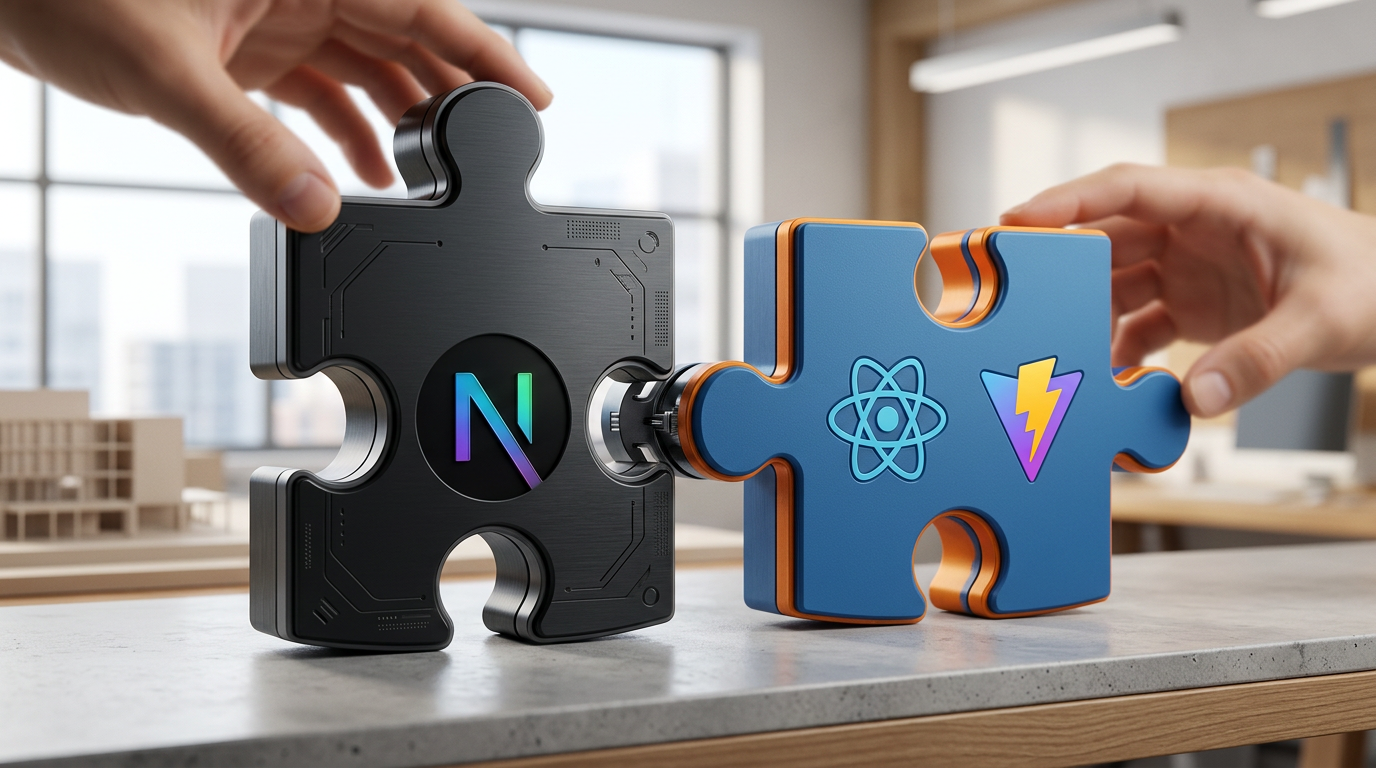
The most sophisticated teams are moving beyond an 'either/or' mindset. They are adopting hybrid strategies, often within a monorepo powered by a tool like Turborepo. In this model, you can get the best of both worlds without compromise.
Imagine this scenario. Your public marketing site at `www.yourcompany.com` is a blazing-fast Next.js application, perfectly optimized with SSG for SEO and content. When a user logs in, they are seamlessly directed to `app.yourcompany.com`, which is a completely separate React + Vite SPA, built for complex data visualization and interactivity. Both apps can import components from a shared UI library, ensuring brand consistency while using the ideal rendering strategy for each distinct part of the business.
Your App, Your Choice
Ultimately, there's no single 'best' tool. There is only the best tool for your job. Start by defining your application's primary purpose. Is it for the public web or a private group of users? Is success measured in search rankings or in-app task completion speed?
Answering those strategic questions first will make your technology choice obvious. Stop the endless framework debates and focus on the architecture that best serves your users and your business goals. When you're ready to translate that vision into a concrete plan, it may be time to start your project with an experienced technical partner.