one brain, two channels: unify your web & whatsapp chatbots
tired of disjointed customer experiences? ditch the separate website and whatsapp bots. it's time to build a single, intelligent ai service layer that powers both.

Most brand chatbots are a disjointed mess. The little widget on the website barely knows what the automated responses on WhatsApp are doing. This fragmentation creates terrible user experiences, erodes customer trust, and doubles your team's workload. It’s a broken model.
The solution isn't to build slightly better individual bots. It's to stop building channel-specific bots altogether. The future of AI chatbot development services is about creating one single, intelligent service layer and pointing your different customer channels, like your website and WhatsApp, directly at it.
This is service-architecture thinking. Design once, deploy twice. It’s the only way to win.
The Ground Shift to Conversational AI is Already Complete
This isn't a future trend; it's a present-day reality driven by staggering user adoption. WhatsApp isn't just a messaging app anymore. With over 3.3 billion monthly active users as of early 2026, it is the primary conversational surface for a huge portion of the planet, projected to reach 3.5 billion by year's end.
Customer behavior has already adapted. Gartner predicts that by 2028, a staggering 70% of all customers will start their service journey with a conversational AI interface. In WhatsApp-dominant regions like LATAM and India, that future arrives even sooner, around 2027. Your audience doesn't just prefer this, they now expect it.
For business leaders, 2026 marks the end of the pilot program. After a 2025 where 85% of customer service leaders explored generative AI, the focus is now squarely on scaled, enterprise-wide implementation. The chatbot market is exploding from $11.45 billion in 2026 to a projected $32.45 billion by 2031 because it is now treated as core business infrastructure, not a side project.
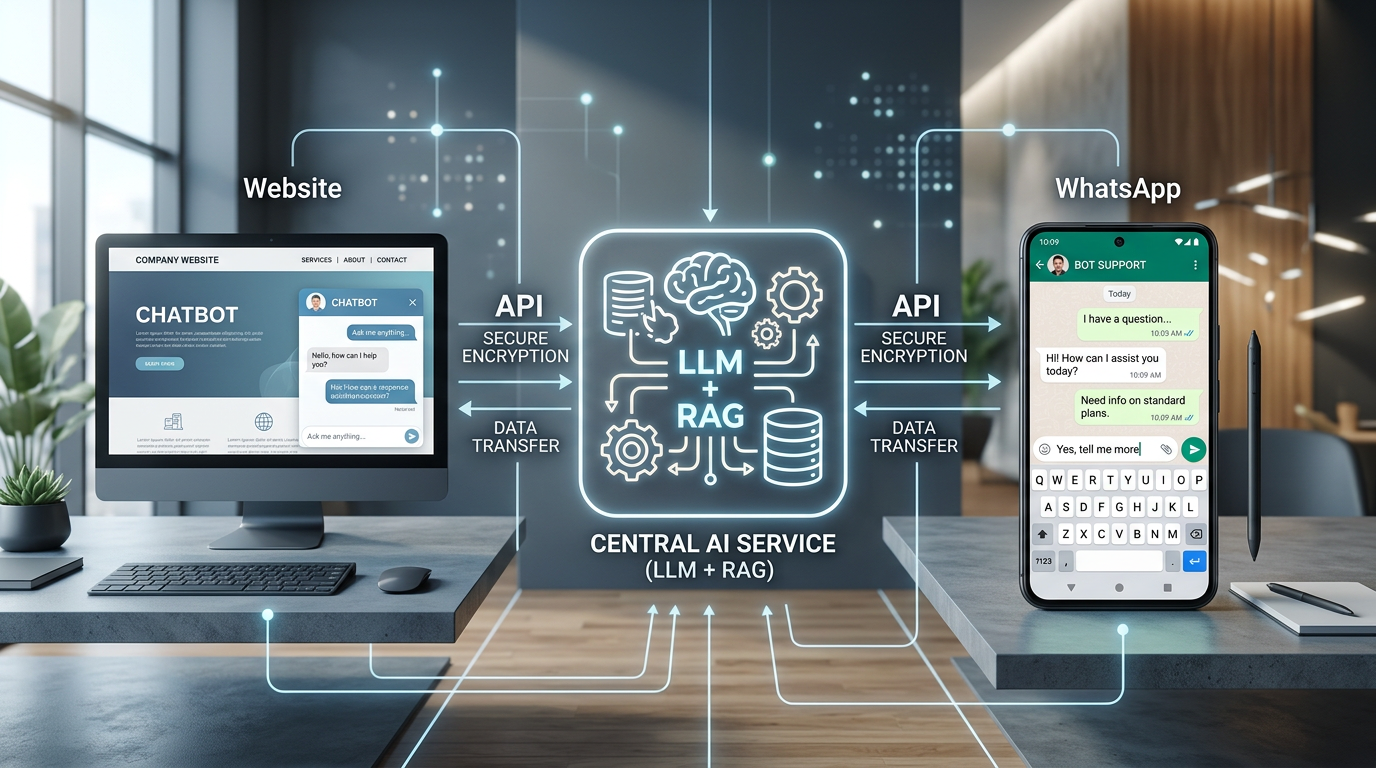
Stop Building Two Bots. Build One Central Intelligence.
The old approach was logical but painfully inefficient. You needed a web chatbot, so you procured a tool. Then you needed a WhatsApp bot, so you wired up another one. Suddenly you’re paying for two systems, maintaining two knowledge bases, and trying to reconcile two completely different sets of analytics. It's a recipe for technical and brand debt.
This is where a profound strategic shift is required. Think like a system architect. Your AI, the brain that understands intent and retrieves answers, must be a centralized service. Your website and your WhatsApp Business account are simply front-end channels that connect to this single, powerful core.
When you unify the backend, you create a consistent, intelligent presence everywhere. You compound results instead of fragmenting them. Look at Nissan’s verified WhatsApp channel. They used an AI-powered bot to drive a 138% increase in leads and a 71% jump in unique users. Now, imagine achieving that and knowing the exact same intelligence is also serving your highest-intent website visitors.
The Architecture of a Unified AI Chatbot Service
How does this work in practice? A unified model isn't just a concept; it's a tangible architecture built from distinct, interconnected components. Executing this requires a deep understanding of ai automation services and disciplined system design.
The Core AI Brain: LLM + RAG
At the heart of the service is a Large Language Model (LLM) supercharged with Retrieval-Augmented Generation (RAG). RAG is the critical technology that grounds the AI in your company’s private, up-to-the-minute information. It connects the bot to your product catalog, shipping policies, and internal knowledge bases, ensuring it gives accurate, context-aware answers instead of generic guesses.
Think of the LLM as a brilliant but amnesiac intern. RAG is the ever-present, perfectly organized binder of your company's proprietary data. This RAG-powered approach is why modern AI agents deliver 14% to 30% productivity gains for support teams, according to recent studies. The performance lift is so significant that operations leaders now see it as mandatory for any team of ten or more agents.
Channel-Specific Front-Ends
While the brain is unified, the interface must be native to its channel. A website chatbot can leverage rich graphical elements, interactive calendars, and embedded forms. It lives in a visually flexible environment that you control.
A WhatsApp bot, however, must work within the constraints and opportunities of the Meta aPI. This means leveraging features like quick-reply buttons, list messages, and managing the 24-hour customer service window for outbound notifications via pre-approved templates. The beauty of the unified architecture is that both front-ends are powered by the same backend logic, knowledge base, and user history.
A Single Point of Handoff
One of the most powerful results of a unified system is seamless handoff logic. Imagine a user starts a query on your website, gets interrupted, and then re-engages on WhatsApp an hour later. With a unified service, the AI maintains the context of that conversation across channels.
Then, if the user needs to speak to a human, the bot can escalate them to an agent in a platform like Trengo. That agent doesn't see a fragmented history. They see one continuous conversation thread from both web and WhatsApp, complete with a helpful AI-generated summary of the issue. This level of cohesion often requires expert custom software development to integrate the APIs and ensure data flows perfectly.
Key Platforms for Deployment
Putting this all together requires the right tools. For WhatsApp, the entire conversation begins and ends with the official Meta WhatsApp Business Platform. It's the only path to a production-grade, scalable, and verified chatbot. For the central AI service itself, developer-centric platforms like Botpress provide the open-core environment needed to build highly customized AI logic designed to serve multiple channels. To manage the human side, an omnichannel conversational platform like Trengo creates a single inbox for agents to handle escalated chats from the web, WhatsApp, Instagram, and more.

The Strategic Wins: Why a Unified Approach Pays Off
Adopting a unified architecture isn't just a cleaner technical choice. It's a business strategy with clear, measurable advantages that create a durable competitive moat.
Radical Cost Efficiency Through Model Tiering
Managing one intelligent system is fundamentally cheaper than managing five dumb ones. You update one knowledge base, not many. More critically, a unified architecture enables sophisticated cost control via “model tiering.” You can use a fast, inexpensive AI model for 80% of your simple queries and reserve a powerful, costly model like GPT-4 for the 20% of complex, multi-step tasks. This centralized control optimizes your spend as you scale.
Unbreakable Brand Consistency and Analytics
With a single source of truth, a customer gets the same answer, in the same brand voice, whether they ask on your website or on WhatsApp. This consistency is a primary driver of trust and adoption, as outlined in many expert guides on AI chatbot development. When users can rely on your bot, they use it more. Your analytics also live in one place, giving you a true 360-degree view of customer needs across all touchpoints.
Future-Proofing Your Entire Customer Experience
This model is built for what comes next. Once your central AI service is driving your website and WhatsApp, adding another channel like Instagram DMs or Facebook Messenger becomes exponentially easier. You’re simply building a new front-end adapter, not a whole new brain from scratch. This is the foundation for a truly connected customer journey. It can even be extended to automate communications for sophisticated campaigns, like fielding real-time questions during an ai influencer marketing launch.
Stop thinking about building a chatbot. It's time to build a central intelligence for your brand's conversations. Investing in a unified AI service architecture is the most strategic, scalable, and customer-centric decision you will make this year. If you're ready to design the right system, let's talk about how to automate your workflow and ensure it’s done right the first time.