paid ads vs. organic seo: the small business budget guide
stop asking if paid ads or organic seo is better. for a small business, the real question is how to blend them to manage cash flow now while building a valuable asset for later.
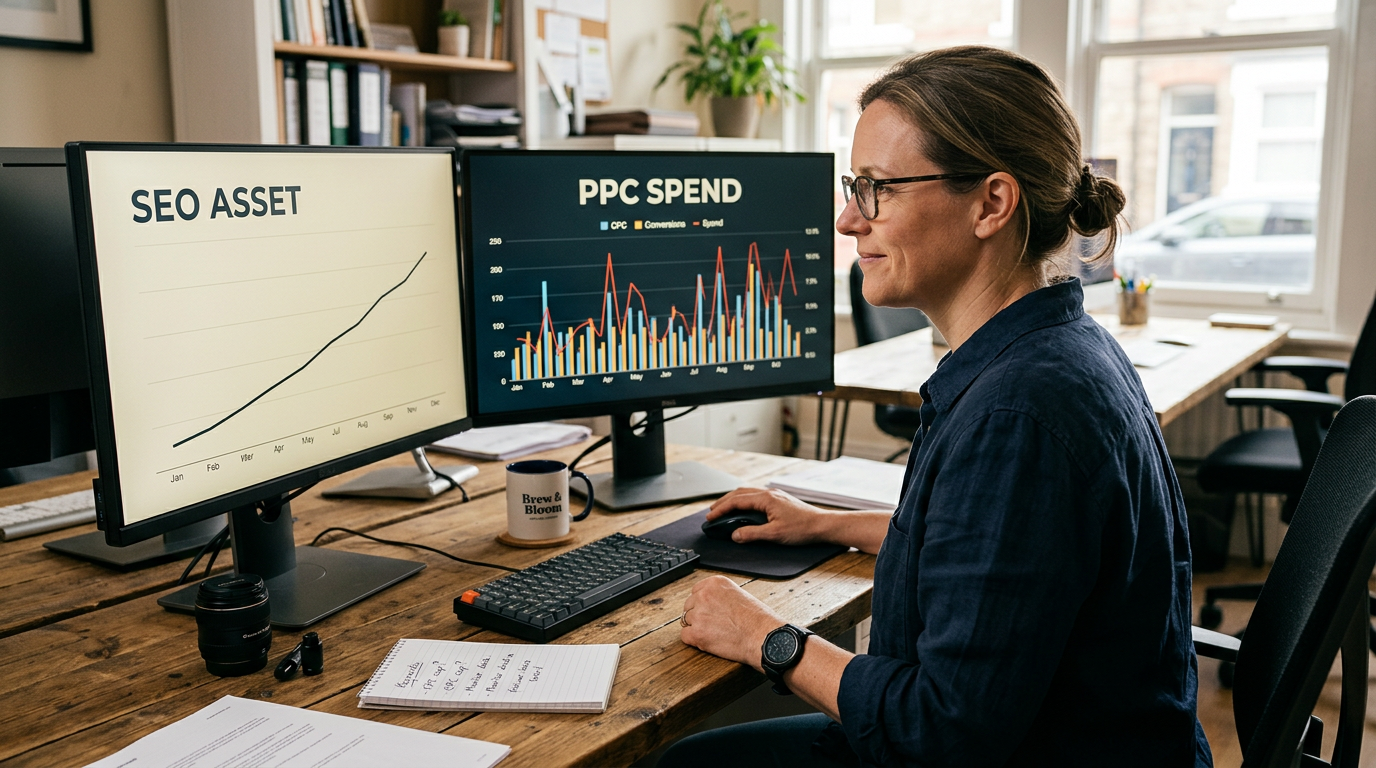
Here’s a number that should make any small business owner pause. Even in 2025, with search pages crowded by ads, organic results still pull in a staggering 55% to 65% of all clicks. Paid ads fight over the remaining slice. So why does the debate over paid search versus SEO still rage on?
It’s because we’re asking the wrong question. The real issue isn’t “which one is better,” but how you should blend them based on your business stage. It's a classic financial tradeoff. One gives you speed. The other gives you an asset.
Think of it like this: paid advertising is renting an accelerator for your car. SEO is building a more powerful engine. One gets you down the road today, the other makes every future trip faster and cheaper. For a small business, getting that balance right is everything.
PPC as Rented Acceleration: When to Pay for Speed
Paid per click, or PPC, is your tool for compressing time. Specifically, the time it takes to get your first lead or sale. If you have a new offer, a seasonal promotion, or you’re an emergency service where customers need you right now, you can’t afford to wait for organic rankings to mature. You need to pay to play, and Google Ads is the biggest stadium.
This is about generating immediate cash flow. For high-intent local queries like “same-day AC repair,” paid ads are unmatched. They capture buyers at the precise moment of need. This is why you see so many home service, legal, and healthcare providers bidding aggressively.
But that aggression comes at a steep price. In many of those competitive local markets, average costs per click in 2025 are routinely hitting $10, $20, or even $30. For a small business, that kind of spending isn't sustainable for broad visibility. You must treat PPC as a surgical tool for acquiring specific, high-value customers, not as a blanket to cover the entire market.
The moment you stop paying, the acceleration stops. Your visibility drops to zero. That's why we call it rented.
SEO as Digital Equity: Building Your Long-Term Asset
Search Engine Optimization is a different game entirely. It’s not about renting space. It’s about building equity in a digital property that you own. Every piece of content you create, every backlink you earn, and every technical improvement you make becomes part of an asset that appreciates over time.
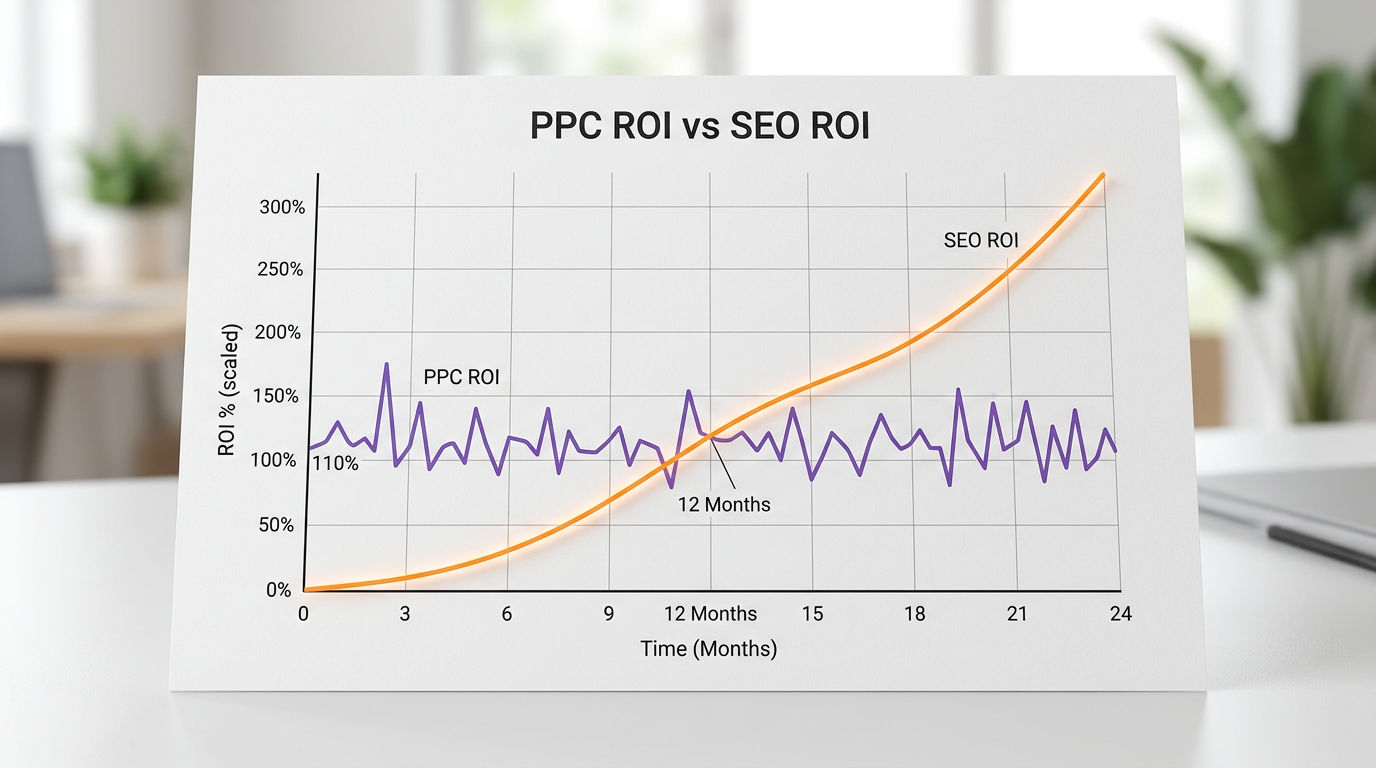
The initial work is front-loaded. You invest time and resources for months before seeing significant returns. But this is where the magic happens. Longitudinal analyses consistently show that after about 12 to 18 months, the ROI from SEO surpasses PPC. Your cost per lead doesn't just stabilize, it actively decreases as your rankings become durable.
This is your compounding advantage. The traffic you earn in month 24 from work you did in month 6 costs you nothing extra. It's the dividend payment from your digital asset. And leads generated from organic search typically have higher trust and better lifetime value. They found you through their own research, not because you flashed an ad. A good seo agency focuses on building this equity, not just chasing quick keyword wins.
You can track the growth of this asset directly inside Google Search Console. Watching your impressions, clicks, and keyword positions climb is like watching a portfolio grow. It proves the work is paying off.
The Hybrid Model: A Practical Budget Breakdown for Small Businesses
So, how do you balance the need for now-money with the wisdom of building a future asset? You create a hybrid strategy that evolves as your business grows. The optimal spend isn’t static. It changes depending on your budget and how much organic traction you have.
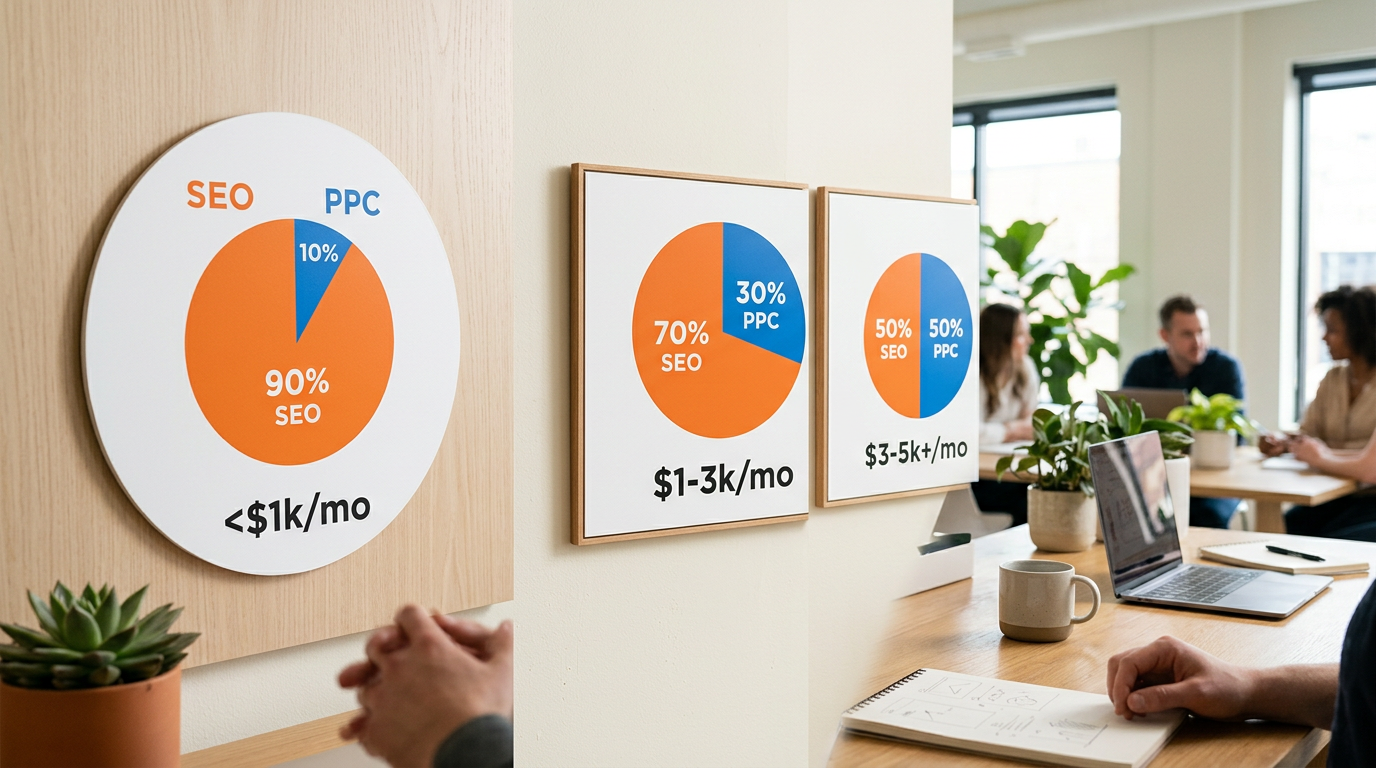
For most businesses spending under $5,000 per month, the consensus for 2025 is to lean heavily into SEO. A common recommendation is a 60% to 70% allocation to SEO and content, with 30% to 40% reserved for highly targeted PPC. Let's break that down into more specific tiers.
Tier 1: Under $1k per Month
With a very limited budget, your priority is survival and foundation. You can’t afford to burn cash on expensive clicks. The focus here should be almost entirely on SEO, perhaps a 90/10 split.
That 90% goes into foundational SEO: setting up your Google Business Profile correctly, building out core service pages, starting a simple blog with helpful local content, and ensuring your site is technically sound. The 10% for PPC? It might be just enough to run a micro-targeted campaign for your single most profitable service in your immediate zip code.
Tier 2: $1k - $3k per Month
This is the most common tier for growing small businesses, and where the dynamic split becomes critical. In months 1 through 12, start with that recommended 70/30 split. Seventy percent of your budget fuels a consistent content and link-building strategy, the engine of your SEO asset. The other 30% goes to Google Ads to target bottom-of-funnel keywords, generating crucial early revenue and customer data.
Then, around month 13, you reassess. Check Google Search Console. If your organic traffic and non-branded keyword rankings are showing consistent growth, it’s time to shift the ratio. You can throttle PPC back to 20% and reinvest that 10% into scaling what’s working in SEO, like creating more in-depth content or exploring adjacent topics like ai influencer marketing to promote your content.
Tier 3: $3k - $5k+ per Month
At this level, you have more flexibility to be aggressive on both fronts. For the first 6 to 9 months, a 50/50 split can work wonders. You can capture immediate market share with a robust PPC campaign while simultaneously making a serious investment in your long-term SEO asset. You're buying data and customers with PPC while building the engine that will replace that spend later.
After that initial push, you begin the strategic ramp-down of PPC to a 30% or 40% share of the budget. It doesn’t go away. Instead, it transitions to a supporting role: protecting branded keywords, running retargeting campaigns, and testing new offers. The bulk of your investment now flows into scaling the SEO asset that has proven its ability to generate leads. This is precisely the kind of channel ROI that platforms like HubSpot are built to measure, and current SEO vs PPC performance data validates this long-term approach.
Measuring Success: From Clicks to Customers
None of this strategy matters if you can't measure what's working. Success looks different for each channel. Stop focusing only on traffic and rankings. You need to connect your spending to actual business results.
For PPC, your KPIs are ruthless and financial. In Google Ads, you should live and die by your Cost Per Acquisition (CPA) and Conversion Rate. How much are you paying for a qualified lead, and is that number profitable? If not, you either fix the campaign or you turn it off.
For SEO, the metrics are about asset growth. Use Google Search Console to track the leading indicators: growth in organic impressions, improvements in click-through rate (CTR) for your target keywords, and an increase in valuable non-branded traffic. These show your equity is building, even before the leads pour in.
Ultimately, a CRM like HubSpot is what ties it all together. It allows you to track a customer from their first click, whether paid or organic, all the way to a closed sale. This is how a seasoned digital marketing agency proves value. It lets you answer the real questions: did our PPC spend generate enough immediate profit, and is our SEO investment successfully lowering our average cost per customer over time?
The choice between paid ads and organic SEO is a false one. The right answer is nearly always a strategic blend. The smartest small businesses use the rented speed of PPC to fund the owned equity of SEO. They create a system where today's ad profits are reinvested into the content engine that will fuel their growth for the next decade. Analyze your budget, define your timeline, and start building. If you're not sure where to start, you can always book a strategy call to get a second opinion.