patient journey seo for dentists: the 2026 playbook
generic seo for dentists is dead. learn the patient journey seo framework to attract high-intent patients, dominate local search, and build a predictable growth engine for your practice.

Almost every potential patient, 97% to be exact, starts their search for a new dentist or specialist online. Yet most dental practices are still using SEO tactics from five years ago. They are chasing broad keywords while their competitors are capturing patients before they even know they need an appointment.
The digital landscape for medical practices is brutally competitive. If your online presence isn't precisely tuned to patient intent, you’re not just losing clicks. You are losing high-value patients to the practice down the street. It’s a battle won not with bigger budgets, but with smarter strategy.
Why Standard SEO Fails Modern Dental Practices
For years, dental SEO meant stuffing a website with keywords like "dentist in [city]". That game is over. Google's algorithms have evolved far beyond simple keyword matching. Today, the search engine understands context, nuance, and, most importantly, user intent.
This is especially true for local searches coming from mobile devices. An incredible 78% of local mobile searches result in an offline visit within just 24 hours. These are not passive browsers. These are people with an immediate need, looking for a solution right now. Your website must meet that urgency.
The Algorithm Shift: From Keywords to Concepts
Think about how a real patient searches. They don't always start with "book dentist appointment". They start with a problem or a question. "Why is my tooth sensitive to cold?" or "safe way to whiten teeth". Google now connects these concepts, guiding users along a path.
If your digital marketing only targets the final booking keyword, you're missing the entire customer journey. You're showing up at the finish line, trying to compete against practices that have been building trust since the very first search. This is where a more sophisticated approach, Patient Journey SEO Mapping, becomes essential.
Mastering Patient Journey SEO: From Symptom to Appointment
Patient Journey SEO is a framework for structuring your entire digital presence around the questions and needs of potential patients at every stage. You map your content directly to their path, from a vague symptom to the moment they book an appointment. It's about anticipating demand, not just reacting to it.
This methodology moves beyond one-off keywords and builds a content ecosystem that answers questions, builds authority, and naturally guides users toward your services. By anticipating what they'll ask next, you create a seamless and persuasive experience.
The Awareness Stage: Capturing Symptom-Based Searches
This is the top of your funnel. Patients here have a problem, but they might not have a solution. They use search terms like "tooth pain relief," "bleeding gums when brushing," or "what to do for a chipped tooth." Your goal is to be the first, most helpful answer they find.
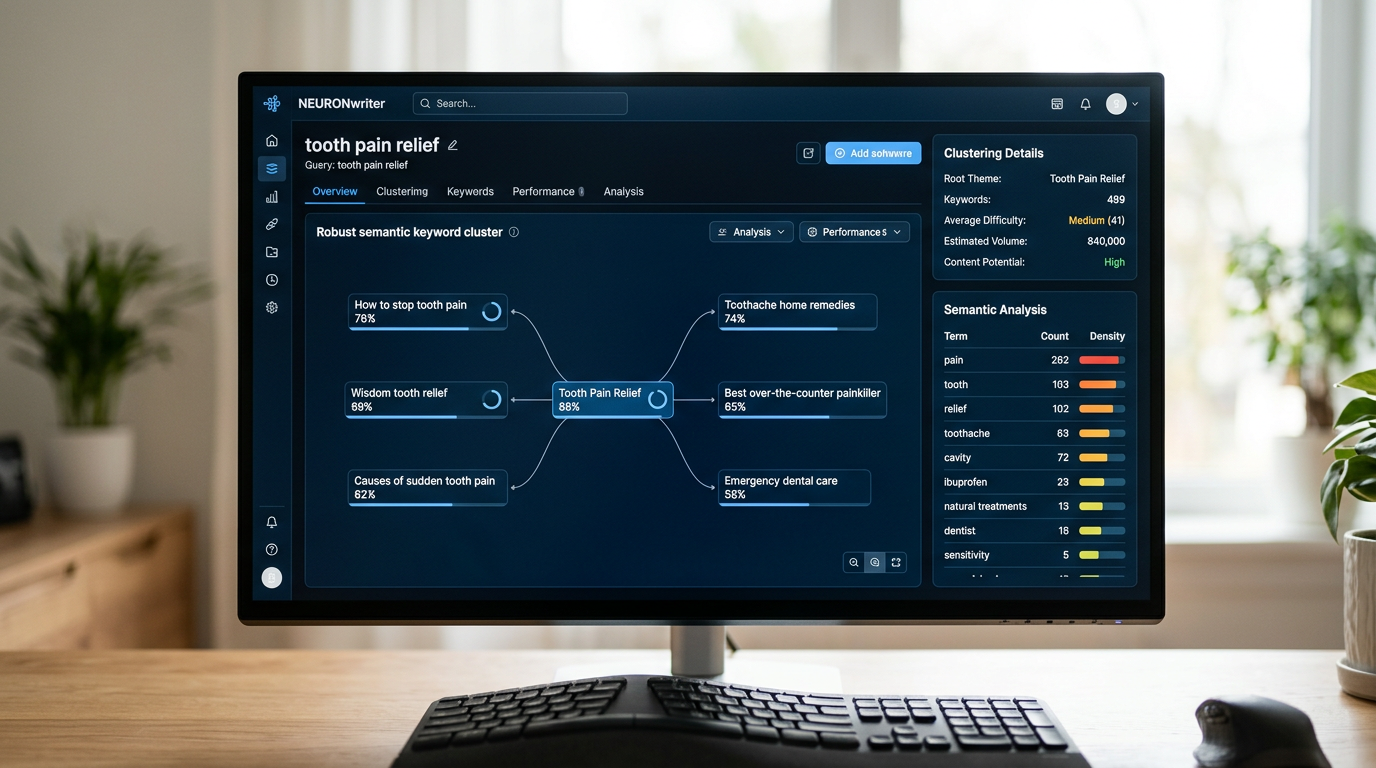
Creating blog posts or guides that address these symptoms positions your practice as a trusted authority, not just a service provider. These pages should be informative and reassuring, subtly introducing your practice as the expert solution. Modern tools can even help group these keywords semantically, ensuring your content covers the topic completely.
The Consideration Stage: Highlighting Treatment Options
Once a patient understands their problem, they start researching solutions. Their searches become more specific. Think "dental implants vs bridges," "cost of Invisalign in [city]," or "best cosmetic dentistry options."
Your website needs dedicated pages that compare treatments, explain procedures, and address cost and recovery. These pages must be comprehensive and transparent. This is also where a well-built custom website shines, allowing for clear layouts, comparison tables, and embedded videos that educate and persuade. Strong internal linking should guide users from your awareness-stage blog posts directly to these deeper treatment pages.
The Conversion Stage: Driving High-Intent Bookings
This is the final step, where intent is highest. Searches are direct and transactional: "emergency dentist near me," "dental implants [city]," or "book dental cleaning." These are the money-making keywords, but they are only effective if you've done the work in the prior stages.
Your conversion pages must be flawless. They need prominent contact information, simple booking forms, and powerful social proof like patient testimonials. Every second of friction here can cost you an appointment. This is where all your hard work pays off.
The Technical Foundation for Local Dominance
A brilliant content strategy is worthless if your website's technical foundation is cracked. You can write the best article on dental implants, but if your page takes five seconds to load on a phone, that high-intent patient is gone forever. Technical SEO isn't an option; it's the platform upon which all patient acquisition is built.
When implemented correctly, solid technical fundamentals can single-handedly lead to 20-30% higher visibility for your most important treatment and service pages. It's truly a non-negotiable part of the process.
Google Business Profile: Your Digital Front Door
Your Google Business Profile (GBP) is arguably your most important local SEO asset. It's often the very first interaction a potential patient has with your practice, appearing in the Google Map Pack and local search results. Optimizing it is not a one-time task.
A fully optimized profile includes high-resolution photos of your team and office, a steady stream of recent patient reviews (and your responses to them), a completed Q&A section, and a detailed list of your services. This profile is your digital storefront, and it needs constant attention to dominate the local competition.
Schema Markup: Speaking Google's Language
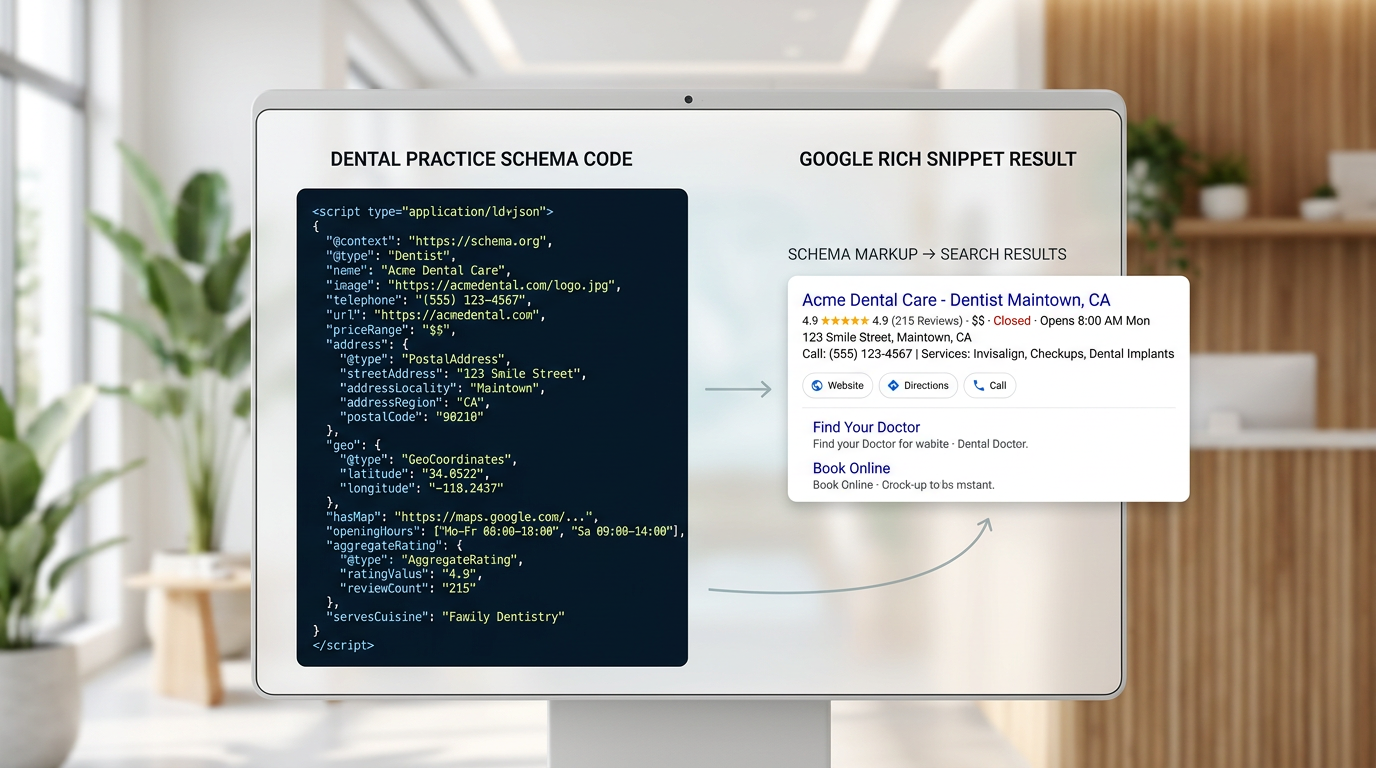
Schema markup is a specific code vocabulary you add to your website to help search engines understand your content more deeply. Instead of just seeing text on a page, Google can identify your address, hours, services offered, and accepted insurance plans.
Using `Dentist` and `LocalBusiness` schema types is critical. This structured data is what fuels the rich snippets you see in search results, like review stars and appointment buttons. It directly tells Google's AI who you are, what you do, and why you are relevant for a local search, making it a cornerstone of effective ai search optimization.
The Role of AI in Future-Proofing Your Practice
AI is transforming SEO from a reactive guessing game into a predictive science. Instead of just looking at historical keyword data, AI-powered tools can analyze competitor strategies, identify content gaps, and build entire content briefs aligned with the patient journey.
Tools like NEURONwriter allow an seo agency to map out entire keyword clusters based on user intent, ensuring that the content you create is precisely what your audience is searching for. It moves the process from art to science. As noted in many professional publications, current dental SEO strategies are rapidly adopting AI-driven content optimization to keep pace with Google's own advancements.
This approach allows you to systematically build authority for entire topics, not just individual keywords. You can predict patient needs and create the content to meet them before your competitors even know what's happening. It’s about building a content moat around your practice.
Your Next Step: From Strategy to Patients
Moving from a generic, keyword-focused strategy to a Patient Journey SEO model is the single most impactful shift a dental practice can make in its marketing. It aligns your business goals directly with patient needs. You stop chasing rankings and start building a predictable system for patient acquisition.
This isn't a simple, set-it-and-forget-it process. It requires deep strategic insight, technical expertise, and a commitment to creating genuinely helpful content. It's a fundamental change in how you view your website, from a digital brochure to your most powerful growth engine.
If you're ready to build a system that attracts a steady stream of high-intent patients, the next step is to see how this framework could work for you. You can get a free consultation to map out a strategy tailored specifically to your practice and your growth goals.