pwa vs. native: the smart choice for small business
is a progressive web app or a native mobile app better for your business? the answer isn't about technology. it's about whether you need to acquire customers or retain them.
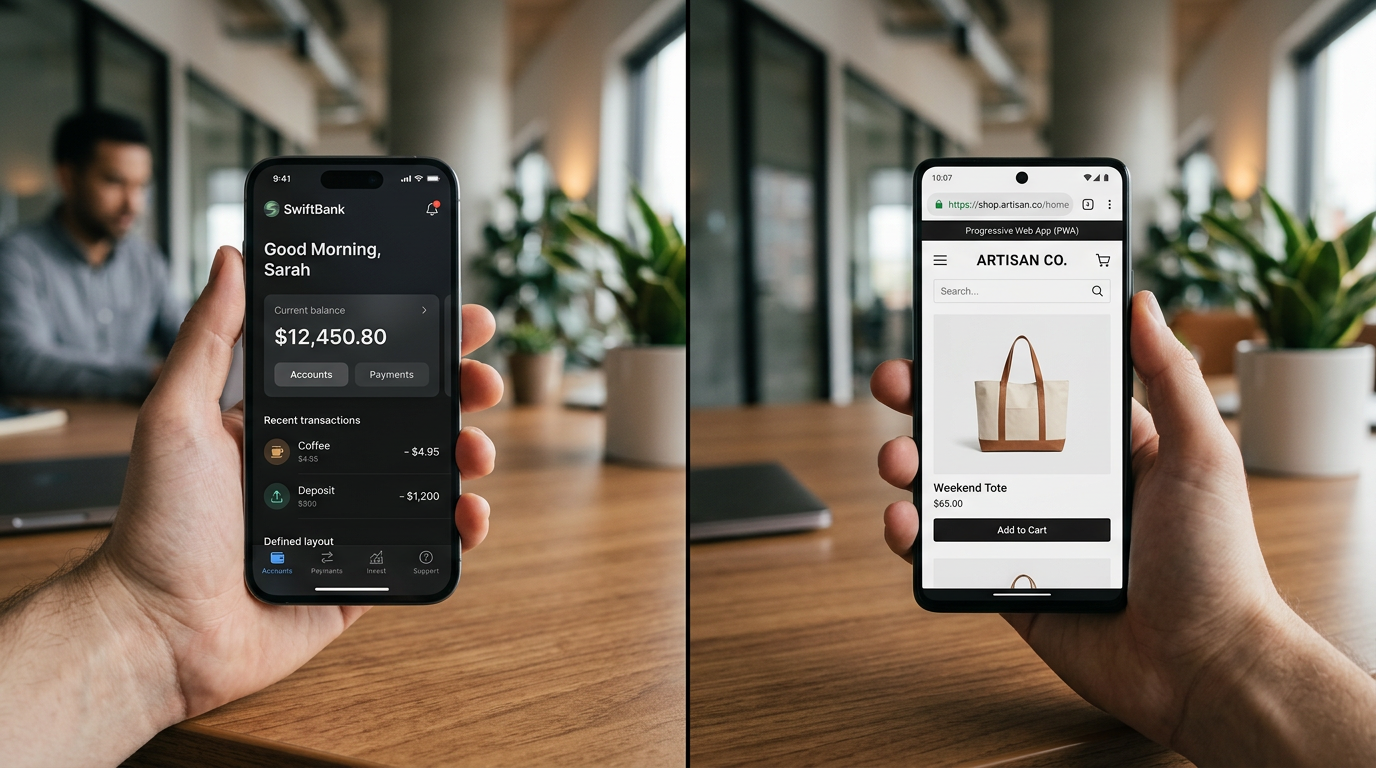
Did you know native apps command a staggering 90% of all smartphone time? It’s a powerful statistic. But it hides a much messier reality for the small business owner trying to get a foothold in the market. Before you can capture that time, you first have to convince a customer to find, download, and install your app from a crowded store. That’s a lot of friction.
The conversation for 2025 and beyond isn't really “PWA or native?” anymore. For a growing business, the real question is much sharper: what gets you to your customers fastest, cheapest, and with the least resistance? The answer changes depending on your goals.
The Real Question: Is Your Goal Acquisition or Retention?
Let's reframe the entire debate. Stop thinking about this as a purely technical choice. Instead, think of it as a strategic business decision centered on your growth model. Are you trying to reach the widest possible audience and attract new customers, or are you focused on deepening the loyalty of your existing ones?
Progressive Web Apps (PWAs) are acquisition engines. They are built for speed, discoverability, and accessibility. They act like a supercharged website that you can add to your home screen, combining the reach of the web with the feel of an app.
Native Apps are retention engines. They are built for performance, deep integration, and creating a sticky user experience that keeps customers coming back. They are the best tool for turning casual users into loyal brand advocates.
Understanding this distinction is everything. Your choice determines where you spend your budget, how quickly you launch, and ultimately, how you grow.
Why PWAs Are Your Secret Weapon for Customer Acquisition
For most small businesses, the first mountain to climb is awareness. People can't buy from you if they can't find you. This is where PWAs have a nearly unbeatable edge, built on a foundation of speed, cost, and visibility.
Speed to Market and Cost Efficiency
Building a native app requires two separate codebases: one for iOS (written in Swift) and one for Android (written in Kotlin). That means two development teams, two deployment processes, and double the maintenance cost. It’s a significant investment in both time and money.
A PWA, on the other hand, is built with standard web technologies like HTML, CSS, and JavaScript. One single codebase works across all platforms, whether it's a phone, tablet, or desktop. This dramatically lowers the cost of professional web development and slashes your launch timeline. You build it once and deploy it everywhere.
The Unbeatable Advantage of Search Engine Visibility
Here’s the killer feature for any business that relies on organic traffic. PWAs are, at their core, websites. This means they are indexable by Google. Every product page, every blog post, and every service description can be a potential entry point for a new customer searching online.
Native apps are the opposite. They exist in the closed ecosystems of the Apple App Store and Google Play. No matter how great your content is inside the app, it’s invisible to search engines. You lose out on the single most powerful customer acquisition channel available to small businesses. With a PWA, your SEO efforts directly fuel your app's discovery.
Breaking Down the Barriers to Entry
Think about the last time you downloaded a new app. You had to search the store, tap download, wait for it to install, and then open it. Each step is a point where a potential user can drop off. A PWA eliminates almost all of that friction.
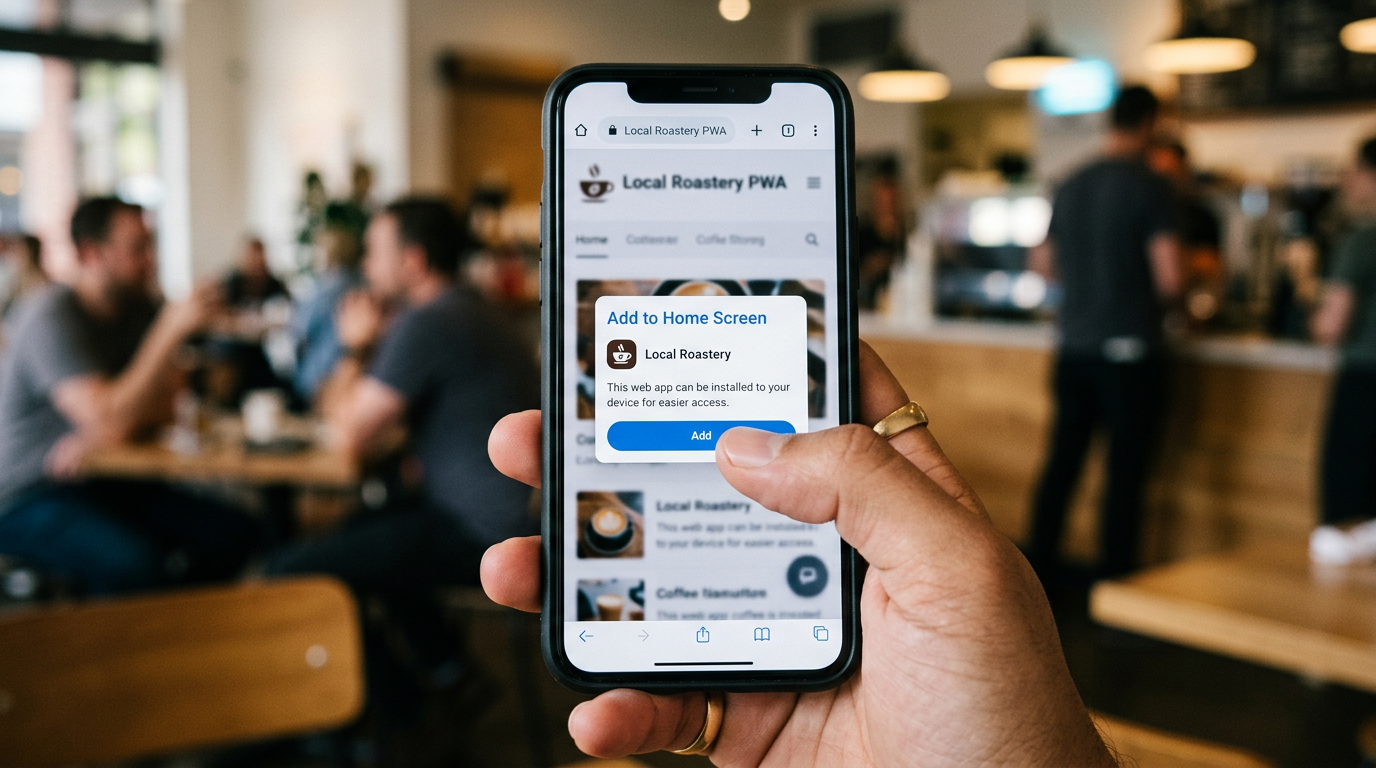
A user just visits your website's URL. If they like what they see, a prompt lets them add your PWA to their home screen with a single tap. There’s no big download, no waiting. The classic example is the Starbucks PWA, which allowed the company to offer a fast, app-like ordering experience to a global audience without forcing a download. It feels seamless because it is.
When Native Apps Become the Engine for Retention and Revenue
Once you've acquired a solid customer base, your focus shifts. Now, the goal is to increase engagement, encourage repeat purchases, and build lasting loyalty. This is where the power and polish of a native app truly start to pay dividends.
Deep Device Integration and Raw Performance
Native apps have direct, unfettered access to a device's hardware. If your app idea relies heavily on the phone's camera, GPS for complex routing, Bluetooth peripherals, or intensive background processing, native is often the only way to deliver a truly fluid and reliable experience.
This is why that 90% usage statistic rings true. For performance-heavy tasks like gaming, intensive photo editing, or complex business tools, the raw speed of native code is superior. A dedicated software development approach ensures your app runs as smoothly as the operating system itself.
The Power of the App Store Ecosystem
While the app store is a hurdle for acquisition, it’s a powerful tool for retention. Having your app icon on a user's home screen is a constant brand reminder. More importantly, native apps have traditionally offered more robust and reliable push notifications, which are critical for re-engaging users who haven't visited in a while.
Getting a user to download your app is a high-intent action. It signals a deeper level of commitment. These are the users most likely to become your power customers, and the native experience is tuned to serve them best.
Building a Premium, Polished Experience
For some brands, the user experience is the product. A native app allows for pixel-perfect control over every animation, transition, and interaction. It can adhere strictly to the design languages of iOS and Android, making it feel like a natural extension of the phone. This level of polish conveys quality and can be a major differentiator for premium brands.

The 2025-2026 Market: Following the Money
The industry isn't just talking about PWAs; it's investing heavily in them. The shift is clear and backed by significant financial momentum. One aggressive forecast sees the global Progressive Web Apps market climbing from USD 2.47 billion in 2025 to over USD 3.14 billion in 2026.
Even more conservative estimates signal a massive change. One study shows the growing PWA market size hitting USD 4.2 billion in 2025, with a projected compound annual growth rate exceeding 30% through the next decade. This isn't a niche trend. It's a fundamental realignment of how we build for the web.
This growth fuels a virtuous cycle. More investment means better tools and more mature standards. Platforms like Google Chrome DevTools and Microsoft's extensive PWA documentation provide developers with powerful resources to build, test, and deploy highly capable web apps that were unthinkable just a few years ago.
A Practical Decision Framework for Your Business
So, what should you do? For most small and growing businesses, the answer is to start with a PWA-first strategy.
Launch with a powerful, discoverable PWA to attract your initial customers. It’s the fastest, most cost-effective way to validate your idea and start generating revenue. Then, pay attention to your user data. When do you consider adding a native app to the mix? Only when you have a clear business case.
Ask yourself these questions:
- Is your primary goal for the next 12 months customer acquisition through organic search? Go PWA.
- Are you working with a limited budget and a tight deadline? Go PWA.
- Is your business model based on serving a massive, low-frequency audience? Go PWA.
- Does your core functionality critically depend on hardware that PWAs can't fully access yet? Go Native.
- Is your revenue driven by a small group of power users who demand extreme performance and deep integration? Consider adding a Native app.
As your business matures, you may find that a hybrid approach is best. Use the PWA as your top-of-funnel acquisition tool and offer a premium native app for your most loyal, high-value customers. You can even use insights from ai automation to predict which users are most likely to convert to the native app, personalizing the upgrade offer for maximum impact.
This isn't an all-or-nothing decision. It's a phased strategy that matches your investment to your stage of growth. If you are unsure which path makes the most sense for your specific goals, you can always request a quote to explore the possibilities with a strategist.
Ultimately, the choice isn't about PWA vs. Native technology. It's about what your business needs to do right now. Start by mapping your customer's journey from discovery to loyalty. The biggest point of friction you find is the problem you need to solve first.