react native vs flutter 2026: a risk-based decision framework
the react native vs flutter debate is no longer about tech specs. in 2026, it's about a strategic risk calculation. here’s how to choose based on your hiring market, brand, and budget.

The job market tells a story most tech comparisons miss. On LinkedIn and Indeed, React Native roles currently outnumber Flutter positions by a staggering 4 or 5 to 1. This isn't a signal of technical superiority. It's a signal about risk, ecosystem gravity, and career safety that dramatically changes how you should approach the cross-platform debate.
For years, the conversation got stuck on performance benchmarks and feature lists. That era is definitively over. In 2026, both frameworks are so capable that choosing between them is no longer a technical decision. It's a strategic one about managing risk across your business.
The Old Performance Debate Is Officially Dead
Let's get this out of the way first. For 95% of commercial apps, the performance gap between React Native and Flutter is now statistically irrelevant. The tired complaints about the React Native bridge bottleneck are mostly behind us, thanks to major architectural overhauls.
React Native’s New Architecture, powered by the Fabric rendering system and the JavaScript Interface (JSI), fundamentally changed its performance profile. This new model eliminates the clunky bridge, allowing for direct, synchronous communication with native components. The result? Apps that consistently hit that buttery-smooth 60 frames-per-second target, even with complex UIs.
Similarly, Flutter's Impeller rendering engine is now the default on recent versions for both iOS and Android. This move gives developers far more predictable GPU performance by pre-compiling shaders to avoid the jank and stutter that once cropped up during complex animations. You can see a great technical explanation of Flutter's rendering to understand the impact. While Flutter holds a small edge in startup time and graphically intense apps, for typical business use cases, it's effectively a tie.
A Risk Budget Framework for Your Decision
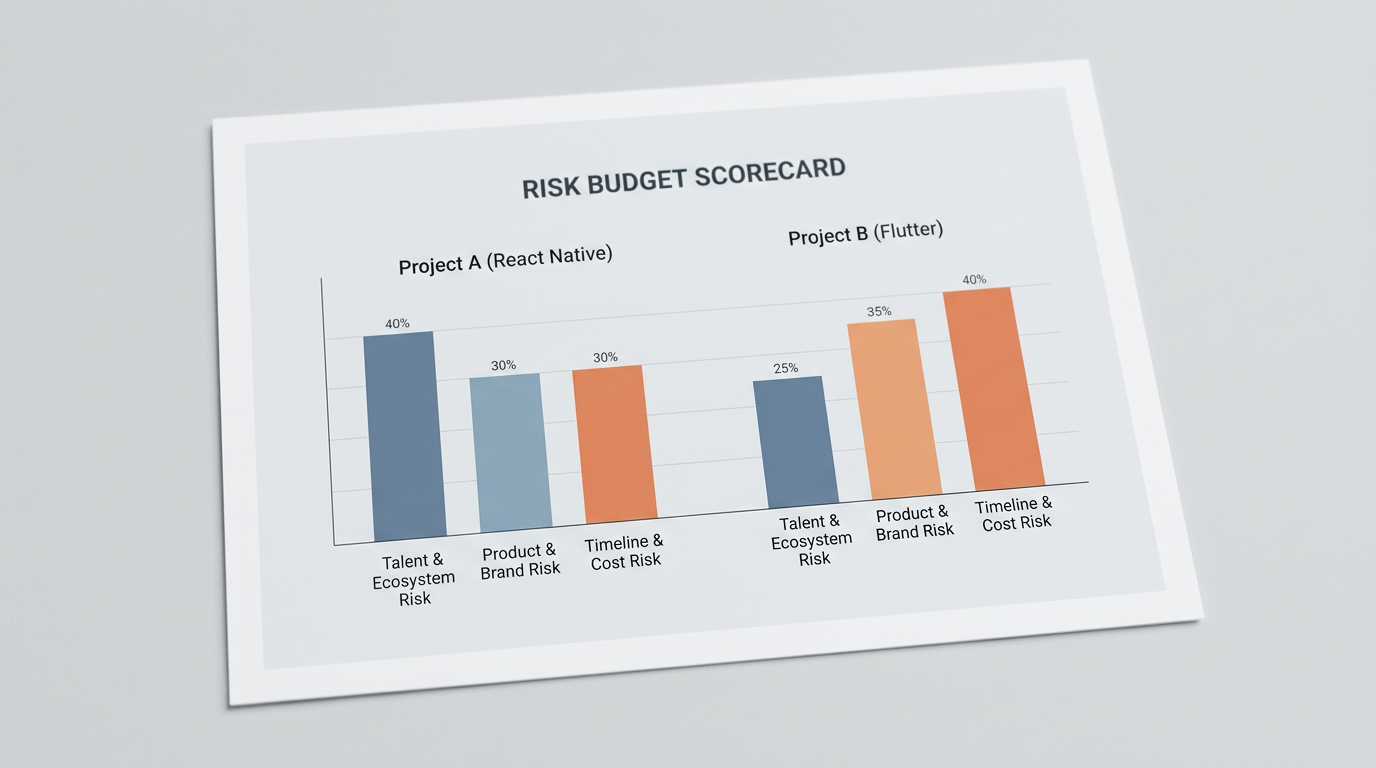
Instead of a feature bake-off, you should be scoring your project against a risk budget. Where are you most vulnerable? In your hiring pipeline? In your brand consistency? In your go-to-market timeline? The right framework is the one that best mitigates the risks your specific business can least afford.
We can break this down into a simple scorecard with three weighted dimensions. This isn't about finding a definitive winner. It’s about finding the right fit for your specific operational reality and long-term goals.
Talent & Ecosystem Risk (40% Weight)
This is the big one. That 5:1 job market ratio in favor of React Native means finding developers, contractors, and agency partners is fundamentally easier and often less expensive. Your existing web team, if fluent in React, is already halfway to building powerful custom mobile apps with React Native. The ecosystem is also more mature, offering a deeper well of third-party libraries and Stack Overflow solutions for nearly any problem.
Choosing Flutter means accepting a higher talent acquisition risk. The developer pool is passionate and growing fast, but it's smaller. You must be prepared to invest more time and resources in finding, training, and retaining that talent.
Product & Brand Risk (40% Weight)
Here, the tables turn completely. Flutter's core promise is a single codebase delivering a pixel-perfect, brand-consistent experience across iOS, Android, Web, Windows, macOS, and Linux. For companies like BMW, with a companion app in 30+ countries, or the fintech giant Nubank, managing a banking app for over 70 million users, this visual and functional consistency is a massive strategic asset.
Flutter's direct control over every pixel on the screen makes it the premier choice when your brand's unique design language is a competitive advantage. React Native, by contrast, is designed to translate your code into standard native UI components. This is perfect if the goal is for your app to feel exactly like a default iOS or Android app, adapting to every subtle platform convention automatically.

Timeline & Cost Risk (20% Weight)
On the surface, MVP costs are converging. A typical mobile MVP estimate for 2026 sits around $50k to $65k with Flutter, versus $55k to $73k with React Native. That slight Flutter advantage often comes from its famously fast hot-reload and the ability to build complex, custom UIs without fighting as many platform-specific layout bugs. Tools like FlutterFlow can further slash timelines with powerful low-code capabilities.
However, if your organization is already a powerhouse of web development using TypeScript and React, those savings can evaporate. The hidden cost of retraining your team in Dart or hiring new specialists could easily tilt the budget in React Native's favor. The least expensive path is often the one that best utilizes the talent you already have in-house.
When React Native Wins the Risk Equation
You should bet on React Native when your risk assessment prioritizes your team, your existing tech stack, and a desire for a pure, native user experience. Think of an established e-commerce company with a massive React-based website. Their biggest risk isn't brand inconsistency, it's speed to market and development cost.
For this company, choosing React Native is the lowest-friction path to mobile. They can leverage their army of JavaScript developers and reuse existing code, business logic, and infrastructure. They're not just adopting a framework; they're extending the capabilities of their current team. This approach de-risks the project by anchoring it to one of the largest developer ecosystems on the planet.
This is also true for projects that require deep integrations with many niche native device features. While Flutter can access native APIs, React Native's vast library ecosystem often means there's already a battle-tested package for that obscure payment SDK or Bluetooth hardware you need to talk to. Tools like Expo further streamline development, abstracting away much of the native configuration pain.
When Flutter is the Smarter Strategic Play
You should choose Flutter when your primary risk is brand fragmentation across a sprawling multi-platform roadmap. Imagine a design-led fintech startup building a beautiful, consistent product for users on iOS, Android, and a web dashboard for internal agents. For them, the biggest risk is a disjointed user experience that erodes trust.
This is why companies like Google (Google Pay), Alibaba, and Philips Hue chose Flutter. Their products are defined by a unique design language that *is* the brand. The ability to write that UI once and deploy it everywhere is a powerful strategic advantage. It dramatically cuts down on long-term maintenance costs and eliminates arguments between iOS, Android, and web teams about small design differences.
For any app defined by a custom design system, heavy animations, or ambitious cross-platform goals, Flutter often wins the risk calculation. It de-risks your brand and future-proofs your product for platforms you might not even be targeting today. It's a bet on consistency at scale.
Stop the Tech Debate, Start the Business Conversation
The era of crowning one framework as technically superior is a waste of time and energy. Both are fantastic. Both can build beautiful, high-performance apps. The real question is not "Which is better?" but "Which set of risks are we better equipped to manage?"
Your decision matrix is about business reality. It requires looking beyond the code to the hard truths of your hiring market, your team's existing skills, your brand's core value, and your company's long-term vision. This strategic analysis is a foundational part of modern software development, long before a single line of code is written.
Factors like the role of ai automation in testing and deployment will continue to shift the landscape, but the core business trade-offs will remain. The framework exists to serve the business, not the other way around.
So, map your risks with your stakeholders. Be ruthlessly honest about your team's DNA, your brand's demands, and your product roadmap. The right answer for you will become clear, and it will have very little to do with which framework shaves a few milliseconds off a benchmark test no real user will ever notice.