restaurant seo: a guide to ai-driven local discovery
ranking on google maps isn't enough. the future of restaurant seo is about being recommended by ai. here’s how to optimize for conversational search and drive more customers.
Is your restaurant ranked number one on Google Maps? For a long time, that was the goal. But that finish line has moved, and if you haven't noticed, you're already running in the wrong direction.
The entire game of being found online by hungry diners has shifted. We're rapidly moving away from a simple list of blue links and map packs. The new frontier is a world of AI-generated answers, conversational recommendations, and automated discovery. Your digital strategy needs a serious update.
The Game Has Changed: Why Your Old SEO Playbook Is Obsolete
Restaurant SEO used to be a fairly predictable process. You'd claim your Yelp page, build a few local citations, and make sure your city name was plastered all over your website. That checklist approach is now dangerously outdated. Diners aren't just typing keywords; they're having conversations with their devices.
They ask their phones, "Where can I get amazing tacos with outdoor seating that's open late?" They see Google's AI Overviews neatly summarize the top three spots before their thumb ever gets a chance to scroll. This isn't a future trend. It's happening right now, and it demands a specialized seo agency that understands the deep nuances of modern, local discovery.
The data tells a clear story. Nearly half, a full 46% of all Google searches, carry a local intent. These are not passive browsers. They are customers ready to make a purchase, and an incredible 76% of people who search for a local business will visit one within 24 hours. Your visibility, or your invisibility, directly impacts your revenue today.
Your Digital Foundation: Mastering Google Business Profile
Before we dive deeper into AI, let's establish ground zero. Your Google Business Profile, or GBP, is the single most critical piece of digital real estate you control. It's not just a boring directory listing. It is a powerful, direct-to-consumer marketing channel.
Your GBP feeds Google Maps. It fuels the local search results. Crucially, it provides the foundational data for Google's AI to decide if you're a good recommendation. The proof is in the engagement. From 2025 to 2026, direct actions from GBP listings, like phone calls, clicks for directions, and website visits, soared by 41% year-over-year. Consumers are booking, calling, and visiting straight from your profile, often without ever seeing your homepage.
GBP Non-Negotiables for the AI Era
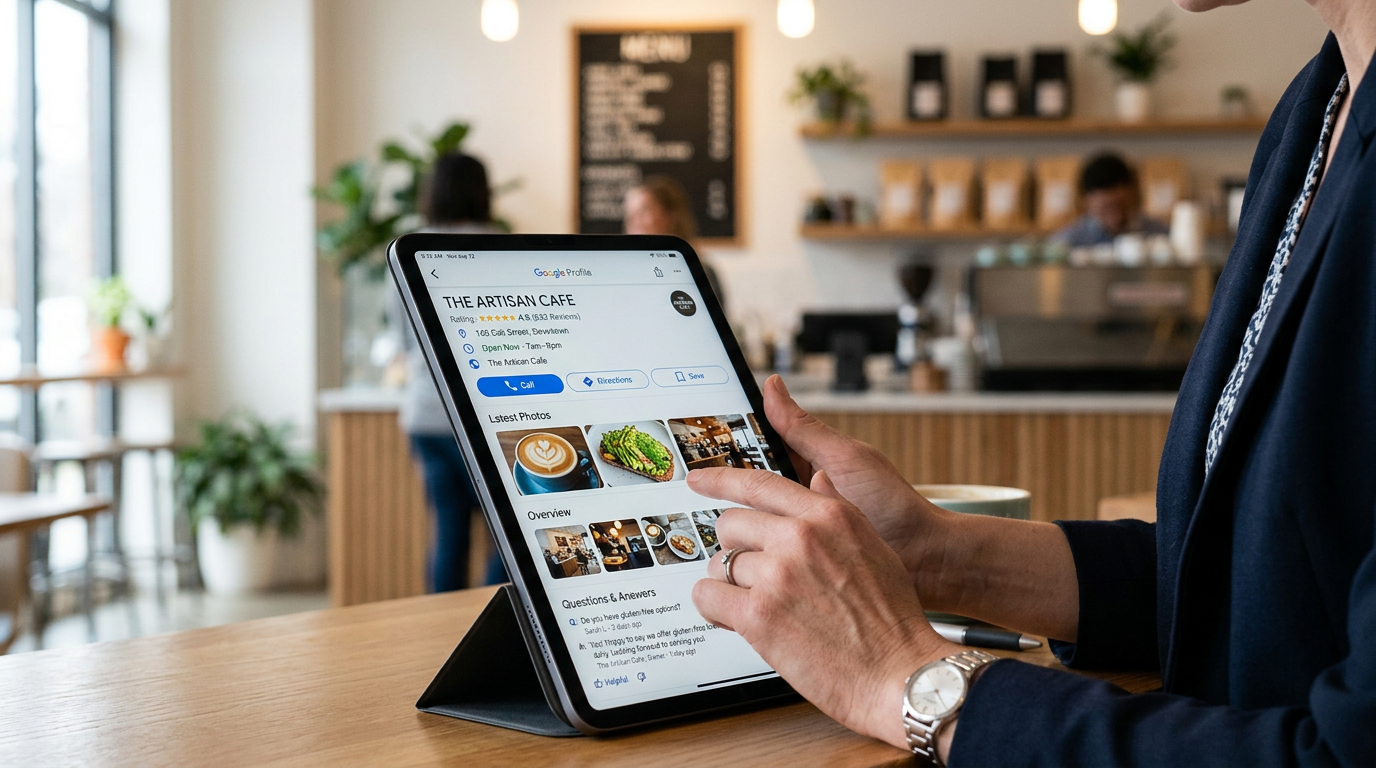
Optimizing your profile is not a set-it-and-forget-it task. It's an ongoing process of feeding Google the rich, accurate, and engaging signals it craves. Go beyond the basics of your name, address, and phone number. Fill out every single attribute Google offers, from accessibility options like wheelchair ramps to ambiance tags like "cozy" or "good for groups." These details are precisely what AI uses to match you to hyper-specific user queries.
Your photos need to be frequent, high-quality, and tell a story about the experience you offer. Show off your signature dishes, your bustling dining room, and your happy staff. And your menu cannot be a PDF. It must be entered as structured data using Google's own tools or integrated from a compatible service, making every item a searchable entity. A high-performing GBP is the perfect complement to a fast, mobile-friendly custom website.
Feeding the Machine: Content for AI and Conversational Search
A perfectly polished GBP is necessary, but it isn't sufficient. AI models like the one powering Google's AI Overviews and even third-party tools like ChatGPT are ravenous for information. They crawl the web to understand who you are, what you offer, and why people like you. Your job is to create the clear, structured content that makes your restaurant the obvious answer.
This means your website must become a deep source of truth. The most powerful way to do this is with structured data, also known as Schema markup. This is a vocabulary of code that you add to your site to explicitly tell search engines what your content is about. Instead of making Google guess, you can state, "This is a restaurant, this is our menu, and here are our customer reviews."
Why Structured Data is Your Secret Weapon
Think about it. That old PDF menu on your site is invisible to an algorithm; it's just an image. A proper HTML menu, enhanced with `Menu` schema, turns every dish, description, and price into a discrete piece of data. An AI can now understand that you serve a "gluten-free margherita pizza for $18" and confidently recommend you to a user searching for exactly that.
This technical approach is what separates basic SEO from elite performance. Companies like Chowly excel by integrating online ordering systems with a focus on structured HTML menus and optimized local pages, ensuring machines can read and understand their offerings. True ai search optimization is about making your information as clear and machine-readable as possible.
You can also use your blog to answer the long-tail questions diners ask. Think beyond your menu. Write a post about "Our Philosophy on Sourcing Local Ingredients" or create a guide to "The Best Date Night Spots in Our Neighborhood." This content provides the conversational context that AI models use to frame their recommendations, positioning you as an authority.
The Trust Signal: Reputation, Reviews, and Social Proof
If your GBP is your digital storefront and your website is your database, then your reviews are your reputation. A striking 87% of consumers read online reviews for local businesses in 2026. This isn't a vanity metric. It's a primary driver of trust and conversion for both humans and machines.
High ratings and a steady stream of recent reviews send a powerful signal. But it goes deeper. AI doesn't just count your stars; it performs sentiment analysis on the text of the reviews. It identifies keywords and concepts that customers consistently mention, like "friendly service," "great cocktails," or "perfect for families." This qualitative data helps the AI build a rich profile of your business.
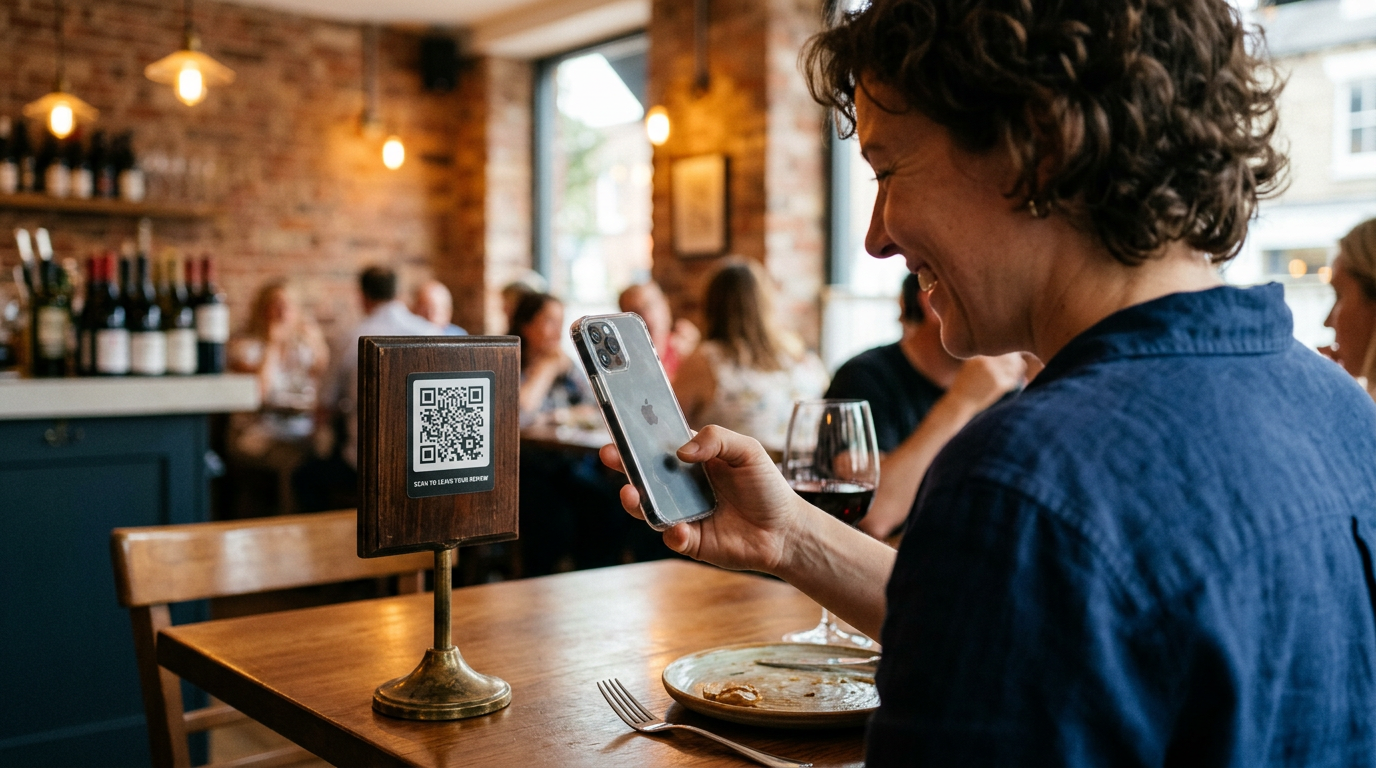
You cannot be passive here. Implement a proactive review generation strategy. Use simple QR codes on tables or receipts that link directly to your review platforms. A thoughtful, professional response to every single review, especially the negative ones, demonstrates that you are engaged and committed to customer satisfaction. Sometimes a well-handled complaint wins more future business than a dozen glowing reviews.
Proving the ROI: Measuring What Actually Drives Foot Traffic
So, how do you know if any of this is actually working? The key performance indicators have evolved. While tracking your organic traffic and keyword rankings still has a place, the most important metrics are now much closer to the cash register.
Dive into your Google Business Profile Insights. The real measure of success is the growth in high-intent actions. Are you getting more phone calls month-over-month? Are requests for driving directions increasing? Are more people clicking from your GBP listing to your reservations page? These are the actions that correlate directly with new customers walking through your door.
The results of a focused, modern strategy can be dramatic. The restaurant marketing platform Malou, for instance, published a 2025 study showing its clients achieved an average of +74% organic traffic in just three months. To get results like that, you have to partner with someone who understands this new landscape. There are some excellent expert insights on choosing a restaurant SEO agency that can help you ask the right questions during your search.
The future of restaurant marketing isn't about gaming an algorithm. It's about providing clear, structured, and compelling information that allows both people and AI to recognize you as the best choice. Shifting your focus from just ranking to being *recommended* is the single most important thing you can do. If you're ready to adapt your strategy for the new age of discovery, contact our team and we can start the conversation.