revenue-driven ecommerce: beyond shopify vs. woocommerce
stop comparing shopify vs. woocommerce features. the real question is how your development partner architects for outcomes. this is how to build a revenue engine for 2026.

Most conversations about ecommerce get stuck on the same tired debate. Shopify versus WooCommerce. It’s a loop of features, pricing, and plugins that completely misses the point, especially as we look towards 2026.
The platform is just the foundation. The real question is how you build on it. Shopify stores using AI personalization see conversion rates jump by up to 30%. That isn’t a platform feature. It’s an engineered outcome.
The brands winning today are focused on outcome-based development, designing their digital storefronts around measurable gains in performance, intelligence, and speed. This is where expert ecommerce web development services create separation, moving past the out-of-the-box template to architect a true revenue engine. Let's talk about how.
Mobile-First Isn't a Checkbox, It's the Entire Game
Let's be perfectly clear. Mobile commerce isn’t a distant trend anymore. It is the dominant force in online retail. With projections showing mobile will drive over 70% of all online sales by 2026, a site not optimized for a fast, intuitive mobile experience is actively rejecting the majority of its customers.
A genuine mobile-first approach goes far beyond a responsive theme that simply reflows content on a smaller screen. It demands a maniacal focus on performance. We're talking about Core Web Vitals. Your Largest Contentful Paint (LCP), First Input Delay (FID), and Cumulative Layout Shift (CLS) are not just technical acronyms. They are direct inputs to your Google ranking and, more importantly, your conversion rate.
This means optimizing images ruthlessly, streamlining code, and implementing one-click payment solutions like Shop Pay to obliterate friction. On Shopify, this is a more controlled process. On WooCommerce, it demands a careful selection of performance-focused plugins and premium hosting to ensure the server responds instantly. This isn't just about aesthetics; it's about building a site that respects a user's limited time and often-spotty connection.
The ultimate goal of this type of custom website development is a mobile web experience so fluid, it feels indistinguishable from a native app. For many brands, leveraging Progressive Web App (PWA) capabilities is the next logical step, offering app-like features such as offline access and push notifications directly from the browser. Building with this in mind from day one also streamlines any future mobile app development, as the core business logic and APIs are already in place.

AI as a Revenue Engine, Not a Gimmick
Artificial intelligence in ecommerce has officially graduated from buzzword to critical business function. The proof is in the adoption rates. Around 42% of Shopify merchants already use the platform's native AI tools like Sidekick and Magic for content generation and store management. This isn't experimental. It's operational.
But the most significant impact is happening on the front end, directly influencing sales. That 30% conversion uplift for stores using AI-driven personalization is a number no brand can afford to ignore. This is where development services transform a generic shopping grid into a curated, one-to-one conversation with the customer.
This means implementing and fine-tuning AI recommendation engines that learn from user behavior. A customer who viewed hiking boots last week shouldn't see random bestsellers on their return visit. They should see high-performance wool socks, waterproof jackets, and a blog post about local trails. It's about proactive, intelligent merchandising.
On Shopify, this often involves integrating and customizing powerful apps to fit a brand's specific catalog and customer segments. For WooCommerce, the open-source ecosystem allows for even deeper customization. Expert developers can integrate a variety of open-source AI models for predictive search, behavioral targeting, or even dynamic pricing. Making these systems work together seamlessly often requires deep expertise in software development services to build the API-driven connective tissue.
Whether on Shopify or WooCommerce, operationalizing AI means making it an active participant in driving revenue. It's not just a feature. It's a virtual sales associate, content creator, and data analyst working 24/7.
The Headless and Composable Revolution
If you ask what the single biggest web development trend is for ecommerce, the answer is headless architecture. Identified as a defining Shopify development trend for the coming years, going headless is about future-proofing your business against the whims of a single platform.
In simple terms, headless commerce decouples the frontend customer experience (the “head”) from the backend commerce engine (like Shopify or WooCommerce). Instead of a single, monolithic system, your store becomes a collection of best-in-class, independent services connected by APIs. This is also called composable commerce.
Why This Architecture is Winning
The primary drivers are speed and flexibility. A headless frontend can be built with modern frameworks optimized for blazing-fast performance, which directly impacts everything from SEO rankings to conversion rates. It breaks you free from the performance constraints of your ecommerce platform's templating system.
This model also enables true omnichannel delivery. You can use the same commerce backend to power a website, a mobile app, an in-store kiosk, or even emerging interfaces like smart mirrors. It centralizes your product data and business logic while giving you complete freedom over how and where you present it.
Headless on Shopify vs. WooCommerce
The two platforms offer different paths to a headless reality. Shopify is all-in with its Hydrogen framework and Oxygen hosting solution. This gives developers a powerful, opinionated toolkit to build custom, high-performance storefronts that still leverage Shopify’s famously robust and reliable backend checkout and admin.
For WooCommerce, a headless build represents ultimate freedom. Developers can construct a completely custom frontend with any technology they choose, communicating with the WordPress backend through its REST or GraphQL APIs. This approach offers unparalleled flexibility but also comes with greater responsibility for hosting, security, and maintenance of the entire stack.
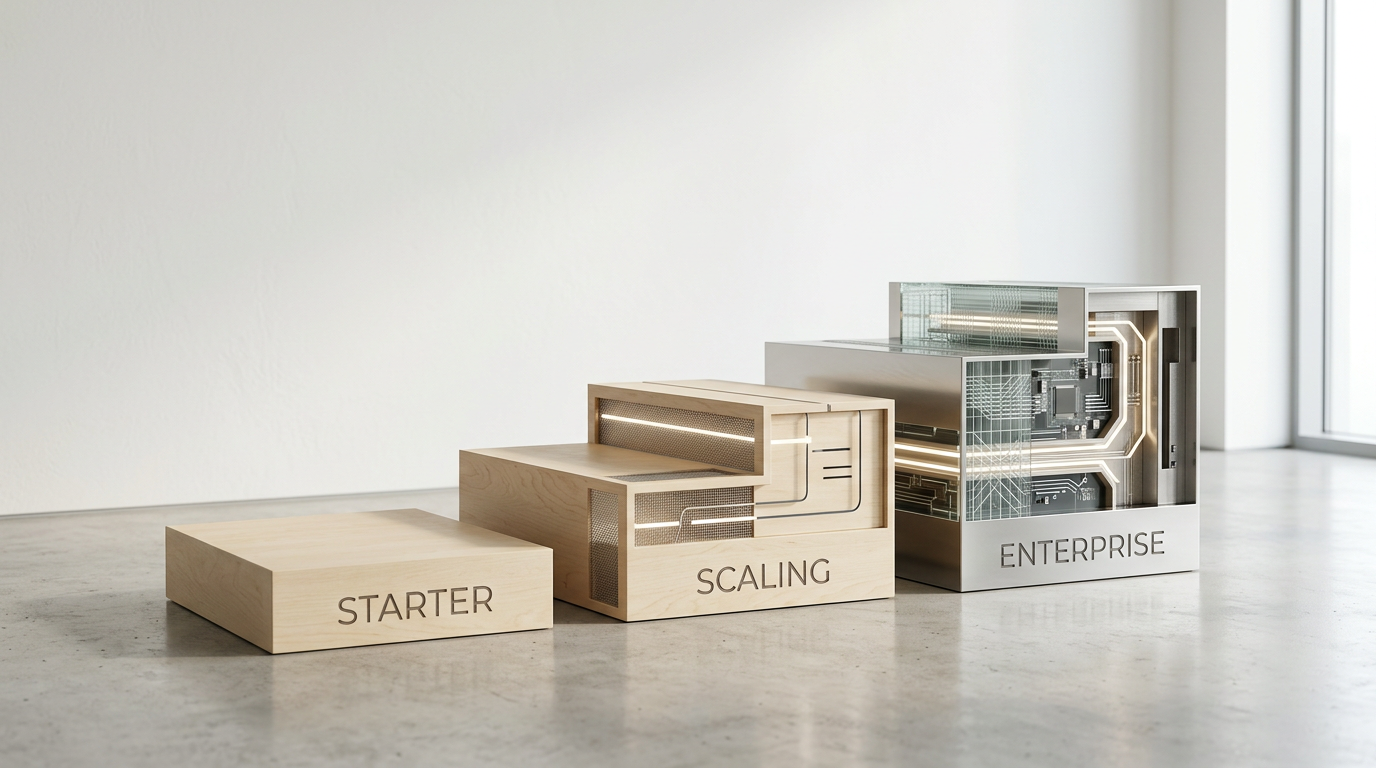
Mapping the Right Build to Your Growth Stage
The right development strategy is not one-size-fits-all. It must be tailored to your business maturity, budget, and ambition. A startup’s needs are vastly different from those of a global enterprise, and the technology choices should reflect that reality.
Stage 1: The Scalable Starter
For merchants just starting out, the priority is speed to market and validating product-market fit. The focus should be on a rock-solid, mobile-first theme, whether on Shopify or a well-chosen WooCommerce setup on quality hosting. The goal is perfecting the core user journey, implementing foundational AI for product recommendations, and ensuring checkout is absolutely frictionless with tools like Shop Pay.
Stage 2: The Scaling Brand
As a brand scales, the limitations of a standard theme often become apparent. This is where Shopify Plus enters the picture, offering more API access, custom checkout capabilities, and greater stability. For WooCommerce users, this means investing in dedicated hosting, more sophisticated caching, and potentially a custom-built theme. Development focuses on deeper AI integrations, robust A/B testing, and preparing for a potential headless future by building with components and APIs in mind.
Stage 3: The Headless Enterprise
For enterprise-level merchants, flexibility and scalability are paramount. This is where headless and composable architectures truly shine. It's no accident that Shopify Plus is the platform's fastest-growing segment, enjoying a 34% year-over-year increase. These large-scale stores require a modular architecture that can handle intense traffic, complex integrations with ERPs and PIMs, and a perfectly consistent brand experience across multiple global touchpoints and channels.
At this stage, the platform choice becomes less about the platform itself and more about its API quality. The entire tech stack is composed of best-in-class services, with the ecommerce platform serving as just one piece of the puzzle. The choice is no longer a simple binary between Shopify and WooCommerce. It’s a strategic decision about which development architecture will deliver the most measurable impact for your specific stage of growth.
Ultimately, your ecommerce platform is just the starting point. The competitive edge comes from the intelligence, speed, and personalized experience you build on top of it. If you're ready to design an ecommerce presence around tangible outcomes, not just a list of features, then it’s time for a different kind of conversation. You can start your project with our team to explore what that architecture looks like for you.