seo content writing that drives real organic growth
stop chasing keywords. our guide reveals how strategic seo content writing services build brand authority and deliver real organic traffic and leads.

Let's cut right to it. More than half of all content consumption, a full 51%, still comes directly from organic search. Despite the constant predictions of its demise, SEO isn't dead. It just grew up.
The era of cheap articles and keyword-stuffing is over. What works now is a far more sophisticated approach. Today, winning at organic traffic means investing in content that builds real authority, satisfies user intent deeply, and delivers measurable business results. Anything less is just adding to the digital noise.
The Unshakeable Foundation: Content's Role in a Google-First World
With Google commanding around 90% of the global search market, aligning your content strategy with its principles isn't optional. It’s the entire game. But the rules have matured. Google's systems, especially with the rise of AI, are better than ever at distinguishing between shallow content and genuine expertise.
This is why we're seeing a powerful resurgence of long-form, expertise-driven content. The data is clear. Blog posts that exceed 2,000 words earn an incredible 77% more backlinks than their shorter counterparts. The rewards grow from there. Push a piece past 3,000 words, and you can expect 3.5 times more backlinks and 2.4 times more social shares.
This isn't about word count for its own sake. It’s about what word count enables: depth. Comprehensive guides, pillar pages, and topic clusters aren't just an SEO trend. They are a direct response to search engines getting better at rewarding the single most helpful resource for any given query.
Moving Beyond Keywords: The Shift to Entity-First SEO
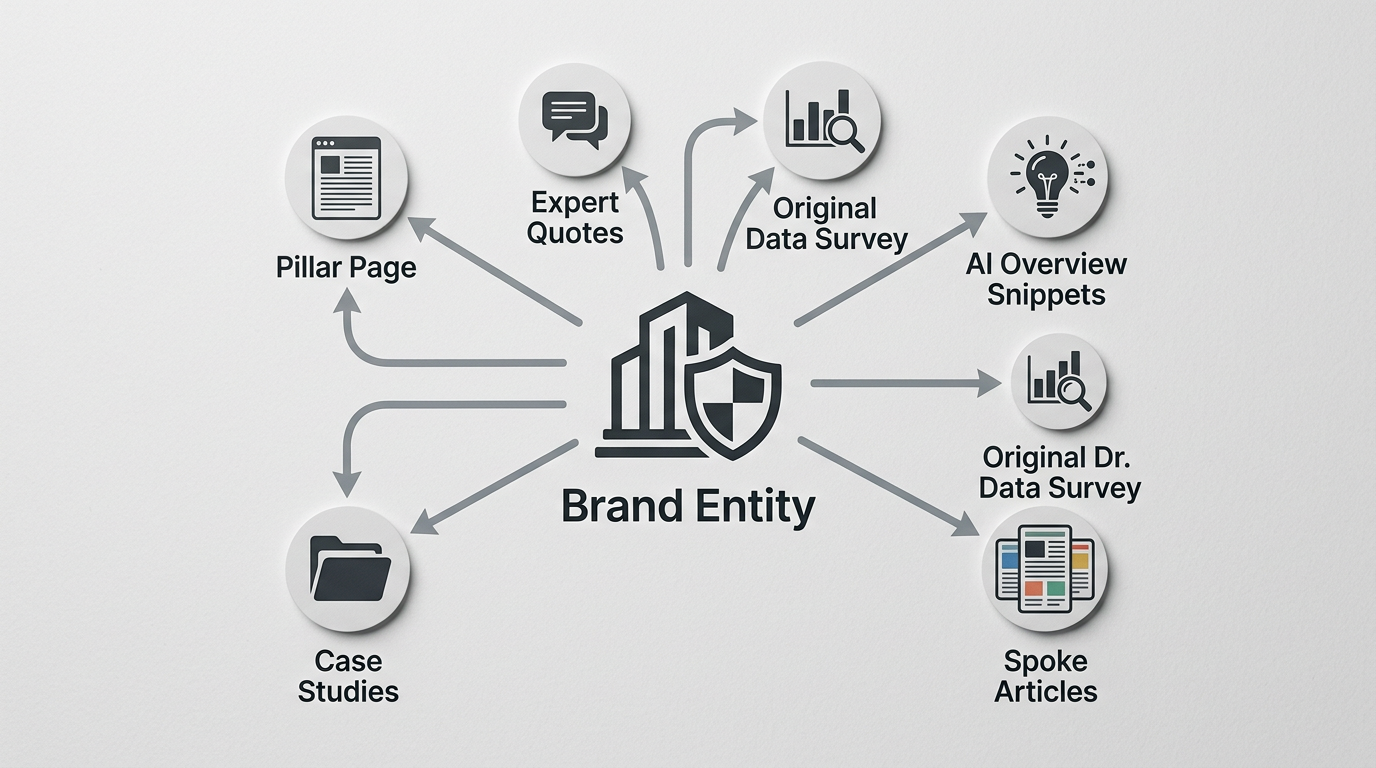
The most significant shift for any forward-thinking brand is moving from a keyword-first to an entity-first mindset. What's the difference? Keywords are isolated queries. An entity is the concept, brand, or expert that Google understands as an authority on a topic.
An entity-first SEO content strategy doesn't just ask “What keywords should we rank for?” It asks, “How can we become the undeniable authority on this entire topic?” This approach is fundamentally about building your brand's reputation in Google's eyes.
This is accomplished by mapping content to concepts, not just search terms. It means weaving in expert commentary, original data, case studies, and testimonials. You are proving that real people with real expertise are behind the words, a core tenet of Google’s own Search Essentials guidelines.
This strategy also future-proofs your content for the next generation of search. Google's AI Overviews and conversational interfaces reward pages that anticipate the user's next question. A great piece of SEO content doesn't just answer the first query. It covers the edge cases, the constraints, and the “what if” scenarios, making it a perfect source for both human readers and AI systems.
Building out this kind of topical authority requires a solid technical foundation. Your content may be brilliant, but if the site structure is a mess, it will fail. This is where partnering with a skilled web development agency can be a critical, and often overlooked, part of a successful content program.

The Smart Workflow: AI-Augmented, Human-Perfected
You can't talk about content in 2025 without addressing AI. The data shows that 67% of bloggers are already using AI writing tools. But here's the catch: relying on purely AI-generated content is a losing game.
Research shows that after 12 months, pure AI content underperforms human-written articles in organic rankings by a significant 23%. Google's algorithms are designed to reward experience, expertise, and a unique point of view, three things that AI models struggle to fabricate convincingly.
The winning model isn’t replacement, it's augmentation. An AI-assisted, human-edited workflow delivers a 12% boost in productivity while maintaining the same ranking performance as content written entirely by humans. This is the new professional standard.
This hybrid approach allows a skilled seo agency to handle research, outlines, and first drafts with incredible speed, freeing up their experts to focus on what truly matters: adding unique insights, verifying facts, polishing the prose, and ensuring the content perfectly matches the brand's voice and the user's intent. It’s about using technology to elevate human expertise, not replace it.
What Does Strategic SEO Content Actually Cost?
As the approach to content has professionalized, so has the market for its creation. The global content writing services industry is booming, projected to grow from $24.2 billion in 2026 to nearly $38.6 billion by 2033, according to industry growth projections for content writing.
With this growth comes a wide spectrum of pricing and quality. Understanding the tiers is crucial for making a smart investment.
- Commodity Services: Priced around $0.05 to $0.15 per word, these services are best for bulk content where quality and originality are not the primary concerns. Expect generic, surface-level articles that are unlikely to build authority or drive significant traffic.
- Managed Editorial Services: Typically costing $200 to $600 per article, this tier brings more process and editorial oversight. It's a step up, but may still lack the deep strategic alignment needed for competitive niches.
- Strategic Retainers: Ranging from $5,000 to $20,000 per month, this is where true partnership happens. This investment covers not just writing, but strategy, topic mapping, expert interviews, performance analytics, and continuous optimization.
The question isn't just about what content costs, but what kind of results you expect. High-volume, high-quality publishing pays dividends. Companies that publish 16 or more posts a month see 3.5 times more traffic than those publishing only a few. But there's a point of diminishing returns around 11 posts per month, which tells us that beyond a certain volume, strategy and quality become the dominant factors for growth.
Measuring What Matters: From Rankings to Revenue
Vanity metrics are a waste of time. Tracking a keyword ranking going from position 8 to 6 is interesting, but it doesn't pay the bills. A modern SEO content program must be measured on its impact on business outcomes.
The starting point for any performance analysis is Google Search Console. It's the ultimate source of truth. By analyzing impressions, clicks, click-through rates, and queries, you can find pages with massive untapped potential. An article getting thousands of impressions but few clicks is a clear signal to rewrite the title and meta description. A page ranking for a valuable query you didn't even target is an opportunity to expand.
Proactive content strategy also relies on smart tools. Using Google Trends, Glimpse, or Exploding Topics helps you spot rising search interest before your competitors. Creating the definitive resource for a topic just as it hits the mainstream is one of the fastest ways to build authority and capture traffic.
Ultimately, the goal of all these tactics is to support your broader business objectives. The traffic you generate should convert into leads, sign-ups, and sales. This is where content becomes a core component of your overall marketing services, feeding every other part of your funnel with qualified, engaged prospects.
Stop thinking about content as a C-level expense and start seeing it as a primary driver of P-level profit. Building a true content engine is a serious undertaking, but it remains the single most effective and durable way to win in organic search. If you're ready to move beyond cheap articles and build a content strategy that delivers real ROI, contact our team to discuss how we build authority for brands like yours.