shopify conversion architecture: how to get to a 3%+ rate
stop settling for a 1.4% conversion rate. learn how strategic shopify development services build a 'conversion architecture' to hit 3%+ through speed, analytics, and testing.

Let's get straight to the point. The average Shopify store converts at a paltry 1.4%. That means for every 1,000 visitors you fight to acquire, 986 of them leave without buying a thing. It’s a leaky bucket that costs brands a fortune.
Many founders and marketers think the solution is a prettier theme or flashier product photos. They’re wrong. The real problem isn't the design; it's the architecture. Getting from that 1.4% average to the 3% or even 4%+ conversion rates of top-tier stores requires a completely different way of thinking about your site.
It’s about building a deliberate, data-driven system engineered for one thing: turning browsers into buyers. It's about conversion architecture.
What's a 'Good' Shopify Conversion Rate, Really?
Numbers don't lie. While the masses are stuck around 1.4%, the game changes dramatically as you climb the ladder. Data shows stores breaking the 3.2% barrier are in the top 20% of all performers on the platform. The truly elite, the top 10%, are converting above 4.7%.
Let that sink in. A store hitting 4.7% is generating more than three times the revenue from the exact same traffic as an average store. This isn't a small tweak; it's a monumental shift in business performance. Shopify itself, with its massive scale of over 5.6 million active stores, pushes merchants to aim for that 3% mark as a sign of a healthy, well-optimized business.
These figures are substantiated by wider industry analysis. Citing various eCommerce conversion rate benchmarks, experts point to a range between 1.70% and 2.96% for the US market. The takeaway is clear: being average is a choice, and the path to excellence is paved with data.
The Four Pillars of High-Converting Shopify Architecture
Achieving top-tier conversion rates doesn’t happen by accident. It’s the result of a disciplined approach to Shopify development that treats the store as an integrated system, not just a collection of pages. This system, this conversion architecture, rests on four essential pillars.
Pillar 1: Radical Speed Optimization
Speed isn't a feature; it's the foundation of the entire user experience. Every millisecond of delay is a silent conversion killer. On mobile, where most eCommerce traffic now lives, a slow-loading page is a death sentence. Customers will simply leave.
Shopify, which processed over $300 billion in GMV in 2025, invests heavily in its core infrastructure. But that core performance can be easily sabotaged. Bloated themes, unoptimized images, and an army of poorly coded apps all add weight and drag down your load times. Expert Shopify development involves obsessively optimizing Liquid code, implementing modern image formats, and carefully vetting every single app for its performance impact. Speed is non-negotiable.
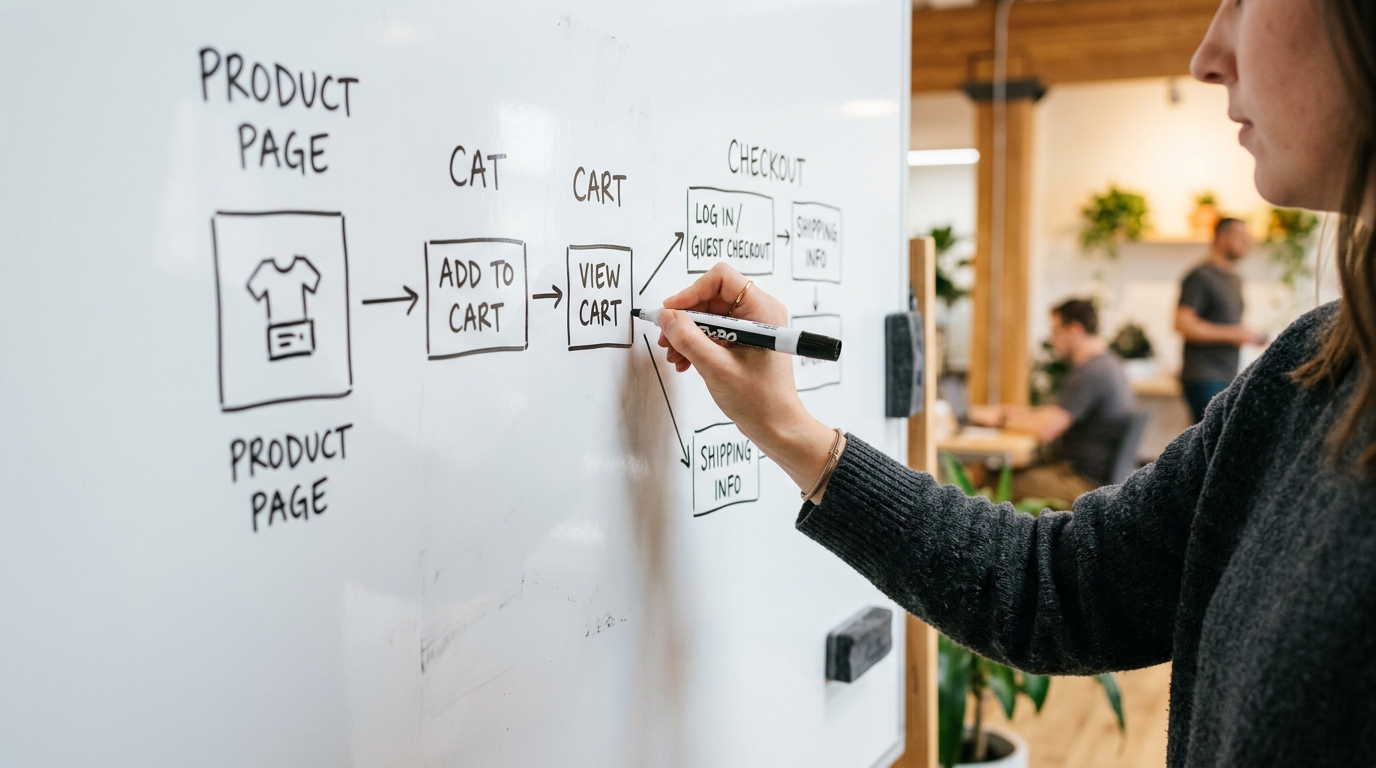
Pillar 2: Eliminating Checkout Friction
The checkout is where the money is made or lost. You could have the most persuasive product page in the world, but if your checkout is confusing, slow, or demands too much information, customers will abandon their carts in droves. Every extra field, every unnecessary click, adds friction.
This is why tools like Shop Pay are so powerful. Accelerated checkouts dramatically reduce the steps required for a customer to complete a purchase, especially returning visitors. A proper Shopify developer architects the entire path to purchase, from the cart page to the final thank you, to be as seamless and frictionless as possible. This includes simplifying forms, offering multiple payment options, and ensuring total clarity at every step.
Pillar 3: Purposeful Analytics Instrumentation
You cannot fix what you cannot measure. A high-converting store is built on a foundation of clean, reliable data. Simply installing the default Google Analytics tag is not enough. You need purposeful instrumentation that tells you the full story of your customer's journey.
This means going deep with tools like Google Analytics 4 (GA4). We're talking about building detailed funnel exploration reports to see exactly where users drop off between adding to cart and completing a purchase. It means tracking micro-conversions to understand user intent. Then you layer on qualitative tools like Microsoft Clarity to watch actual session recordings and see rage-clicks or confusing UI elements in action. This is how you move from guessing to knowing.
This data-first approach is also crucial for our seo services, as understanding user behavior directly informs how we optimize for organic search intent. It's all connected.
Pillar 4: A Disciplined Testing and Iteration Culture
Data shows you the problem. Testing finds the solution. The world's best Shopify stores are never 'done.' They exist in a perpetual state of optimization, driven by a disciplined culture of testing and iteration. This is where development becomes a growth lever.
Once your analytics are properly configured, you can start forming hypotheses. 'Will a clearer headline on the product page increase add-to-carts?' 'Does changing the CTA button color improve click-through rates?' 'Will rewriting this product description reduce bounce rate?' You then use A/B testing to get definitive, data-backed answers.
This iterative loop, audit, hypothesize, test, and learn, is the engine of conversion rate optimization. It turns your website from a static brochure into a dynamic selling machine. This is a core part of our philosophy for any custom website development project, whether on Shopify or another platform.
From Insight to Action: A Practical Shopify Development Roadmap
So how do you actually implement this? It begins with a comprehensive audit. A proper Shopify development partner doesn’t just jump into coding. They start by diagnosing the current state of your conversion architecture.
The process starts with a deep dive into your analytics, combing through GA4 and Microsoft Clarity to identify the biggest leaks in your funnel. We look for pages with high exit rates, confusing user journeys, and technical errors. This gives us the 'what' and the 'why' behind your current performance.
Next comes the technical audit. We analyze your site's performance using tools like Google PageSpeed Insights, checking Core Web Vitals, code efficiency, and app bloat. This uncovers the technical roadblocks hurting your speed and user experience. This holistic view is essential, as even a brilliant marketing campaign can fail if the destination page is slow and buggy.
From these two audits, we develop a prioritized backlog. It’s a strategic roadmap of improvements, ordered by impact and effort. This isn't a random to-do list; it's a calculated plan to generate the biggest conversion lift with the most efficient use of resources. Some stores may need a technical overhaul, while others may benefit more from mobile app development to create a stickier native experience.
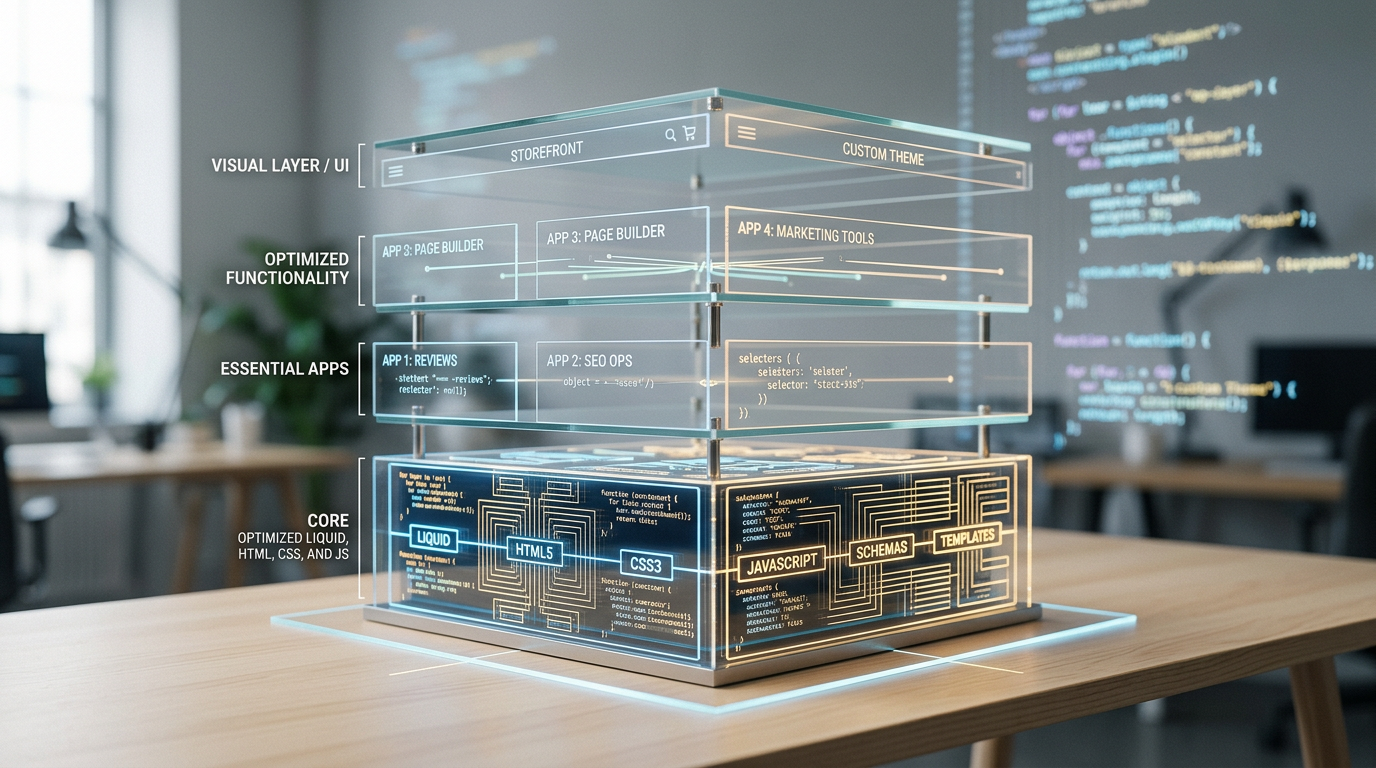
Why Your Shopify Theme Is Just the Starting Point
Too many merchants believe buying a $350 premium theme is the end of their development journey. In reality, it's just the beginning. A theme provides the visual starting blocks, but the real performance comes from what's built on top of, and inside of, that theme.
Over time, even the best themes accumulate technical debt. Every app you install adds scripts that can slow your site down. Every 'quick fix' by a freelancer can create conflicts or break best practices. Soon, your once-clean theme is a tangled mess of conflicting code that's impossible to maintain and slow to load.
Expert Shopify development services are about managing this complexity. It's about customizing the theme's Liquid code for maximum efficiency, building features without relying on heavy apps, and ensuring the entire ecosystem, theme, apps, and custom code, works in harmony. It's foresight and architecture, not just styling.
This disciplined approach ensures your store is not only fast and high-converting today but also scalable and easy to update tomorrow. It’s the difference between a storefront and a business asset.
Bridging the conversion gap from the 1.4% average to the 3%+ goal is a strategic imperative. It requires moving beyond surface-level design and embracing a data-driven conversion architecture. It demands a focus on speed, frictionless checkout, deep analytics, and relentless testing.
The path forward is clear. Stop guessing what might improve your store and start building a system designed for growth. If you are ready to transform your Shopify store into a true conversion engine, we can show you the way. Let's start your project and build the architecture your brand deserves.