shopify seo for product pages: a 2026 guide to ranking
stop losing traffic. our 2026 guide reveals how shopify seo services for product pages can help you rank in google, optimize for ai overviews, and drive sales.

Let's start with a brutal fact. Poor product page SEO can cost a Shopify store up to 40% of its potential organic traffic. That’s not a rounding error. It’s a massive, preventable leak in your sales funnel.
For years, store owners treated product pages as an afterthought. You'd launch the site, then maybe sprinkle some keywords around later. That approach is now obsolete. Winning on Google, especially in the era of AI Overviews, means treating your product pages as the absolute starting point of your entire SEO strategy.
The New Ground Rules: Product Pages are Your SEO Battleground
Your homepage isn't where your most valuable traffic lands. It's your product pages. These are the URLs that capture high-intent searches from people ready to buy, and Google is increasingly prioritizing them. If your product pages aren’t optimized, you are invisible to your best customers.
Modern SEO checklists now flip the script. We begin by mapping high-intent, long-tail keywords directly to individual products and collections. This isn't about generic terms. It's about precision. A shopper looking for a “men’s merino wool crew sock size 12” is not a browser, they are a buyer.
Failing to optimize at this level means leaving a staggering amount of money on the table. Under-optimized titles, generic meta descriptions, missing image alt text, and a lack of proper data structure all contribute to that 40% traffic loss. This is the foundational work that a competent digital marketing agency handles first.
Building for Bots and Buyers: Technical SEO That Actually Matters
Google’s crawlers and your customers want the same thing: a fast, logical, easy-to-use website. Technical SEO isn't just a box to check. It's the architecture that determines whether your products are even discoverable in the first place.
The Three-Click Rule and Shallow Architecture
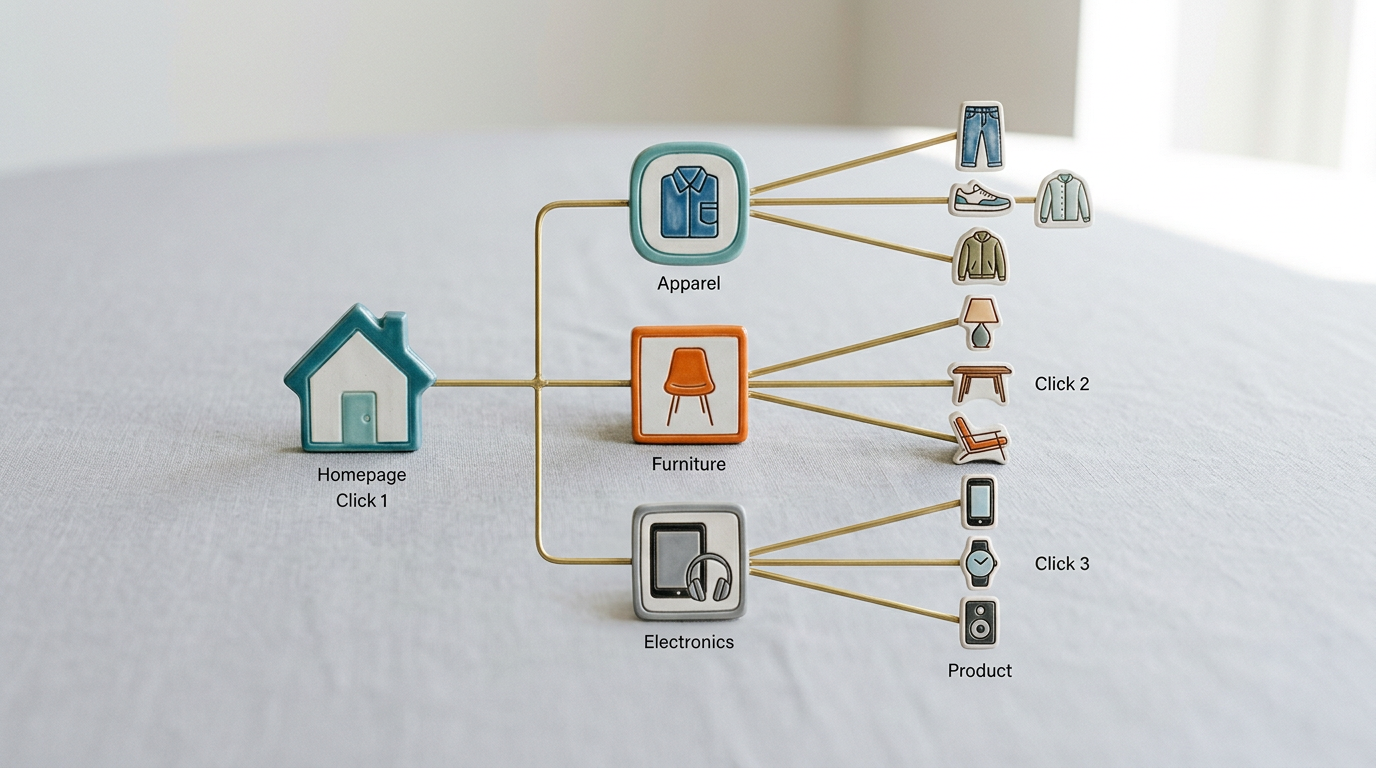
Complexity kills conversions and crawlability. 2025 and 2026 Shopify SEO standards are built around a simple mandate: every product must be reachable within three clicks of the homepage. This is non-negotiable for both user experience and ensuring Googlebot can find and index your entire catalog.
This means rethinking how you build your collections. The recommended structure is now a ruthlessly shallow hierarchy, with a maximum of three levels. Think: Root Collection → Sub-Collection → Product. Anything deeper gets buried.
How do you handle complex inventories? Not by creating endless nested collection pages. Instead, you should use Shopify’s native filtering and robust on-site search. This keeps your architecture flat, preserves internal link equity, and helps users find exactly what they need without getting lost in a maze of pages.
Speed and Experience Are Direct Ranking Factors
Your site's performance isn't just a nice-to-have, it's a direct signal to Google about the quality of your page. Core Web Vitals are now core tasks for ranking product pages. For Shopify stores, this means hitting specific, measurable thresholds.
You should be aiming for a Largest Contentful Paint (LCP) under 2.5 seconds on a standard 4G connection. Your visual layout should be stable, and your add-to-cart button must be visible above the fold on mobile. Tap targets, like buttons and links, need to be at least 48x48 pixels to avoid frustrating users with clumsy fingers. If your theme can’t deliver this, you might need a custom website built for performance from the ground up.
Winning in the AI Overview: Structuring Content for Google’s Future
Ranking with a blue link is no longer the only goal. The new prize is being featured directly in Google's AI-generated summaries, known as AI Overviews. This requires shifting your thinking from just 'ranking a page' to 'becoming the canonical product answer' for a given query.
This isn't guesswork. It's a specific strategy that combines technical structure with smart content. You are essentially formatting your product pages to be the most helpful, concise, and authoritative source available.
Structured Data: Speaking Google's Native Language
Structured data, or schema markup, is the code that explicitly tells Google what your page is about. It’s what powers the star ratings, pricing, and availability you see directly in search results. For a product page, complete schema is now table stakes.
At a minimum, your page needs Product schema that defines the item's name, price, currency, and availability. But to truly stand out, you should also implement AggregateRating schema (the stars) and even FAQ schema for a dedicated question-and-answer section on your page. This data not only enhances your click-through rate but also feeds directly into the knowledge graph that powers AI Overviews.
A Tactical Approach to AI Summaries
Shopify’s own guidance for 2026 presents a clear tactic for getting featured. The strategy is to focus on product pages that are already ranking on the cusp of page one, typically in positions 11 through 20. These pages are already seen by Google as relevant, they just need a push.
To give them that push, you reformat the content. Move the most succinct, helpful answer to a user's likely question right to the top of the page. Build out FAQ sections that directly answer related queries. This approach is a core component of modern ai search optimization services, turning your product pages into answer hubs, not just static catalog entries.

Keyword Strategy That Actually Converts Shoppers
The final piece of the puzzle is targeting the right keywords. Chasing massive search volume is a fool's errand for most e-commerce stores. The real value is in capturing commercial intent.
Beyond Volume: Mapping Intent to Your Product Catalog
Success comes from mapping long-tail, product-specific keywords to their corresponding product pages. A user searching for a “waterproof red bucket hat for hiking” has far more purchase intent than someone just searching for “hats.” Your product page should be optimized for the former, while your collection page can target the latter.
Tools like Ahrefs Keywords Explorer are invaluable here. You can identify these high-intent phrases and filter for question-based keywords that signal a user is in the research phase. This allows you to build a content ecosystem that serves customers at every stage of their journey.
Building Authority with Supporting Content
Your blog isn't just for brand stories. It’s a powerful SEO asset for building topical authority. By creating content that answers adjacent, informational queries, you establish your store as an expert resource.
For example, a store selling high-end candles could publish an article on “how to make scented candles last longer.” This article attracts searchers with a related interest and, critically, allows you to internally link back to your candle product and category pages. As Shopify's own advanced SEO marketing advice points out, this strategy builds a powerful web of relevance that Google rewards.
This isn't a one-and-done task. It's a continuous process of technical monitoring, content refinement, and strategic linking. Using tools like Google Search Console is essential to confirm your sitemap is being crawled, monitor indexing status for new products, and track the performance of your target keywords.
Ultimately, driving organic sales on Shopify comes down to this: treat your product pages as your most valuable SEO assets. Structure them for speed, clarity, and crawlers. Optimize them to be the definitive answer for AI. And target them with keywords that reflect true buyer intent. Get that right, and you'll capture the traffic that actually matters. Want to see where your pages stand? When you're ready, you can get a free consultation with our team.