the startup playbook: launching a mobile app under $25k
think a powerful mobile app is out of reach? this guide breaks down the mvp-to-scale playbook for startups, covering how to launch for under $25k and scale for growth.
Everyone has heard the horror stories. A founder sinks their entire pre-seed round into an app, only to find the market doesn’t care. The typical project cost, often quoted between $25,000 and $250,000 in a mature market like the US, can feel like an impossible barrier for a bootstrapped startup or a small business.
But that narrative is starting to crumble. You don’t need a quarter-million dollars to get in the game. You need a playbook.
This is the playbook for small and medium-sized businesses aiming to launch a meaningful mobile presence without breaking the bank. It’s about starting lean, proving your concept, and scaling intelligently. It's about building an asset, not just a line item on a budget.
Why 2025 is a Tipping Point for SMB Mobile Apps
The ground is shifting tectonically. The global mobile app development market isn’t just growing, it's exploding. Projections show a leap from about $116 billion in 2025 to a staggering $988.5 billion by 2035. That’s a compound annual growth rate of nearly 24%.
What’s fueling this fire? It’s not just tech giants and unicorns. It’s entrepreneurs, local shops, and growing businesses finally gaining access to a market once guarded by high costs and technical complexity. The mobile application development platform market itself is expected to hit over $327 billion in 2025, largely because SMEs are adopting these tools to connect with customers.
For years, a custom app was a luxury. Now, it's becoming a fundamental tool for customer engagement, process automation, and competitive differentiation. The rise of accessible platforms means you’re no longer just competing with the shop down the street. You’re competing with the convenience of a button click.
The MVP-to-Scale Playbook: Launching Lean and Winning Big
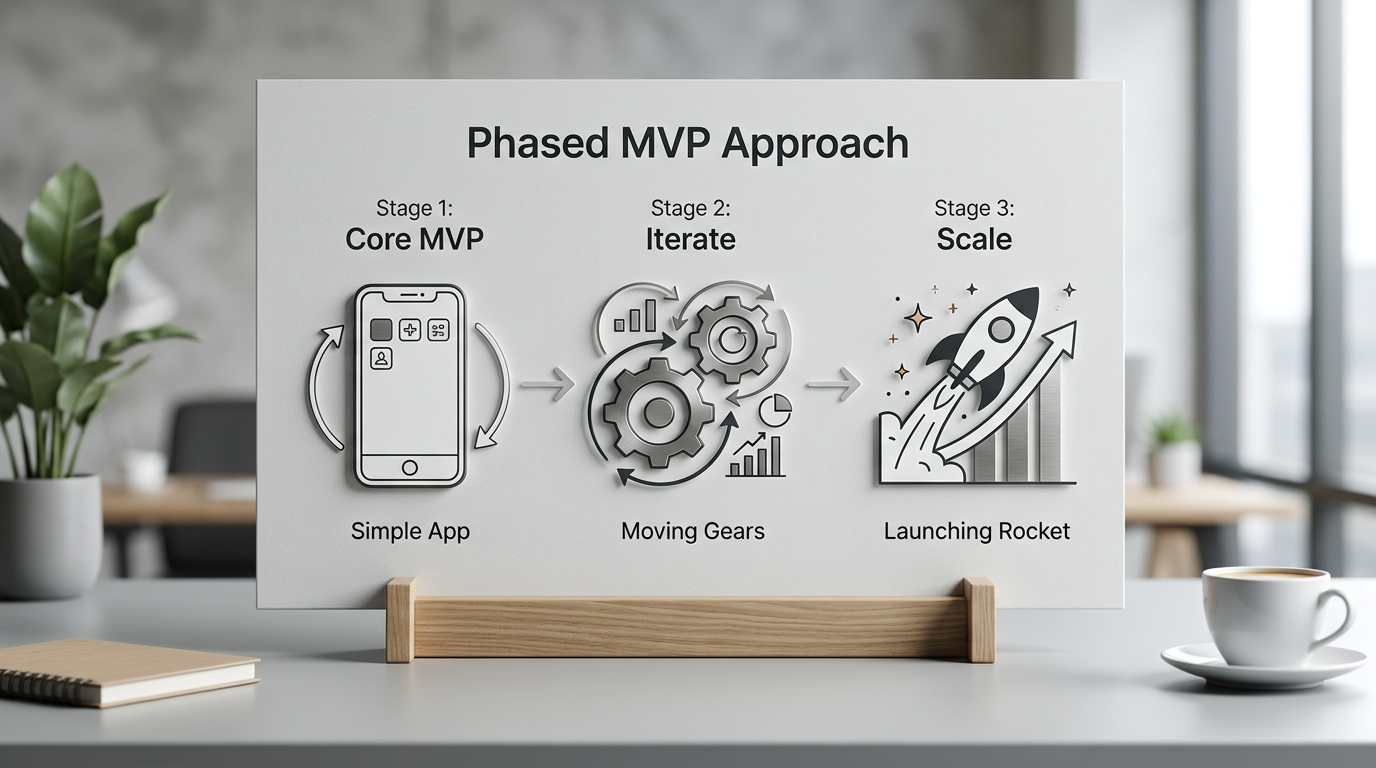
Getting your app to market is not a single, monolithic task. It’s a phased campaign. The goal isn't to build your forever-app on day one. The goal is to launch a Minimum Viable Product (MVP) that solves one core problem exceedingly well, gather real-world feedback, and then iterate.
Step 1: Defining Your Minimum Viable Product
An MVP isn't a cheap or buggy version of your final product. It is the most streamlined, focused version that delivers immediate value to your first users. Ask yourself one question: what is the single most important problem my app solves? Everything else is noise, at least for now.
This ruthless focus is what gets costs down into the manageable $5,000 to $50,000 range for many SMBs. Your MVP might have just three key screens, one core function, and a simple backend. That’s not just acceptable, it's strategic. It gets you data and user validation, the two most valuable currencies for any growing company.
Step 2: Choosing Your 'Lean Stack' for Speed and Savings
The technology you choose directly impacts your timeline and budget. Building separate native apps for iOS and Android is often too slow and expensive for a startup. This is where cross-platform frameworks become your most powerful ally.
Tools like React Native and Flutter are dominant for a reason. They allow developers to write one codebase that works on both platforms, effectively cutting development time and costs by 30% to 50%. This means you can get to market faster, on both major app stores, for a fraction of the traditional cost. This is the cornerstone of building smart custom mobile apps on a budget.
Your lean stack can also include Progressive Web Apps (PWAs). These are web applications that look and feel like native apps, can work offline, and send push notifications. Integrating a PWA strategy can offer an incredibly cost-effective way to reach users who may not be ready to download a full app from the store.
Step 3: Finding the Right Development Partner
The right partner understands the MVP philosophy. They won't try to upsell you on a dozen features you don't need yet. They will function as a strategic advisor, helping you pare down your idea to its powerful core. Hourly rates in the US can range from $25 to a staggering $200, so finding the right fit is critical.
Many startups and SMBs find success with a blended model, using onshore project managers with offshore development talent to balance cost and quality. For example, some full-cycle agencies focus specifically on this market segment, offering experienced teams at competitive rates. A quick review of what top mobile app development firms offer reveals that many provide specialized packages for MVPs, starting in the $25,000 range. Their focus is not just on coding, but on building a scalable foundation for your entire software development lifecycle.
Beyond the MVP: Scaling with Smart Tech and Data
Launching your MVP is the starting pistol, not the finish line. The next phase is all about listening, learning, and iterating. Your first 1,000 users are a focus group providing invaluable data on what's working, what isn't, and what they want next.
Now you can begin to strategically layer in more advanced features. The data from your MVP guides these decisions, ensuring you’re investing in functionality that users will actually value, not just features that sound good in a pitch deck. This is where you evolve from a simple app to a sophisticated business tool.
Leveraging Next-Gen Features
Once you have a stable user base, you can explore technologies that deepen engagement and create a competitive moat. Integrating an AI-powered chatbot, for example, can handle customer service inquiries 24/7, freeing up your team and providing instant support to users.
The rollout of 5G networks unlocks possibilities for richer, more responsive experiences. Think high-definition video streaming, real-time data synchronization, and even augmented reality (AR) features that were previously impossible. While not every app needs AR, for retail, real estate, or industrial businesses, it can be a true differentiator.
From App to Ecosystem
A successful app rarely lives in a vacuum. It should be the hub of your digital ecosystem, seamlessly connected to your other platforms. This means ensuring your app data talks to your CRM, your inventory system, and your website.
This holistic approach transforms your app from a simple marketing channel into the central nervous system of your customer relationships. The expertise required often bridges mobile and web development, creating a unified brand experience across all touchpoints. The goal is a frictionless journey for the customer, whether they’re on their laptop or their phone.
The Real Cost and ROI for a Startup App
Let's talk brass tacks. How is an MVP under $25,000 even possible? It comes down to discipline. This budget typically covers a focused feature set, a clean UI/UX design built from templates, a cross-platform build with Flutter or React Native, and a basic backend.
This isn't a fantasy number. It aligns with the minimum project costs at agile, SMB-focused development shops. The data backs up this focus: with mobile platforms accounting for an estimated 65% of development projects, the industry is geared towards efficient delivery. Agencies have perfected the process of launching lean MVPs because the market demands it.
The return on this investment comes in many forms. It could be direct revenue from in-app purchases or subscriptions. It could be cost savings from automating a manual process. Or it could be increased customer lifetime value from building a loyal, engaged community. By validating your idea with a lean MVP, you dramatically de-risk future investment and can show investors, or yourself, a clear path to profitability.
Your app isn't an expense. It's an engine for growth. The question is, what problem will you solve first? If you are ready to explore how a focused MVP could transform your business, it might be time to request a quote and see what's possible.