website redesign & seo: how to avoid losing all your traffic
a website redesign can crater your seo if you're not careful. our guide covers the pre-launch audits and technical strategy needed to protect rankings and grow traffic.

About 80% of website redesigns are triggered by outdated aesthetics. While a fresh look feels productive, it's a dangerously superficial reason to overhaul your most important digital asset. A poorly planned redesign, focused only on visuals, can obliterate years of search engine equity overnight.
For local businesses, a bad design can cost them 50% of their clients. The stakes are immense. If your redesign strategy doesn't start with SEO, you aren't just getting a new coat of paint. You are setting your house on fire.
Why Most Website Redesigns Secretly Fail
The story is always the same. A company invests five or six figures into a beautiful new website. It launches. Everyone celebrates. Then, a few weeks later, the marketing team notices a catastrophic drop in organic traffic, leads, and sales.
This happens when the redesign process ignores the technical foundation that Google uses to understand and rank your pages. It’s a failure to see the site through the eyes of a search crawler, which cares far more about structure, speed, and content mapping than it does about your new hero image.
Backlinks are a perfect example. An incredible 94% of pages online have zero backlinks pointing to them. If your site has earned valuable links over the years, they are like gold. A redesign that changes URL structures without a proper redirect plan makes those links point to dead pages, vaporizing their authority. Considering the top result on Google gets a 34% click-through rate, losing a page one ranking is a direct hit to your bottom line.
A website refresh should be a strategic growth project, not just a cosmetic one. It's an opportunity to fix underlying issues and build a faster, more authoritative platform. Anything less is just expensive digital decoration.

The Pre-Launch SEO Audit: Your Redesign Insurance Policy
You wouldn't build a skyscraper without a blueprint. So why would you redesign a website without one? A pre-launch SEO audit is that blueprint. It's the most critical phase of the entire project, establishing benchmarks and defining the technical requirements for success.
Benchmarking Your Current Performance
Before you change a single line of code, you need a complete picture of your current SEO health. This is your baseline. Without it, you have no way to measure the impact of your redesign or diagnose what went wrong if traffic tanks.
Start with Google Search Console. It's Google's own tool, and it gives you the ground truth on what pages are indexed, which keywords drive impressions and clicks, and your current Core Web Vitals scores. This data is invaluable for identifying your most important pages, the ones you absolutely cannot afford to break.
Next, you need a deep technical scan. A tool like Semrush Site Audit is built for this, crawling your entire site to identify over 140 potential SEO issues. It flags everything from broken links and duplicate content to missing metadata. This creates a punch list of technical debt that your redesign must fix, not recreate. It also helps you inventory your existing backlinks so you can protect them.
Mapping Your URL Structure with 301 Redirects
This is where most redesigns go wrong. If you change a page's URL, you must tell Google where it moved. A 301 redirect is a permanent instruction that passes ranking signals from the old URL to the new one. Neglecting this step is like changing your business address without telling the post office.
The process is meticulous but not optional. You must map every important old URL to its new equivalent. This prevents users and search crawlers from hitting 404 "not found" errors, which destroys user experience and tells Google your site is poorly maintained. Preserving this link equity is the core of defensive SEO during a redesign. Our comprehensive seo services always prioritize a complete redirect map as a foundational deliverable.
Building a Future-Proof Foundation: Mobile, Speed, and AI
Once your audit and redirect map are complete, you can start building. But a modern redesign has to solve for the web of tomorrow, not just look good today. This means prioritizing mobile performance, page speed, and the new reality of AI-driven search.
Mobile-First Isn't a Buzzword, It's a Requirement
With nearly 60% of all web traffic now coming from mobile devices, a responsive design is table stakes. Google agrees. Its mobile-first indexing now applies to 100% of searches, meaning it ranks your site based on the mobile version, not the desktop one.
If your new site isn't flawless on a smartphone, you're already behind. Research shows that 50% of users will abandon a site if it's not mobile-friendly. For many businesses, building a native app can be an even better solution for engaging this audience, which is why our mobile app development process focuses on seamless user experience across all devices.
Core Web Vitals: The Engine of Conversion
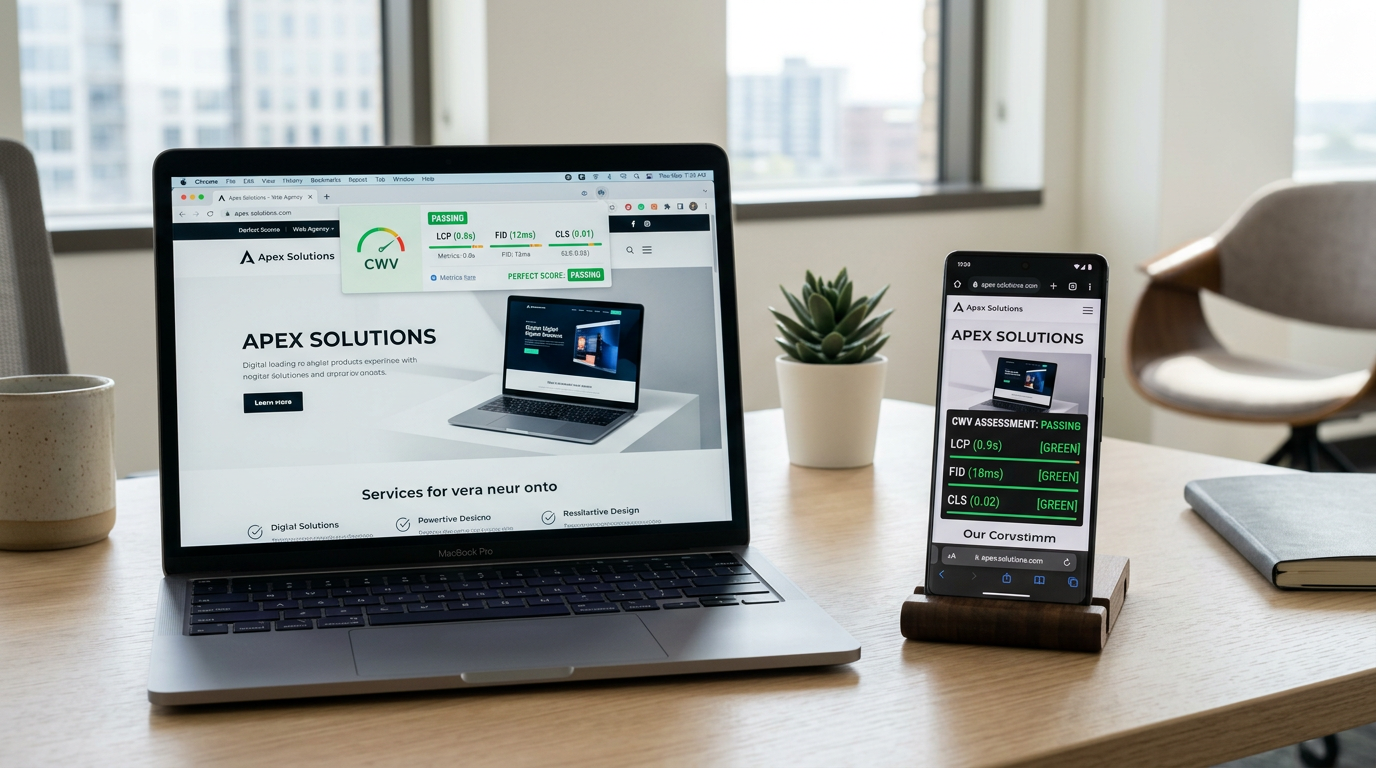
Page speed is no longer just a technical metric. It's a core component of user experience and a confirmed Google ranking factor. The Core Web Vitals (CWV) are a set of three specific metrics that measure loading performance, interactivity, and visual stability.
Optimizing for these metrics during a redesign isn't just about SEO. It's about money. According to Google's own data, improving CWV can boost conversions by a staggering 10% to 30%. We've seen sites double their conversion rates, jumping from 1.5% to 3%, simply by building a faster experience from the ground up. This aligns perfectly with the key trends shaping modern websites, where performance is paramount.
Designing for AI Overviews
The search results page is changing fast. AI Overviews now appear for 43% of local searches, directly answering user queries and reducing clicks to traditional web links by an estimated 31%. The zero-click search is here, and your redesign must account for it.
This is the unique angle for a truly modern redesign: making your content "AI-proof." You achieve this by structuring your content for discoverability beyond the blue link. This involves implementing robust schema markup, which is code that helps search engines understand the context of your content, making it a prime candidate for featured snippets and AI answers.
For local businesses, this strategy must also include deep integration with your Google Business Profile (GBP). An optimized GBP paired with a new site sees 2.4 times more profile views. This translates into real-world action and revenue, with some studies showing 3.8 times higher local conversions.
The Post-Launch Checklist: Monitor, Iterate, and Win
Going live is not the finish line. It's the starting gun for the monitoring phase. Your first few weeks post-launch are critical for catching any issues that slipped through the cracks and confirming that your SEO preservation strategy worked.
Your first stop, again, is Google Search Console. Watch your Index Coverage report like a hawk. Are your new pages being indexed? Are there any spikes in crawl errors or 404s? Compare your pre-launch and post-launch traffic and impression data to ensure you haven't lost visibility for your money-making keywords.
Next, run another full site audit with your chosen tool. This will verify that all your 301 redirects are working as intended and that no new technical problems were introduced during development. A clean bill of health here is the first sign of a successful migration.
A website is a living asset. The best designs are built on flexible platforms that allow for continuous improvement. The strong foundation you've built provides the perfect platform for ongoing content marketing, conversion rate optimization, and deeper integration with other platforms. The right software development services ensure your site is not just a brochure but a dynamic business tool.
A redesign is a rare and powerful opportunity. When you approach it with a technical, SEO-first mindset, you don't just protect what you have. You build a platform for accelerated growth. Don't settle for a simple facelift. Ready to plan a redesign that actually boosts your bottom line? Let's start your project and build it right.